DNS in Microsoft Azure Part 1 – Azure-provided DNS

DNS in Microsoft Azure Part 1 – Azure-provided DNS

Updates:

  • 7/2025 – Removed bullet point highlighting lack of DNS query logging and added that this can be achieved with DNS Security Policy

This is part of my series on DNS in Microsoft Azure.

Hi everyone,

In this series of posts I’m going to talk about a technology, that while old, still provides a critical foundational service.  Yes folks, we’re going to cover Domain Naming System (DNS).  Specifically, we’re going to look at how internal DNS (non-public) works in Microsoft Azure and what the positives and negatives are of each pattern.  I’m going to go into this assuming you have a basic knowledge of DNS and understand the namespaces, different record types, forward and reverse lookup zones, recursive and iterative queries, DNS forwarding and conditional forwarding, and other core DNS concepts. If those topics are unfamiliar to you, I’d suggest reading through DNS 101 by RedHat

I’m a big fan of establishing a shared vocabulary. Below I’m going to define some terms I’ll be using throughout the series.

  • A record – Resolves a hostname to an IP address such as http://www.journeyofthegeek.com to 5.5.5.5.
  • PTR Record – Resolves an IP address to a hostname.
  • CNAME record – Alias record where you can point on (FQDNs) fully qualified domain name to another to make it a domain a human can remember and for high availability configurations.
  •  Recursive Name Resolution – A DNS query where the client asks for a definitive answer to a query and relies on the upstream DNS server to resolve it to completion.  Forwarders such as Google DNS function as recursive resolvers.
  • Iterative Name Resolution – A DNS query where a client receives back a referral to another server in place of resolving the query to completion.  Querying root hints often involves iterate name resolution.
  • Standard DNS Forwarder – Forward all queries the DNS service can’t resolve to an upstream DNS service.  These upstream servers are typically configure to perform recursive or iterative name resolution.
  • Conditional Forwarder – Forward queries for a specific DNS namespace to an upstream DNS service for resolution. This is referred to as a forward zone in BIND.
  • Split-brain / Split Horizon DNS – A DNS configuration where a DNS namespace exists authoritatively across one or more DNS implementations.  A common use case is to have a single DNS namespace defined on Internet-resolvable public facing DNS servers and also on Intranet private facing DNS servers.  This allows trusted clients to reach the service via a private IP address and untrusted clients to reach the service via a public IP address.

Now that I’ve established our vocabulary for DNS, I want to cover the 168.63.129.16 address.  If you’ve ever done anything even basic in Azure, you’ve probably run into this address or used it without knowing it.  This public IP address is owned by Microsoft and is presented as a virtual IP address serving as a communication channel to the host node  for a number of platform resources.  It provides functionality such as virtual machine (VM) agent communication of the VM’s ready state, health state, enables the VM to obtain an IP address via DHCP, and you guessed it, enables the VM to leverage Azure DNS services.  The address is static and is the same for any VNet you create in every Azure region.

Traffic is routed to and from this virtual IP address through the subnet gateway.  If you run a route print on a Windows machine, you can see this route defined in the routing table of the VM.

route
Output of route print on Azure VM

The IP address is also defined in the VirtualNetwork service tag meaning the default rules within a network security group (NSG) allow this traffic to and from the VM. DNS traffic to the IP address is not filtered by NSGs by default, but you can block it with an NSG if you wish to using the instructions outlined here. You might do this if you do not want clients using the Azure platform for DNS and instead want all of these lookups to occur through another DNS mechanism such as the Azure Private DNS Resolver or a 3rd-party DNS service you have deployed.

Now that you understand what the 168.63.129.16 virtual IP address is, let’s first cover the very basics of DNS in Azure. You can configure Azure’s DHCP service to push a custom set of DNS servers to Azure resources within the virtual network or leave the default. The default DNS Server settings for a virtual network is 168.63.129.16 IP address which provides access to the Azure-provided DNS service. DNS Server settings pushed through the Azure DHCP Service can be configured at the virtual network or virtual network interface (VNI). Best practice is to configure this at the virtual network. I’ve never come across a use case to configure it at the VNI.

Configure DNS on VNet
Configure DNS Server DHCP option on VNet

This brings us to the first option for DNS resolution in Azure, Azure-provided name resolution.  Each time you spin up a virtual network Azure assigns it a unique private DNS namespace using the format <randomly generated>.internal.cloudapp.net.  This namespace is pushed to any virtual machines with VNIs in the virtual network via DHCP Option 15. An A record for each VM deployed in the virtual network is automatically registered which allows each VM the built-in ability to resolve the names of virtual machines within the same virtual network. The platform also creates PTR records in reverse lookup zones created for each of the subnets in the virtual network where VMs have VNICs in.

Let’s look at an example with a single VNet.  I’ve created a single VNet named vnet1.  I’ve assigned the CIDR block of 10.101.0.0/16 and created a single subnet assigned the 10.101.0.0/24 block.  Two Windows Server 2016 VMs have been created named azuredns and azuredns1 with the IP addresses 10.101.0.4 and 10.101.0.5.  Azure has assigned the a namespace of r0b5mqxog0hu5nbrf150v3iuuh.bx.internal.cloudapp.net to the VNet.  Note the DHCP Server and DNS Server settings in the ipconfig output of the azuredns vm shown below.

ipconfig
IPConfig output of Azure VM

If azuredns1 is pinged from azuredns you can see the in below Wireshark capture that prior to executing the ping, azuredns performs a DNS query to the 168.63.129.16 VIP and gets back a query response with the IP address of azuredns1. Pinging the single label name of the virtual machine will work as well because the Azure-provided virtual network DNS namespace is automatically prepended to the label by the operating system due to DHCP option 15 (assuming you haven’t configured the operating system to do anything different).

wireshark
Wireshark packet capture of DNS query

An example of the resolution path is diagrammed below.

In this example, the following happens:

  1. VM1 creates a DNS query for vm2 and the FQDN configured for the virtual network is automatically added to the single label resulting in a query for vm2.random.internal.cloudapp.net. VM1 does not have a cached entry for vm2.random.internal.cloudapp.net so the query is passed on to the DNS Server configured for the VMs virtual network interface (VNIC). The DNS Server has been configured by the Azure DHCP Service to the 168.63.129.16 virtual IP which is the default configuration for virtual network DNS Server settings.
  2. The DNS query is passed through the virtual IP and on to the Azure-provided DNS Service. The Azure-provided DNS Service resolves this query against the virtual network namespaces and returns the IP address for vm2.
Azure-provided DNS resolution within a virtual network

That’s all well and good for very basic DNS resolution, but who the heck has a single VNet in anything but a test environment?  So can we expand Azure-provided DNS to multiple VNets?  The answer is yes.  Recall that each VNet has its own private DNS namespace.  The only way to resolve names contained within that namespace is for a VM in that VNet to send the query to the 168.63.129.16 address.  Yes folks, this means you would need to drop a DNS server in each VNet in order to resolve the Azure-provided DNS host names assigned to VMs within that VNet by another VMs in another VNet as illustrated in the diagram below.

In this example, the following happens:

  1. VM1 creates a DNS query for vm3.random2.internal.cloudapp.net. The fully-qualified domain name (FQDN) must be provided because each virtual network uses a different randomly generated namespace. VM1 does not have a cached entry for vm3.random2.internal.cloudapp.net so the query is passed on to the DNS Server configured for the VMs virtual network interface (VNIC). Here the virtual network DNS server settings have been configured to for 10.0.2.4 which has been passed down to VM1 through the Azure DHCP Service.
  2. The DNS query arrives at DNS Server 1. DNS Server 1 does not have a cached entry. It determines it is not authoritative for the random2.internal.cloudapp.net namespace but determines it has a conditional forwarder configured for the zone pointing to 10.100.2.4. The DNS query is recursively passed on to 10.100.2.4 over the virtual network peering.
  3. The DNS query arrives at DNS Server 2. DNS Server 2 does not have a cached entry. It determines it is not authoritative for the random2.internal.cloudapp.net namespace and it does not have a conditional forwarder configured. DNS Server 2 has been configured with a standard forwarder to the 168.63.129.16 virtual IP. The query is passed on to the virtual IP and to Azure-provided DNS which resolves the query for requested record and returns the response.
Azure-provided DNS with multiple virtual networks

You can see as the number of VNets increases the scalability of this solution quickly breaks down because who the heck wants to have a DNS Server deployed to evey virtual network. Take note that if you wanted to resolve these host names from on-premises you could use a similar conditional forwarder pattern where you would pass the query to the DNS Server in Azure and on to Azure-provided DNS.

Let’s sum up the positives and negatives of Azure-provided DNS with the default virtual network namespaces..

  • Positives
    • No need to provision your own DNS servers and worry about high availability or scalability
    • DNS service provided by Azure automatically scales
    • VMs within a VNet can resolve each other’s IP addresses out of the box
    • VMs within a VNet can perform reverse lookups to get the IP address of another VM
    • DNS Query Logging is supported with use of DNS Security Policy
  • Negatives
    • Solution doesn’t scale with multiple VNets
    • You’re stuck with the namespace assigned to the VNet
    • WINS and NetBIOS are not supported
    • Only A records and PTR records that are automatically registered by the service are supported (no manual registration of records)

As you can see from the above the negatives far outweigh the positives for using the default virtual network namespaces and you’ll likely never use them. The important thing to take away from this post is an understanding of how DNS Server settings are configured and how you can configure a DNS Server to communicate with the Azure-provided DNS service. This will be relevant for everything we talk about moving forward.

In the next post l cover Azure’s new offering in the DNS space, Azure Private DNS Zones.  I’ll walk through how it works and how we can combine it with BYO DNS to create some pretty neat patterns.

See you then!

Capturing Azure Management Group Activity Logs Using Azure Automation – Part 1

Capturing Azure Management Group Activity Logs Using Azure Automation – Part 1

Hello again fellow geeks!

Over the past few months I’ve been working with a customer who is just beginning their journey into the cloud.  We’ve had a ton of great conversations around security, governance, and operationalizing Microsoft Azure.  We recently finalized the RACI and identified the controls required by both their internal security policy and their industry compliance requirements.  With those two items complete, we put together our Azure RBAC model and narrowed down the Azure Policies we needed to put in place to satisfy our compliance controls.

After a lot of discussion about the customer’s organization, its geographical locations, business unit makeup, and how its developers and central IT operate, we came up with a subscription model.  This customer had decided on an Azure subscription model where each workload would exist in its own subscription.  Further, each workload’s production and non-production environment would be segmented in different subscriptions.  Keeping each workload in a different subscription ensures no workload will compete for resources with other workloads and hit any subscription limits.  Additionally, it allowed the customer to very easily track the costs associated with each workload.

Now why did we use separate production and non-production subscriptions for each workload?  One reason is to address the same risk as above where a non-production workload could potentially consume all resources within a subscription impacting a production workload.  The other more critical reason is it makes it easier for us to apply different governance and access controls on production workloads vs non-production workloads.  The way we do this is through the usage of Azure Management Groups.

Management Groups were introduced into general availability back in late 2018 to help address the challenges organizations were having operating subscriptions at scale.  They provided a hierarchal method to apply governance and access controls across a collection of subscriptions.  For those of you familiar with AWS, Management Groups are somewhat similar to AWS Organizations and Organizational Units.  For my fellow Windows AD peeps, you can think of Management Groups somewhat like the Active Directory container and organizational unit hierarchy in an Active Directory domain where you apply different access control entries and group policy at high levels in the OU hierarchy that is then enforced and inherited down to the children.  Management Groups work in a similar manner in that the Azure RBAC definitions and assignments and Azure Policy you assign to the parent Management Groups are inherited down into the children.

Every Azure AD tenant starts with a top-level management group called the tenant root group.  Additional management groups created within the tenant are children of the group up to a maximum of 10,000 management groups and up to six levels of depth.  Any RBAC assignment or Azure Policy assigned to the tenant root group applies to all children management group in the tenant.  It’s important to understand that Management Groups are a resource within the Azure AD tenant and not a resource of an Azure subscription.  This will matter for reasons we’ll see later.

The tenant root management group can only be administered by a Global Admin by default and even this requires a configuration change in the tenant.  The method is describe here and what it does is places the global administrator performing the action in the User Access Administrator RBAC role at the root of scope.  Once that is complete, the name of the root management group could be changed, role assignments created, or policy assigned.

Screen Shot 2019-10-17 at 9.59.59 PM

Administering Tenant Root Group

Now there is one aspect of Management Groups that is a bit funky.  If you’re very observant you probably noticed the menu option below.

Screen Shot 2019-10-17 at 9.59.59 PM.png

That’s right folks, Management Groups have their own Activity Log.  Every action you perform at the management group scope such creating an Azure RBAC role assignment or assigning or un-assigning an Azure Policy is captured in this Activity Log.  Now as of today, the only way to access these logs is viewing them through the portal or through the Azure REST API.  Unlike the Activity Logs associated with a subscription, there isn’t native integration with Event Hubs or Azure Storage.  Don’t be fooled by the Export To Event Hub link seen in the screenshot below, this will simply send you to the standard menu where you would configure subscription Activity Logs to be exported.

Screen Shot 2019-10-17 at 10.34.19 PM

Now you could log into the GUI every day and export the logs to a CSV (yes that does work with Management Groups) but that simply isn’t scalable and also prevents you from proactively monitoring the logs.  So how do we deal with this gap while the product team works on incorporating the feature?  This will be the challenge we address in this series.

Over the next few posts I’ll walk through the solution I put together using Azure Automation Runbooks to capture these Activity Logs and send them to Azure Storage for retention and an Azure Log Analytics Workspace for analysis and monitoring using Azure Monitor.

Continue the series in my second post.

Debugging Azure SDK for Python Using Fiddler

Debugging Azure SDK for Python Using Fiddler

Hi there folks.  Recently I was experimenting with the Azure Python SDK when I was writing a solution to pull information about Azure resources within a subscription.  A function within the solution was used to pull a list of virtual machines in a given Azure subscription.  While writing the function, I recalled that I hadn’t yet had experience handling paged results the Azure REST API which is the underlining API being used by the SDK.

I hopped over to the public documentation to see how the API handles paging.  Come to find out the Azure REST API handles paging in a similar way as the Microsoft Graph API by returning a nextLink property which contains a reference used to retrieve the next page of results.  The Azure REST API will typically return paged results for operations such as list when the items being returned exceed 1,000 items (note this can vary depending on the method called).

So great, I knew how paging was used.  The next question was how the SDK would handle paged results.  Would it be my responsibility or would it by handled by the SDK itself?

If you have experience with AWS’s Boto3 SDK for Python (absolutely stellar SDK by the way) and you’ve worked in large environments, you are probably familiar with the paginator subclass.  Paginators exist for most of the AWS service classes such as IAM and S3.  Here is an example of a code snipped from a solution I wrote to report on aws access keys.

def query_iam_users():

todaydate = (datetime.now()).strftime("%Y-%m-%d")
users = []
client = boto3.client(
'iam'
)

paginator = client.get_paginator('list_users')
response_iterator = paginator.paginate()
for page in response_iterator:
for user in page['Users']:
user_rec = {'loggedDate':todaydate,'username':user['UserName'],'account_number':(parse_arn(user['Arn']))}
users.append(user_rec)
return users

Paginators make handling paged results a breeze and allow for extensive flexibility in controlling how paging is handled by the underlining AWS API.

Circling back to the Azure SDK for Python, my next step was to hop over to the SDK public documentation.  Navigating the documentation for the Azure SDK (at least for the Python SDK, I can’ t speak for the other languages) is a bit challenging.  There are a ton of excellent code samples, but if you want to get down and dirty and create something new you’re going to have dig around a bit to find what you need.  To pull a listing of virtual machines, I would be using the list_all method in VirtualMachinesOperations class.  Unfortunately I couldn’t find any reference in the documentation to how paging is handled with the method or class.

So where to now?  Well next step was the public Github repo for the SDK.  After poking around the repo I located the documentation on the VirtualMachineOperations class.  Searching the class definition, I was able to locate the code for the list_all() method.  Right at the top of the definition was this comment:

Use the nextLink property in the response to get the next page of virtual
machines.

Sounds like handling paging is on you right?  Not so fast.  Digging further into the method I came across the function below.  It looks like the method is handling paging itself releasing the consumer of the SDK of the overhead of writing additional code.

        def internal_paging(next_link=None):
            request = prepare_request(next_link)

            response = self._client.send(request, stream=False, **operation_config)

            if response.status_code not in [200]:
                exp = CloudError(response)
                exp.request_id = response.headers.get('x-ms-request-id')
                raise exp

            return response

I wanted to validate the behavior but unfortunately I couldn’t find any documentation on how to control the page size within the Azure REST API.  I wasn’t about to create 1,001 virtual machines so instead I decided to use another class and method in the SDK.  So what type of service would be a service that would return a hell of a lot of items?  Logging of course!  This meant using the list method of the ActivityLogsOperations class which is a subclass of the module for Azure Monitor and is used to pull log entries from the Azure Activity Log.  Before I experimented with the class, I hopped back over to Github and pulled up the source code for the class.  Low and behold we an internal_paging function within the list method that looks very similar to the one for the list_all vms.

        def internal_paging(next_link=None):
            request = prepare_request(next_link)

            response = self._client.send(request, stream=False, **operation_config)

            if response.status_code not in [200]:
                raise models.ErrorResponseException(self._deserialize, response)

            return response

Awesome, so I have a method that will likely create paged results, but how do I validate it is creating paged results and the SDK is handling them?  For that I broke out one of my favorite tools Telerik’s Fiddler.

There are plenty of guides on Fiddler out there so I’m going to skip the basics of how to install it and get it running.  Since the calls from the SDK are over HTTPS I needed to configure Fiddler to intercept secure web traffic.  Once Fiddler was up and running I popped open Visual Studio Code, setup a new workspace, configured a Python virtual environment, and threw together the lines of code below to get the Activity Logs.

from azure.common.credentials import ServicePrincipalCredentials
from azure.mgmt.monitor import MonitorManagementClient

TENANT_ID = 'mytenant.com'
CLIENT = 'XXXXXXXX-XXXX-XXXX-XXXX-XXXXXXXXXXXX'
KEY = 'XXXXXX'
SUBSCRIPTION = 'XXXXXX-XXXX-XXXX-XXXX-XXXXXXXX'

credentials = ServicePrincipalCredentials(
    client_id = CLIENT,
    secret = KEY,
    tenant = TENANT_ID
)
client = MonitorManagementClient(
    credentials = credentials,
    subscription_id = SUBSCRIPTION
)

log = client.activity_logs.list(
    filter="eventTimestamp ge '2019-08-01T00:00:00.0000000Z' and eventTimestamp le '2019-08-24T00:00:00.0000000Z'"
)

for entry in log:
    print(entry)

Let me walk through the code quickly.  To make the call I used an Azure AD Service Principal I had setup that was granted Reader permissions over the Azure subscription I was querying.  After obtaining an access token for the service principal, I setup a MonitorManagementClient that was associated with the Azure subscription and dumped the contents of the Activity Log for the past 20ish days.  Finally I incremented through the results to print out each log entry.

When I ran the code in Visual Studio Code an exception was thrown stating there was an certificate verification error.

requests.exceptions.SSLError: HTTPSConnectionPool(host='login.microsoftonline.com', port=443): Max retries exceeded with url: /mytenant.com/oauth2/token (Caused by SSLError(SSLCertVerificationError(1, '[SSL: CERTIFICATE_VERIFY_FAILED] certificate verify failed: unable to get local issuer certificate (_ssl.c:1056)')))

The exception is being thrown by the Python requests module which is being used underneath the covers by the SDK.  The module performs certificate validation by default.  The reason certificate verification is failing is Fiddler uses a self-signed certificate when configured to intercept secure traffic when its being used as a proxy.  This allows it to decrypt secure web traffic sent by the client.

Python doesn’t use the Computer or User Windows certificate store so even after you trust the self-signed certificate created by Fiddler, certificate validation still fails.  Like most cross platform solutions it uses its own certificate store which has to be managed separately as described in this Stack Overflow article.  You should use the method described in the article for any production level code where you may be running into this error, such as when going through a corporate web proxy.

For the purposes of testing you can also pass the parameter verify with the value of False as seen below.  I can’t stress this enough, be smart and do not bypass certificate validation outside of a lab environment scenario.

requests.get('https://somewebsite.org', verify=False)

So this is all well and good when you’re using the requests module directly, but what if you’re using the Azure SDK?  To do it within the SDK we have to pass extra parameters called kwargs which the SDK refers to as an Operation config.  The additional parameters passed will be passed downstream to the methods such as the methods used by the requests module.

Here I modified the earlier code to tell the requests methods to ignore certificate validation for the calls to obtain the access token and call the list method.

from azure.common.credentials import ServicePrincipalCredentials
from azure.mgmt.monitor import MonitorManagementClient

TENANT_ID = 'mytenant.com'
CLIENT = 'XXXXXXXX-XXXX-XXXX-XXXX-XXXXXXXXXXXX'
KEY = 'XXXXXX'
SUBSCRIPTION = 'XXXXXX-XXXX-XXXX-XXXX-XXXXXXXX'

credentials = ServicePrincipalCredentials(
    client_id = CLIENT,
    secret = KEY,
    tenant = TENANT_ID,
    verify = False
)
client = MonitorManagementClient(
    credentials = credentials,
    subscription_id = SUBSCRIPTION,
    verify = False
)

log = client.activity_logs.list(
    filter="eventTimestamp ge '2019-08-01T00:00:00.0000000Z' and eventTimestamp le '2019-08-24T00:00:00.0000000Z'",
    verify = False
)

for entry in log:
    print(entry)

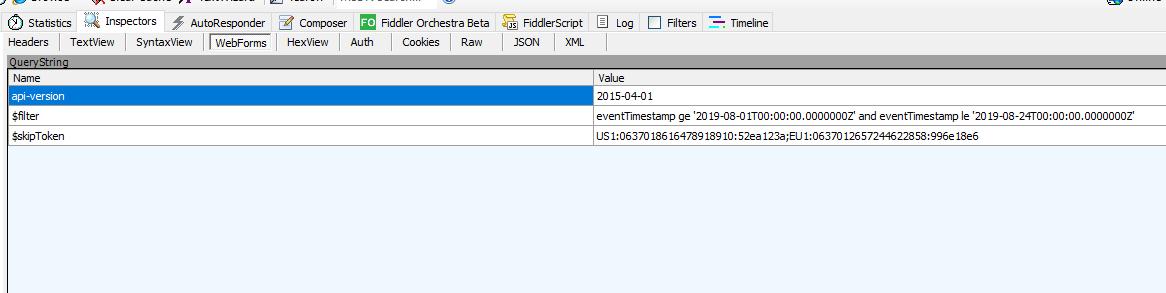
After the modifications the code ran successfully and I was able to verify that the SDK was handling paging for me.

fiddler.png

Let’s sum up what we learned:

  • When using an Azure SDK leverage the Azure REST API reference to better understand the calls the SDK is making
  • Use Fiddler to analyze and debug issues with the Azure SDK
  • Never turn off certificate verification in a production environment and instead validate the certificate verification error is legitimate and if so add the certificate to the trusted store
  • In lab environments, certificate verification can be disabled by passing an additional parameter of verify=False with the SDK method

Hope that helps folks.  See you next time!

Deep Dive into Azure Managed Identities – Part 2

Welcome back fellow geeks for the second installment in my series on Azure Managed Identities.  In the first post I covered the business problem and the risks Managed Identities address and in this post I’ll be how managed identities are represented in Azure.

Let’s start by walking through the components that make managed identities possible.

The foundational component of any identity is the data store in which the identity lives in.  In the case of managed identities, like much of the rest of the identity data for the Microsoft cloud, the data store is Azure Active Directory.  For those of you coming from the traditional on-premises environment and who have had experience with your traditional directories such as Active Directory or one of the many flavors of LDAP, Azure Active Directory (Azure AD) is an Identity-as-a-Service which includes a directory component we can think of as a next generation directory.  This means it’s designed to be highly scalable, available, and resilient and be provided to you in “as a service” model where a simple management layer sits in front of all the complexities of the compute, network, and storage infrastructure that makes up the directory.  There are a whole bunch of other cool features such as modern authentication, contextual authorization, adaptive authentication, and behavioral analytics that come along with the solution so check out the official documentation to learn about those capabilities.  If you want to nerd out on the design of that infrastructure you can check out this whitepaper and this article.

It’s worthwhile to take a moment to cover Azure AD’s relationship to Azure.  Every resource in Azure is associated with an Azure subscription.  An Azure subscription acts as a legal and payment agreement (think type of Azure subscription, pay-as-you-go, Visual Studio, CSP, etc), boundary of scale (think limits to resources you can create in a subscription), and administrative boundary.  Each Azure subscription is associated with a single instance of Azure AD.  Azure AD acts as the security boundary for an organization’s space in Azure and serves as the identity backend for the Azure subscription.  You’ll often hear it referred to as “your tenant” (if you’re not familiar with the general cloud concept of tenancy check out this CSA article).

Azure AD stores lots of different object types including users, groups, and devices.  The object type we are interested in for the purposes of managed identity are service principals.  Service principals act as the security principals for non-humans (such as applications or Azure resources like a VM) in Azure AD.  These service principals are then granted permissions to access resources in Azure by being assigned permissions to Azure resources such as an instance of Azure Key Vault or an Azure Storage account.  Service principals are used for a number of purposes beyond just Managed Identities such as identities for custom developed applications or third-party applications

Given that the service principals can be used for different purposes, it only makes sense that the service principal object type includes an attribute called the serviceprincipaltype.  For example, a third-party or custom developed application that is registered with Azure AD uses the service principal type of Application while a managed identity has the value set to ManagedIdentity.  Let’s take a look at an example of the serviceprincipaltypes in a tenant.

In my Geek In The Weeds tenant I’ve created a few application identities by registering the applications and I’ve created a few managed identities.  Everything else within the tenant is default out of the box.  To list the service principals in the directory I used the AzureAD PowerShell module.  The cmdlet that can be used to list out the service principals is the Get-AzureADServicePrincipal.  By default the cmdlet will only return the 100 results, so you need to set the All parameter to true.  Every application, whether it’s Exchange Online or Power BI, it needs an identity in your tenant to interact with it and resources you create that are associated with the tenant.  Here are the serviceprincipaltypes in my Geek In The Weeds tenant.

serviceprincipaltype.PNG

Now we know the security principal used by a Managed Identity is stored in Azure AD and is represented by a service principal object.  We also know that service principal objects have different types depending on how they’re being used and the type that represents a managed identity has a type of ManagedIdentity.  If we want to know what managed identities exist in our directory, we can use this information to pull a list using the Get-AzureADServicePrincipal.

We’re not done yet!  Managed Identities also come in multiple flavors, either system-assigned or user-assigned.  System-assigned managed identities are the cooler of the two in that they share the lifecycle of the resource they’re used by.  For example, a system-assigned managed identity can be created when an Azure Function is created thus that the identity will be deleted once the Azure VM is deleted.  This presents a great option for mitigating the challenge of identity lifecycle management.  By Microsoft handling the lifecyle of these identities each resource could potentially have its own identity making it easier to troubleshoot issues with the identity, avoid potential outages caused by modifying the identity, adhering to least privilege and giving the identity only the permissions the resource requires, and cutting back on support requests by developers to info sec for the creation of identities.

Sometimes it may be desirable to share a managed identity amongst multiple Azure resources such as an application running on multiple Azure VMs.  This use case calls for the other type of managed identity, user-assigned.  These identities do not share the lifecycle of the resources using them.

Let’s take a look at the differences between a service principal object for a user-assigned vs a system-assigned managed identity.  Here I ran another Get-AzureADServicePrincipal and limited the results to serviceprincipaltype of ManagedIdentity.

ObjectId                           : a3e9d372-242e-424b-b97a-135116995d4b
ObjectType                         : ServicePrincipal
AccountEnabled                     : True
AlternativeNames                   : {isExplicit=False, /subscriptions//resourcegroups/managedidentity/providers/Microsoft.Compute/virtualMachines/systemmis}
AppId                              : b7fa9389-XXXX
AppRoleAssignmentRequired          : False
DisplayName                        : systemmis
KeyCredentials                     : {class KeyCredential {
                                       CustomKeyIdentifier: System.Byte[]
                                       EndDate: 11/11/2019 12:39:00 AM
                                       KeyId: f8e439a8-071b-45e0-9f8e-ac10b058a5fb
                                       StartDate: 8/13/2019 12:39:00 AM
                                       Type: AsymmetricX509Cert
                                       Usage: Verify
                                       Value:
                                     }
                                     }
ServicePrincipalNames              : {b7fa9389-XXXX, https://identity.azure.net/XXXX}
ServicePrincipalType               : ManagedIdentity
------------------------------------------------
ObjectId                           : ac960ac7-ca03-4ac0-a7b8-d458635b293b
ObjectType                         : ServicePrincipal
AccountEnabled                     : True
AlternativeNames                   : {isExplicit=True,
                                     /subscriptions//resourcegroups/managedidentity/providers/Microsoft.ManagedIdentity/userAssignedIdentities/testing1234}
AppId                              : fff84e09-XXXX
AppRoleAssignmentRequired          : False
AppRoles                           : {}
DisplayName                        : testing1234
KeyCredentials                     : {class KeyCredential {
                                       CustomKeyIdentifier: System.Byte[]
                                       EndDate: 11/7/2019 1:49:00 AM
                                       KeyId: b3c1808d-6778-4004-b23f-4d339ed0a91f
                                       StartDate: 8/9/2019 1:49:00 AM
                                       Type: AsymmetricX509Cert
                                       Usage: Verify
                                       Value:
                                     }
                                     }
ServicePrincipalNames              : {fff84e09-XXXX, https://identity.azure.net/XXXX}
ServicePrincipalType               : ManagedIdentity


In the above results we can see that the main difference between the user-assigned (testing1234) and system-assigned (systemmis) is the within the AlternativeNames property.  For the system-assigned identity has values of isExplicit set to False and has another value of /subscriptions//resourcegroups/managedidentity/
providers/Microsoft.Compute/virtualMachines/systemmis
Notice the bolded portion specifies this is being used by a virtual machine named systemmis.  The user-assigned identity has the isExplicit set to True and another property with the value of /subscriptions//resourcegroups/managedidentity/
providers/Microsoft.ManagedIdentity/userAssignedIdentities/testing1234
.  Here we can see the identity is an “explicit” managed identity and is not directly linked to an Azure resource.

This difference gives us the ability to quickly report on the number of system-assigned and user-assigned managed identities in a tenant by using the following command.

Get-AzureADServicePrincipal -All $True | Where-Object AlternativeNames -like “isExplicit=True*”

True would give us user-assigned and False would give us system-assigned.  Neat right?

Let’s summarize what we’ve learned:

  • An object in Azure Active Directory is created for each managed identity and represents its security principal
  • The type of object created is a service principal
  • There are multiple service principal types and the one used by a Managed Identity is called ManagedIdentity
  • There are two types of managed identities, user-assigned and system-assigned
  • System-assigned managed identities share the lifecycle of the resource they are associated with while user-assigned managed identities are created separately from the resource, do not share the resource lifecycle, and can be used across multiple resources
  • The object representing a user-assigned managed identity has a unique value of isExplicit=True for the AlternativeNames property while a system-assigned managed identity has that value of isExplicit=False.

That’s it for this post folks.  In the next post I’ll walk through the process of creating a managed identity for an Azure VM and will demonstrate with a bit of Python code how we can use the managed identity to access a secret stored in Azure Key Vault.

See you next post!