Microsoft Foundry – Publishing Agents To Teams Deep Dive – Part 2

Microsoft Foundry – Publishing Agents To Teams Deep Dive – Part 2

With Memorial Day weekend coming quickly, I wanted to get the second post to this series out before the knowledge my late nights with Red Eye coffee brought leaks from my brain. In my last post I did a walkthrough of the Publishing Agents To Teams feature of the Foundry Agent Service within Microsoft Foundry. In that post I covered the Portal experience, broke open some of the black box as to my understanding of the workflow that happens underneath when you push the publish button, and talked through the AI Bot Service’s role in the feature. For this post I’m going to cover a possible network architecture to support this feature when security controls are required around inbound and outbound network access (I mentioned a few last post), the network flow for that architecture, and some of the switches and knobs you can turn to add additional security beyond the basic layer 4 network controls. After that, I’m going to walk through a Jupyter Notebook I put together than shows you how to perform the steps behind the publish button programmatically. If you haven’t read my last post, Graeme’s blog post on this topic, and Moim’s blog post on reverse engineering Bot services you should do that before you try to tackle this one.

A Possible Architecture

As I covered in my last post, when we want to make an agent available in Teams we need Teams to be capable of reaching it. In this design, with Teams interacting with the AI Bot Service which relays the information to our agent, this means we need to make the agent’s messaging endpoint available to the Microsoft public backbone (i.e. it needs to be exposed via a public IP address). Graeme provided one architecture to accomplish this which will work for a number of folks. I foresee a few different architectural options:

  • APIM v2 configured for public inbound and regional vnet integration
  • APIM classic configured for external mode
  • App Gateway with a public listener with APIM v2 VNet Injected or PE + regional vnet integration behind it
  • App Gateway with a public listener with APIM classic VNet injection behind it
  • Firewall DNAT + APIM v2 VNet Injected or PE + regional vnet integration behind it
  • Firewall DNAT + APIM classic VNet injection behind it

For this post I’m going to focus on the 3rd option which has Application Gateway sitting in front of an v2 tier API Management. I like this pattern because I get the WAF, SNI, host-based routing, and path-based routing benefits of an App Gw (Application Gateway) and avoid slapping a public IP on my APIM (API Management). There is more complexity to this pattern, but more security and flexibility always comes with more complexity, right?

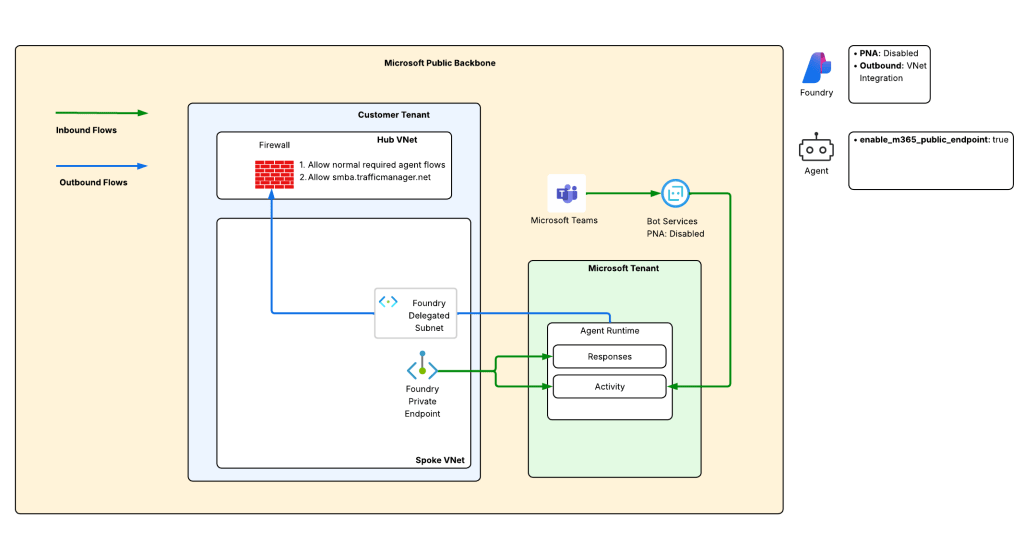
Generally my traffic will look something like the image you seen down below.

The green line is the incoming message from the Microsoft Teams. We see it is relayed from the Teams Service to the public IP address of the AppGw via the Bot Service. From there, we send it through the APIM and finally on to the Private Endpoint for Foundry which tunnels it on to the Microsoft-managed compute behind the Foundry Agent Service.

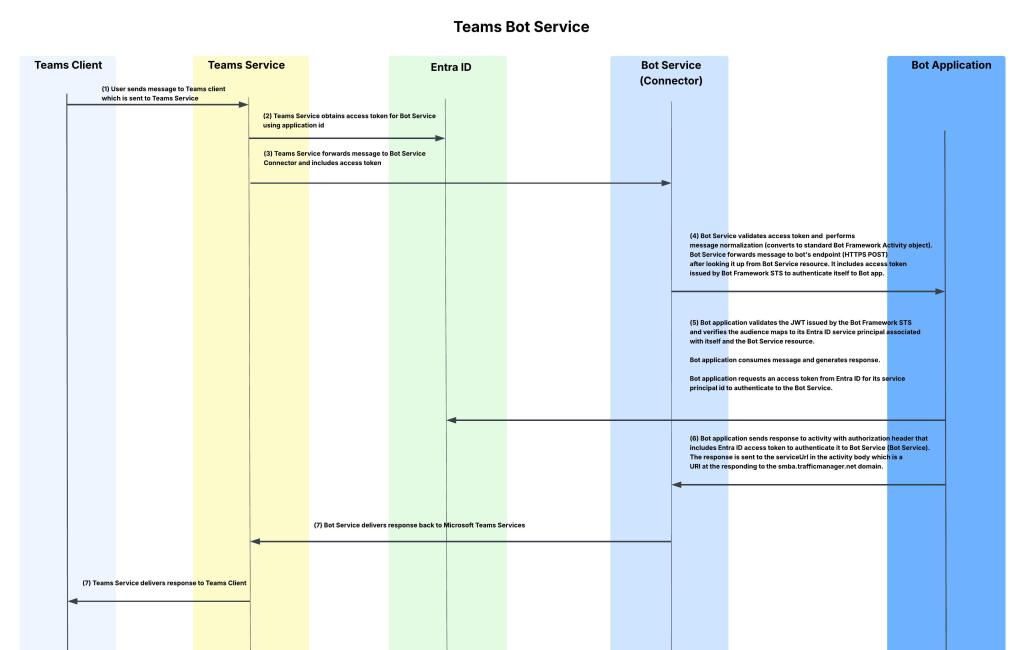
The blue line is the response from the agent. You’ll notice there are two blue lines. Based on the logs in my firewall when I tested this, I did not see the response traffic back to the Bot Service (this would be the endpoint in the serviceurl in the JWT received from the Bot Service which should be something like smba.trafficmanager.net). I’m making the assumption that this traffic isn’t egressed through the customer virtual network and instead flows out whatever path Microsoft is providing in the network where the managed compute lives that hosts the agent runtimes. Additionally, you’ll notice a blue line flowing through my virtual network and headed to an FQDN at tenant.api.powerplatform.com. I’m still trying to get clarification on if this flow is truly required and what it’s for.

The first instinct of us old networking farts is to look at this diagram and think this is asymmetric routing. However, in this situation it isn’t because the green and blue flows are separate TCP sessions because the message and response sequence is asynchronous.

Execution of the Architecture

Alright, you now have an understanding of the flow with this architecture. Let’s talk about the cool shit we can do with it. I’ve set the messaging endpoint in my Bot Service resource to https://agent.agw.jogcloud.com/agents/api/projects/sampleproject1/agents/test-manual-publish/endpoint/protocols/activityProtocol?api-version=2025-05-15-preview. What I’ve done is replace my FQDN with my AppGw’s FQDN and I appended /agents after the FQDN to ensure it routes to the proper API on my APIM.

Given we’re starting with AppGw we can use the WAF functionality to validate the source IP address is coming from the Teams service. A simple rule like the below will do that check.

Next, I want to validate the request header of x-ms-tenant-id to validate that the header is present and contains my tenant id.

Next up I have APIM. Here I’ve created an API with an operation named PublishedAgent. The operation is defined as you see below.

Within the operation, I’ve taken Graeme’s policy and made a small tweak to it to validate the serviceurl claim in the JWT and ensure it contains my tenant id.

<policies>
<inbound>
<base />
<validate-jwt header-name="Authorization" require-scheme="Bearer">
<openid-config url="https://login.botframework.com/v1/.well-known/openidconfiguration" />
<audiences>
<audience>8fd8ec07-ae24-4038-8771-6d4b85a4b19a</audience>
</audiences>
<issuers>
<issuer>https://api.botframework.com</issuer>
</issuers>
<required-claims>
<claim name="serviceurl" match="all">
<value>https://smba.trafficmanager.net/amer/6c80de31-d5e4-4029-93e4-5a2b3c0e1299/</value>
</claim>
</required-claims>
</validate-jwt>
</inbound>
<backend>
<base />
</backend>
<outbound>
<base />
</outbound>
<on-error>
<base />
</on-error>
</policies>

If we bring it back up out of the weeds and to the high level, here is what we’re doing at each component in the flow.

So there you have it folks, that’s an architecture you could use and some of the details of getting it up and running. Now let’s bounce over and take a look at how to avoid the manual action of “pushing the pretty blue button” and look at how we’d publish a Foundry Agent programmatically.

Programmatic Setup

The kind folks over at the Foundry Agents PG (product group) put together a sample of the steps needed to do this programmatically with PowerShell and Bicep. Since I prefer good ole bash shell, Python, and Terraform I reworked their steps into a Jupyter Notebook which you can find here. There is a sample env file in the repository. You don’t need to populate the client id and client secret unless you want to play around with the commands in the appendix. Those are not required.

The first step in the process is creation of the Bot Service resource in Azure. As I covered in my last post, this resource mainly exists to store metadata about your bot (or agent in this scenario) that the AI Bot Service uses to relay data back and forth between Teams and the agent. You’ll want to create a new Bot Service which will require you have the specific permissions to do that (if you want to go the custom role) or something more generic like Contributor. You’ll also want to make sure the Bot.Service resource provider is registered in your subscription (pretty sure this requires Owner).

I’ve crafted a Terraform template for this step. Before you can create the Bot Service with the template, you need to collect some Entra ID-related information. First, you’ll need to fetch your Entra ID tenant ID. You can do this programmatically by running after logging into az cli using the command below.

az account show --query tenantId -o tsv

Now that you have you’re logged into az cli and you’ve grabbed the tenant id, your next step is to fetch the principal id (or appId) of the Entra ID Agent Identity associated with the Foundry Agent. You’ll associate this identity with the Bot Service resource. Before you do that, you’ll need to get fetch an access token with the appropriate scope.


from azure.identity import DefaultAzureCredential
from dotenv import load_dotenv

# Get a token for Foundry scope
credential = DefaultAzureCredential()
scopes = ["https://ai.azure.com"]

user_token = credential.get_token(*scopes)


Next you can use this function to grab the principal_id property.

import os
import json
import requests
from dotenv import load_dotenv
# Load environmental variables
load_dotenv(override=True)
# Function that gets the agent object
def get_foundry_agent(account_name: str, project_name: str, agent_name: str, token: str):
"""This function retrieves a Foundry agent by name from a Foundry project
Args:
account_name (str): The name of the Foundry account
project_name (str): The name of the Foundry project
agent_name (str): The name of the Foundry agent to retrieve
token (str): The authentication token to use for the API request
Returns:
dict: The Foundry agent details if found, otherwise None
"""
response = requests.get(
f"https://{account_name}.services.ai.azure.com/api/projects/{project_name}/agents/{agent_name}?api-version=v1",
headers={
"Content-Type": "application/json",
"Authorization": f"Bearer {token}"
}
)
if response.status_code == 200:
return response.json()
else:
logging.error(f"Failed to retrieve agent: {response.status_code} - {response.text}")
return None
# Grab the principal_id of the Entra ID Agent Identity associated with the Foundry Agent
foundry_account_name = os.getenv("FOUNDRY_ACCOUNT_NAME")
project_name = os.getenv("FOUNDRY_PROJECT_NAME")
agent_name = os.getenv("FOUNDRY_AGENT_NAME")
agent = get_foundry_agent(foundry_account_name, project_name, agent_name, user_token.token)
agent_principal_id = agent.get("instance_identity", {}).get("principal_id")
print(f"Foundry Agent Principal ID: {agent_principal_id}")
print(json.dumps(agent, indent=2))

Once you have the tenant id and principal id of the agent identity associated with your Foundry Agent, you are almost ready to create the Bot Service. The last step is formulating your messaging endpoint. It will look something like this:

https://FOUNDRY_ACCOUNT_NAME.services.ai.azure.com/api/projects/PROJECT_NAME/agents/AGENT_NAME/endpoint/protocols/activityProtocol?api-version=2025-05-15-preview

As I showed earlier, you can modify this to change the FQDN to point to your preferred ingress infrastructure and add pathing to the beginning to ensure proper routing through an API Gateway.

Now that you have everything ready to go you can run a Terraform template like the one located here. This will create the Bot Service and Teams channel child object and configure diagnostic settings with delivery to the specified (Log Analytics Workspace).

Once that is complete, you need enable the activity protocol support for your agent. You can do this using the code below:

import os
import json
import requests
from dotenv import load_dotenv
# Load environmental variables
load_dotenv(override=True)
# Function that enables the activity protocol for the agent and configures the required Bot Service authorization scheme
def enable_agent_activity_protocol(account_name: str, project_name: str, agent_name: str, token: str):
"""This function enables the activity protocol for a Foundry agent and configures the required Bot Service authorization scheme
Args:
account_name (str): The name of the Foundry account
project_name (str): The name of the Foundry project
agent_name (str): The name of the Foundry agent to retrieve
token (str): The authentication token to use for the API request
Returns:
dict: The updated Foundry agent details if the update was successful, otherwise None
"""
#
body = {
"agent_endpoint": {
"protocols": [
"responses",
"activity"
],
"authorization_schemes": [
{
"type": "Entra",
"isolation_key_source": {
"kind": "Entra"
}
},
{
"type": "BotServiceRbac"
}
]
}
}
response = requests.patch(
f"https://{account_name}.services.ai.azure.com/api/projects/{project_name}/agents/{agent_name}?api-version=v1",
headers={
"Content-Type": "application/merge-patch+json",
"Authorization": f"Bearer {token}",
"Foundry-Features": "AgentEndpoints=V1Preview"
},
json=body
)
if response.status_code == 200:
return response.json()
else:
logging.error(f"Failed to enable agent activity protocol: {response.status_code} - {response.text}")
return None
# Grab the principal_id of the Entra ID Agent Identity associated with the Foundry Agent
foundry_account_name = os.getenv("FOUNDRY_ACCOUNT_NAME")
project_name = os.getenv("FOUNDRY_PROJECT_NAME")
agent_name = os.getenv("FOUNDRY_AGENT_NAME")
enabled_agent = enable_agent_activity_protocol(foundry_account_name, project_name, agent_name, user_token.token)
enabled_agent_guid = enabled_agent.get('versions', {}).get("latest", {}).get("agent_guid", {})
print(f"Enabled Agent GUID: {enabled_agent_guid}")
updated_agent_endpoint = enabled_agent.get('agent_endpoint', {})
print(f"Updated Agent Endpoint: {json.dumps(updated_agent_endpoint, indent=2)}")

At this point, you have the Bot Service setup and you’ve activated the activity protocol for the agent so its now listening for requests at the messaging endpoint. The last step in the process is to use the publish operation and you will need the Foundry User role for this (as far as I can tell).

What exactly this does is still a bit of a black box for me, but it seems like it’s creating some type of API object to represent the agent in M365 Agent Registry (soon to be rebranded to Agent 365 I’m sure). Some of the APIs I need to poke around with require an Agents 365 license. Once I get that, I’ll update this section with more detail if I find exactly what it’s doing.

import os
import json
import requests
from dotenv import load_dotenv

# Load environmental variables
load_dotenv(override=True)

def publish_agent_teams(
    subscription_id: str,
    resource_group: str,
    account_name: str, 
    project_name: str, 
    location: str,
    agent_name: str, 
    agent_guid: str,
    bot_id: str,
    app_publish_scope: str,
    publish_as_digital_worker: bool,
    app_version: str,
    short_description: str,
    full_description: str,
    developer_name: str,
    developer_website_url: str,
    privacy_url: str,
    terms_of_use_url: str,
    token: str
    ):
    """This function uses the Foundry API to publish a Foundry agent to Microsoft Teams
    Args:
        subscription_id (str): The Azure subscription ID where the Foundry account is provisioned
        resource_group (str): The name of the resource group where the Foundry account is provisioned
        account_name (str): The name of the Foundry account
        project_name (str): The name of the Foundry project
        location (str): The Azure region where the Foundry account is provisioned
        agent_name (str): The name of the Foundry agent to publish
        agent_guid (str): The GUID of the Foundry agent to publish
        bot_id (str): The Microsoft App ID of the Bot registered in Entra ID for this agent
        app_publish_scope (str): The scope to publish the Teams app to, either "Individual" or "Tenant"
        publish_as_digital_worker (bool): Whether to publish the agent as a Digital Worker in Teams, which surfaces it in the Power Virtual Agents app in addition to allowing it to be installed as a standard Teams app
        app_version (str): The version of the Teams app to publish
        short_description (str): A short description of the agent to display in Teams
        full_description (str): A full description of the agent to display in Teams
        developer_name (str): The name of the developer or organization that created the agent, to display in Teams
        developer_website_url (str): The URL for the developer's website, to display in Teams
        privacy_url (str): The URL for the privacy policy for this agent, to display in Teams
        terms_of_use_url (str): The URL for the terms of use for this agent, to display in Teams
        token (str): The Entra ID access token with the scope of https://ai.azure.com/.default to authenticate the API request
    Returns:
        dict: The response from the Foundry API if the publish was successful, otherwise None
    """

    body = {
        "subscriptionId": subscription_id,
        "agentGuid": agent_guid,
        "agentName": agent_name,
        "appRegistrationId": appRegistrationId,
        "botId": bot_id,
        "appPublishScope": app_publish_scope,
        "publishAsDigitalWorker": publish_as_digital_worker,
        "appVersion": app_version,
        "shortDescription": short_description,
        "fullDescription": full_description,
        "developerName": developer_name,
        "developerWebsiteUrl": developer_website_url,
        "privacyUrl": privacy_url,
        "termsOfUseUrl": terms_of_use_url
    }

    response = requests.post(
        url = f"https://{location}.api.azureml.ms/agent-asset/v2.0/subscriptions/{subscription_id}/resourceGroups/{resource_group}/providers/Microsoft.MachineLearningServices/workspaces/{account_name}@{project_name}@AML/microsoft365/publish",
        headers={
            "Content-Type": "application/json", 
            "Accept": "application/json",
            "Authorization": f"Bearer {token}",
        },
        json=body
    ) 

    if response.status_code == 200:
        print("Agent published successfully! Status code: 200")
    else:
        logging.error(f"Failed to publish agent: {response.status_code} - {response.text}")
        return None

publish_response = publish_agent_teams(
    subscription_id = os.getenv("FOUNDRY_SUBSCRIPTION_ID"),
    resource_group = os.getenv("FOUNDRY_RESOURCE_GROUP"),
    account_name = os.getenv("FOUNDRY_ACCOUNT_NAME"),
    project_name = os.getenv("FOUNDRY_PROJECT_NAME"),
    location = os.getenv("FOUNDRY_LOCATION"),
    agent_name = os.getenv("FOUNDRY_AGENT_NAME"),
    agent_guid = enabled_agent_guid,
    bot_id = enabled_agent_guid,
    app_publish_scope = "Tenant",
    publish_as_digital_worker = False,
    app_version = "1.0.0",
    short_description = "This is a sample agent published from Foundry to Teams",
    full_description = "This agent was created in Foundry and published to Microsoft Teams using the Foundry API.",
    developer_name = "Carl Carlson",
    developer_website_url = "https://www.example.com",
    privacy_url = "https://www.example.com/privacy",
    terms_of_use_url = "https://www.example.com/terms",
    token = user_token.token
)

This step is effectively the last step in the Foundry Portal publishing experience. If you installed it for an individual it will be immediately available for that user. If you publish it to the Teams App Catalog (tenant option) it will be put in a pending state until approved via the M365 Admin Portal.

And like magic, you have a programmatic way to emulate the magical blue button in the Foundry portal. If you’re curious as to what that API call is going to an AML (Azure Machine Learning) endpoint, that is because (today at least) Foundry is built on top of AML.

Summing it up

What I’ve hoped you gathered from here is publishing an agent to Teams isn’t as simple as pushing a button. Requirements needs to be gathered, a design needs to be worked out, services chosen, service properties chosen for security and scale, services load tested, and security controls properly implemented and any risks accepted.

You have a ton of flexibility with this design and my take is there is no optimal design. The optimal design is the one that provides you with the user experience you require aligned with the risks your org is willing to accept. If you’re building an agent that is hitting some public data source, maybe you don’t care about any of this infrastructure. Either way, do not just hit the publish button, group up with your peers across security, networking, operations, collaboration, and AI engineering and put your heads together to come up with a design you’re all happy with.

With that, I’m out for Memorial Day weekend. See you next time!

Microsoft Foundry – The Evolution (Revisited)

Microsoft Foundry – The Evolution (Revisited)

Hi folks! In the past I did a series on the Azure OpenAI Service and Microsoft Foundry Hubs (FKA AI Foundry Hubs FKA AI Studio). Instead of going through and updating all those posts and losing the historical content and context (I don’t know about you, but I love have the historical context of a service) I’m instead going to preserve it as is and spin up a new series on the latest iteration of Microsoft Foundry. I’ll likely keep much of the general framework of the older series because it seemed to work. One additional piece I’ll be included in this series is some of the quirks of the service I’ve run into to potentially save you pain from having to troubleshoot it. For this first post, I’m going to start this off explaining how the service has involved. As always, my persona focus here is my fellow folks in the central IT and infrastructure space.

The history

Way back in 2023 the hype behind generative AI really started go insane. Microsoft managed to negotiate rights to host OpenAI’s models in Azure and introduced the Azure OpenAI Service. The demand across customers was insane where every business unit (BU) wanted it yesterday. Microsoft initially offered the service within the Cognitive Services framework under the Cognitive Services resource provider. This mean it inherited many of the controls native to Cognitive Services which included Private Endpoints, a limited set of outbound controls, support for API key and Entra ID authentication, and support for Azure RBAC for authorization. Getting the deployed was pretty straightforward with the hold-ups to deployment being more concerns about LLM security in general. Deployment typically looked like the architecture below.

Azure OpenAI Service

As folks started to build their AI applications, they tapped into other services under the Cognitive Services umbrella like Content Safety, Speech-to-Text, and the like. These services fit in nicely as they also fell under the Cognitive Services umbrella and had a similar architecture as the above, requiring deployment of the resource and the typical private endpoint and authentication/authorization (authN/authZ) configuration.

I like to think of this as stage 1 of the Microsoft’s AI offerings.

Microsoft then wanted to offer more models, including models they have built such and Phi and third-party models such as Mistral. This drove them to create a new resource called an AI Service resource. This resource fell under the Cognitive Services resource provider, and again inherited similar architectures as above. Beyond hosting third-party models, it also included and endpoint to consume OpenAI models and some of the pool of Cognitive Services. This is where we begin to see the collapse of Microsoft’s AI Services under a single top-level resource.

What about building AI apps though? This is where Foundry Hubs (FKA AI Studio) were introduced. The intent of Foundry Hubs were to be the one stop shop for developers to create their AI Apps. Here developers could experiment with LLMs using the playgrounds, build AI apps with Prompt Flow, build agents, or deploy 3rd party LLMs for Hugging Face. Foundry Hubs were a light overlay on top of the Azure Machine Learning (AML) service utilizing a new feature of AML built specifically for Foundry called AML Hubs. Foundry Hubs inherited a number of capabilities of AML such as its managed compute (to host 3rd party models and run prompt flows) and its managed virtual network (to host the managed compute).

Microsoft Foundry Hubs

While this worked, anyone who has built a secure AML deployment knows that shit ain’t easy. Getting the service working requires extensive knowledge of how its identity and networking configuration. This was a pain point for many customers in my experience. Many struggled to get it up and running due to the complexity.

Example of complexity of Microsoft Foundry IAM model

I think of the combination of AI Services and Microsoft Foundry Hubs as stage 2 of Microsoft’s journey.

Ok, shit was complicated, I ain’t gonna lie. Given this complexity and feedback from the customers, Microsoft got ambitious and decided to further consolidate and simplify. This introduced the concept of a new top-level resource called Microsoft Foundry Accounts. In public documentation and conversation this may be referred to as Foundry Projects or Foundry Resources. Since this is my blog I’m going to use my term which is Microsoft Foundry Accounts. With Microsoft Foundry accounts, Microsoft collapsed the AI Services and Foundry Hubs into a single top level resource. Not only did they consolidate these two resources, they also shifted Foundry Hubs from the Azure Machine Learning resource provider into the Cognitive Services resource provider. This move consolidated the Cognitive Services resource provider as the “AI” resource provider in my brain. It resulted in a new architecture which often looks something like the below.

Microsoft Foundry Accounts common architecture

This is what I like to refer to as stage 3, which is the current stage we are in with Microsoft’s AI offerings. We will continue to see this stage evolve which more features build and integrated into the Microsoft Foundry Account. I wouldn’t be surprised at all to see other services collapse into it as just another endpoint to a the singular resource.

Why do you care?

You might be asking, “Matt, why the hell do I care about this?” The reason you should care is because there are many customers who jumped into these products at different stages. I run across a ton of customers still playing in Foundry Hubs with only a vague understanding that Foundry Hubs are an earlier stage and they should begin transitioning to stage 3. This evolution is also helpful to understand because it gives an idea of the direction Microsoft is taking its generative AI services, which is key to how you should be planning you future of these services within Azure.

I’ll dive into far more detail in future posts about stage 3. I’ll share some of my learnings (and my many pains), some reference architectures that I’ve seen work, how I’ve seen customers successfully secure and scale usage of Foundry Accounts.

For now, I leave you with this evolution diagram I like to share with customers. For me, it really helps land the stages and the evolution, what is old and what is new, and what services I need to think about focusing on and which I should think about migrating off of.

Foundry evolution

Well folks, that wraps it up. Your takeaways today are:

  1. Assess which stage your implementation of generative AI is right now in Azure.
  2. Begin plans to migrate to stage 3 if you haven’t already. Know that there will be gaps in functionality with Foundry Hubs and Foundry Accounts. A good example is no more prompt flow. There are others, but many will eventually land in Foundry project.

See you next post!

Network Security Perimeters – NSPs for Troubleshooting

Network Security Perimeters – NSPs for Troubleshooting

This is part of my series on Network Security Perimeters:

  1. Network Security Perimeters – The Problem They Solve
  2. Network Security Perimeters – NSP Components
  3. Network Security Perimeters – NSPs in Action – Key Vault Example
  4. Network Security Perimeters – NSPs in Action – AI Workload Example
  5. Network Security Perimeters – NSPs for Troubleshooting

Hello folks! The past 3 months have been completely INSANE with customer work, building demos, experimentation and learning. It’s been awesome, but goddamn has it been grueling. I’m back to finally close out my series on Network Security Perimeters. In my past posts I’ve covered NSPs from an conceptional level, the components that make them up, and two separate examples. Today I’m going to cover my favorite use case for NSPs, and this is using them for troubleshooting.

The Setup

At a very high level most enterprises have an architecture similar what you see below. In this architecture network boundaries are setup around endpoints and services. These boundaries are erected to separate hardware and services based on the data stored in that environment, the security controls enforced in that environment, whether that environment has devices connected to the Internet, what type of trust level the humans and non-humans running in those environments have, and other similar variables. For the purposes of this post, we’re gonna keep it simple and stick to LAN (trusted) and DMZ (untrusted). DMZ is where devices connected to the Internet live and LAN is where devices restricted to the private network live.

Very basic network architecture

Environments like these typically restrict access to the Internet through a firewall or appliance/service that is performing a forward web proxy function. This allows enterprises to control what traffic leaves their private network through traditional layer 5-tuple means, deep packet inspection to inspect and control traffic at layer 7, and control access to specific websites based on the user or endpoint identity. Within the LAN there is typically a private DNS service that provides name resolution for internal domains. The DMZ has either separate dedicated DNS infrastructure for DNS caching and limited conditional fowarding or it utilizes some third-party hosted DNS service like a CloudFlare. The key takeaway from the DNS resolution piece is the machines within the LAN and DMZ use different DNS services and typically the DMZ is limited or completely incapable of resolving domains hosted on the internal DNS servers.

You’re likely thinking, “Cool Matt, thanks for the cloud 101. WTF is your point?” The place where this type of setup really bites customers is when consuming Private Endpoints. I can’t tell you how many times over the years I’ve been asked to help a customer struggling with Private Endpoints only to find out the problem is DNS related to this infrastructure. The solution is typically a simple proxy bypass, but getting to that resolution often takes hours of troubleshooting. I’m going to show you how NSPs can make troubleshooting this problem way easier.

The Problem

Before we dive into the NSP piece, let’s look at how the problem described above manifests. Take an organization that uses a high level architecture to integrate with Azure such as pictured below.

Same architecture as above but now with Azure connectivity

Here we have an organization that has connectivity with Azure configure through both an ExpressRoute with S2S VPN as fallback (I hate this fallback method, but that’s a blog for another day). In the ideal world, VM1 hits Service PaaS 1 on that Private Endpoint with the traffic being sent through the VPN or ExpressRoute connection. To do that, the DNS server in the LAN must properly resolve to the private IP address of the Private Endpoint deployed for Service PaaS 1 (check out my series on DNS if you’re unfamiliar with how that works). Let’s assume the enterprise has properly configured DNS so VM1 resolves to the correct IP address.

Now it’s Monday morning and you are the team that manages Azure. You get a call from a user complaining they can’t connect to the Private Endpoint for their Azure Storage account for blob access and gives you the typical “Azure is broken!”. You hop on a call with the user and ask the user to do some nslookups from their endpoint which return the correct private IP address. You even have the user run a curl against the FQDN and still you get back the correct IP address.

This is typically the scenario that at some point gets escalated beyond support and someone from the account team says, “Hey Matt, can you look at this?” I’ll hop on a call, get a lowdown of what the customer is doing, double-check what the customer checked, maybe take a glance at routing and Network Security Groups and then jump to what is almost always the problem in these scenarios. The next question out of my mouth is, “Do you have a proxy?”

So why does this matter? This question is important whenever we consider HTTP/HTTPS traffic because it is almost always sent through through an appliance or service that is performing the architectural function of a forward web proxy before it egresses to the Internet as I covered earlier. This could be a service hosted within the organization’s boundry or it could be a third-party service like a ZScaler. Where it’s hosted isn’t super important (but can play a role in DNS), the key thing to understand is the enterprise using one and is the application being used to access the Azure PaaS service using it.

When HTTP/HTTPS traffic is configured to be proxied, the connection from the endpoint is made to the proxy service. The proxy service examines the endpoint’s request, executes any controls configured, and initiates a connection to the outbound service. This last piece is what we care about because to make a connection, the proxy service needs to do its own DNS query which means it will use the DNS server configured in the proxy. This is typically the problem because as I covered earlier, this DNS service doesn’t typically have resolution to internal domains, which would include resolution to the privatelink domains used by Azure PaaS services.

DNS resolution when using proxy

When you did curl (without specifying proxy settings) or nslookup the machine was hitting the internal DNS service which does have the ability to resolve privatelink domains giving you the false sense that everything looks good from a DNS perspective. The resolution to this problem is to work with the proxy team to put in the appropriate proxy bypass so the endpoint will connect directly to the Azure PaaS (thus using its own DNS service).

All of this sounds simple, right? The reality is getting to the point of identifying the issue was the proxy tends to take hours, if not days, and tons of people from a wide array of teams across the enterprise. This means a lot of money spent diagnosing and resolving the issue.

What if there was an easier way? In comes NSPs.

NSPs to the rescue!

If you were a good Azure citizen, you would have wrapped this service in an NSP (assuming that service has been onboarded by Microsoft to NSPs) and turned on logging as I covered in my prior posts. If you had done that, you could have leveraged the NSP logs (the NSPAccessLogs table) to identify incoming traffic being blocked by the NSP. Below is an example of what the log entry looks like.

NSP Log Sample

In the above log entry I get detail as to the operation the user attempted to perform (in this instance listing the Keys in a Key Vault), the effect of the NSP (traffic is denied), and the category of traffic (Public). If we go back to the troubleshooting steps from earlier, I may have been able to identify this problem WAY earlier and with far less people involved even if the Azure resource platform logs obfuscated the full IP address or didn’t list it at all. I can’t stress the value this presents, especially having a standardized log format. The amount of hours my customers could have saved by enabling and using these logs makes me sad.

Even more uses!

Beyond troubleshooting the proxy problem, there are any scenarios where this comes in super handy. Another such example is PaaS to PaaS traffic. Often times the documentation around when a PaaS talks to another PaaS is not clear. It may not be obvious that one PaaS is trying to communicate with another over the Microsoft public backbone. This is another area NSPs can help because this traffic can also be logged and used for troubleshooting

Troubleshooting PaaS to PaaS

We’re not done yet! Some Azure compute services can integrate into a customer virtual network using a combination of Private Endpoints for inbound traffic and regional VNet integration for outbound access (traffic initiated by the PaaS and destined for customer endpoints or endpoints in the public IP space). A good example is Azure App Services or the new API Management v2 SKUs. Often times, I’ll work with customers who think they enabled this correctly but only actually enabled Private Endpoints and missed configuring regional Vnet integration causing outbound traffic to leave the Microsoft public backbone and hit the PaaS over public IPs or misconfigured DNS for the virtual network the PaaS service has been integrated with. NSP logs can help here as well.

NSPs helping to diagnose regional VNet integration issues

Summing it up

Here are the key takeways for you for this post:

  1. Enable NSPs wherever they are supported. If you’re not comfortable enforcing them, at least turn them on for the logging.
  2. Don’t forget NSPs capture both the inbound AND outbound traffic. You’d be amazed how many Azure PaaS services (service based) can make outbound network calls that you probably aren’t tracking or controlling.
  3. Like platform logs, NSP logs are not simply a security tool. Don’t lock them away from operations behind a SIEM. Make them available to both security and operations so everyone can benefit.
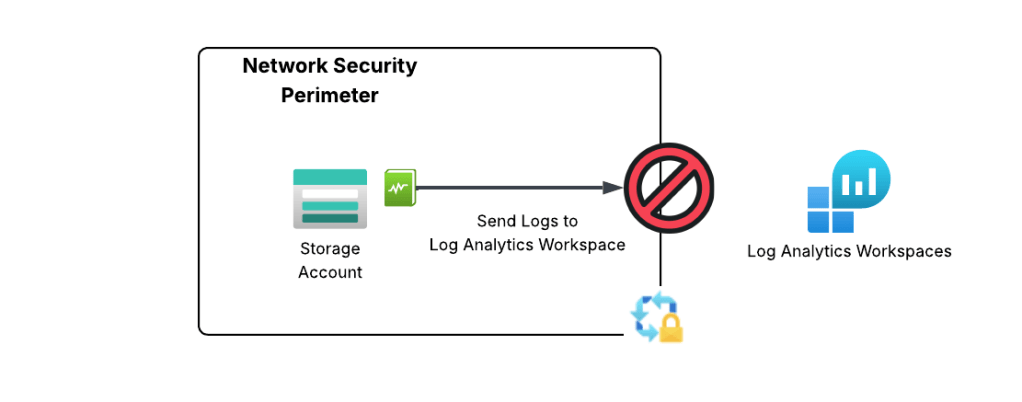
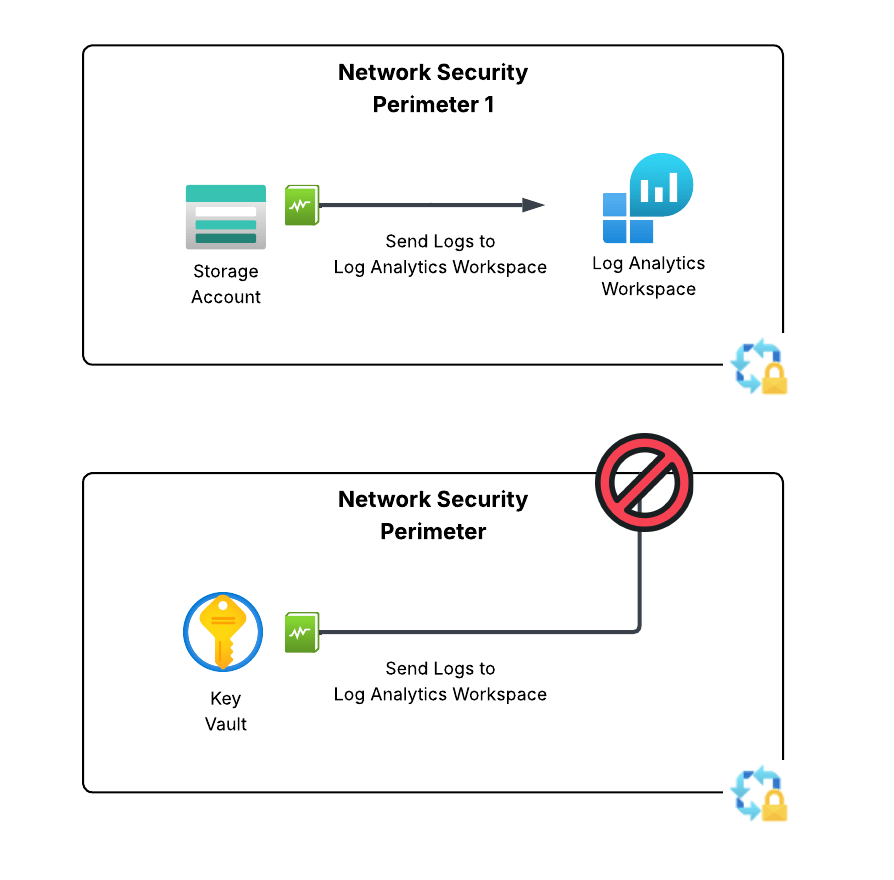
  4. Remember that enforcing NSPs WILL block the associated resources from delivering their logs to a Log Analytics Workspace, Storage Account, or Event Hub. If you’re using a centralized Log Analytics Workspace model, you’ll want to leave your NSPs in transition mode for now.

NSPs are more than just a tool to block and get visibility into incoming and outbound traffic for security purposes, but also an important tool in your toolbox to help with day-to-day operational headaches. If you’re not using NSPs for supported services today, you should be. There is absolutely zero reason not to do it, and your late night troubleshooting sessions will only consume 1 Mountain Dew vs 10!

That’s it for me. Off to snowblow!

Network Security Perimeters – NSPs in Action – AI Workload Example

Network Security Perimeters – NSPs in Action – AI Workload Example

This is part of my series on Network Security Perimeters:

  1. Network Security Perimeters – The Problem They Solve
  2. Network Security Perimeters – NSP Components
  3. Network Security Perimeters – NSPs in Action – Key Vault Example
  4. Network Security Perimeters – NSPs in Action – AI Workload Example
  5. Network Security Perimeters – NSPs for Troubleshooting

UPDATE 2/23/2026 – NSP support for Microsoft Foundry resources is generally available!

Hello again! Today I’ll be covering another NSP (Network Security Perimeters) use case, this time focused on AI (gotta drive traffic, am I right?). This will be the fourth entry in my NSP series. If you haven’t read at least the first and second post, you’ll want to do that before jumping into this one because, unlike my essays back in college, I won’t be padding the page count by repeating myself. Let’s get to it!

Use Case Background

Over the past year I’ve worked with peers helping a number of customers get a quick and simple RAG (retrieval augmented generation) workload into PoC (proof-of-concept). The goal of these PoCs were often to validate that the LLMs (large language models) could provide some level of business value when supplementing them with corporate data through a RAG-based pattern. Common use cases included things like building a chatbot for support staff which was supplemented with support’s KB (knowledge base) or chatbot for a company’s GRC (governance risk and compliance) team which was supplemented with corporate security policies and controls. You get the gist of it.

In the Azure realm this pattern is often accomplished using three core services. These services include the Azure OpenAI Service (now more typically AI Foundry), AI Search, and Azure Storage. In this pattern AI Search acts as the as the search index and optional vector database, Azure Storage stores the data in blob storage before it’s chunked and placed inside AI Search, and Azure OpenAI or AI Foundry hosts the LLM. Usage of this pattern requires the data be chunked (think chopped up into smaller parts before it’s stored as a record in a database while still maintaining the important context of the data). There are many options for chunking which are far beyond the scope of this post (and can be better explained by much smarter people), but in Azure there are three services (that I’m aware of anyway) that can help with chunking vs doing it manually. These include:

  1. Azure AI Document Intelligence’s layout model and chunking features
  2. Azure OpenAI / AI Foundry’s chat with your data
  3. Azure AI Search’s skillsets and built-in vectorization

Of these three options, the most simple (and point and click) options are options 2 and 3. Since many of these customers had limited Azure experience and very limited time, these options tended to serve for initial PoCs that then graduated to more complex chunking strategies such as the use of option 1.

The customer base that was asking for these PoCs fell into one or more of the these categories:

  1. Limited staff, resources, and time
  2. Limited Azure knowledge
  3. Limited Azure presence (no hybrid connectivity, no DNS infrastructure setup for support of Private Endpoints

All of these customers had minimum set of security requirements that included basic network security controls.

RAG prior to NSPs

While there are a few different ways to plumb these services together, these PoCs would typically have the services establish network flows as pictured below. There are variations to this pattern where the consumer may be going through some basic ChatBot app, but in many cases consumers would interact direct with the Azure OpenAI / AI Foundry Chat Playground (again, quick and dirty).

Network flows with minimalist RAG pattern

As you can see above, there is a lot of talk between the PaaS. Let’s tackle that before we get into human access. PaaS communication almost exclusively happens through the Microsoft public backbone (some services have special features as I’ll talk about in a minute). This means control of that inbound traffic is going to be done through the PaaS service firewall and trusted Azure service exception for Azure OpenAI / AI Foundry, AI Search, and Azure Storage (optionally using resource exception for storage). If you’re using the AI Search Standard or above SKU you get access to the Shared Private Access feature which allows you to inject a managed Private Endpoint (this is a Private Endpoint that gets provisioned into a Microsoft-managed virtual network allowing connectivity to a resource in your subscription) into a Microsoft-managed virtual network where AI Search compute runs giving it the ability to reach the resource using a Private Endpoint. While cool, this is more cost and complexity.

Outbound access controls are limited in this pattern. There are some data exfiltration controls that can be used for Azure OpenAI / AI Foundry which are inherited from the Cognitive Services framework which I describe in detail in this post. AI Search and Azure Storage don’t provide any native outbound network controls that I’m aware of. This lack of outbound network controls was a sore point for customers in these patterns.

For inbound network flows from human actors (or potentially non-human if there is an app between the consumer and the Azure OpenAI / AI Foundry service) you were limited to the service firewall’s IP whitelist feature. Typically, you would whitelist the IP addresses of forward web proxy in use by the company or another IP address where company traffic would egress to the Internet.

RAG design network controls prior to NSPs

Did this work? Yeah it did, but oh boy, it was never simple to approved by organizational security teams. While IP whitelisting is pretty straightforward to explain to a new-to-Azure customer, the same can’t be said for the trusted services exception, shared private access, and resource exceptions. The lack of outbound network controls for AI Search and Storage went over like a lead balloon every single time. Lastly, the lack of consistent log schema and sometimes subpar network-based logging (I’m looking at you AI Search) and complete lack of outbound network traffic logs made the conversations even more difficult.

Could NSPs make this easier? Most definitely!

RAG with NSPs

NSPs remove every single one of the pain points described above. With an NSP you get:

  1. One tool for controlling both inbound and outbound network controls (kinda)
  2. Standardized log schema for network flows
  3. Logging of outbound network calls

We go from the mess above to the much more simple design pictured below.

The design using NSPs

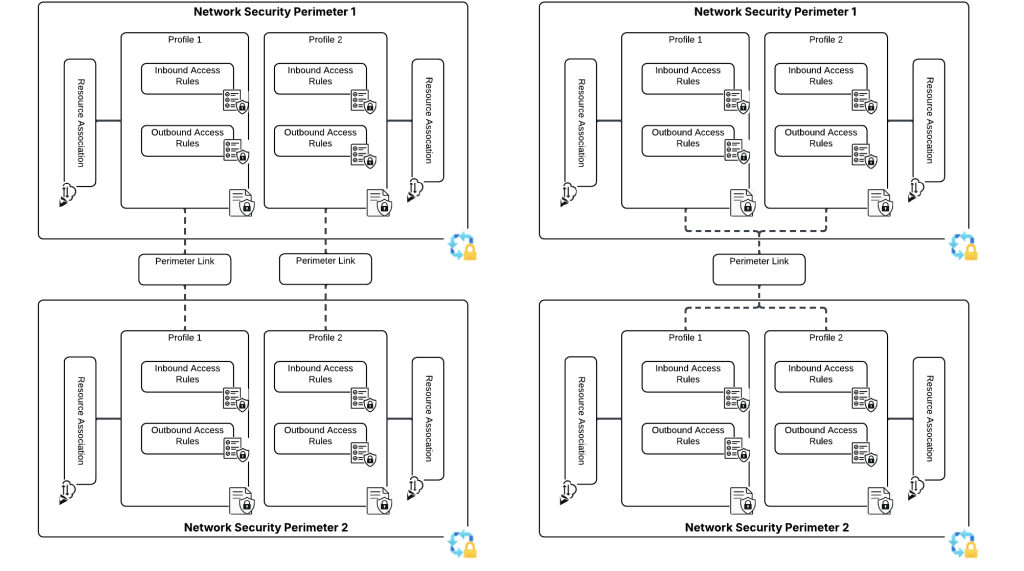
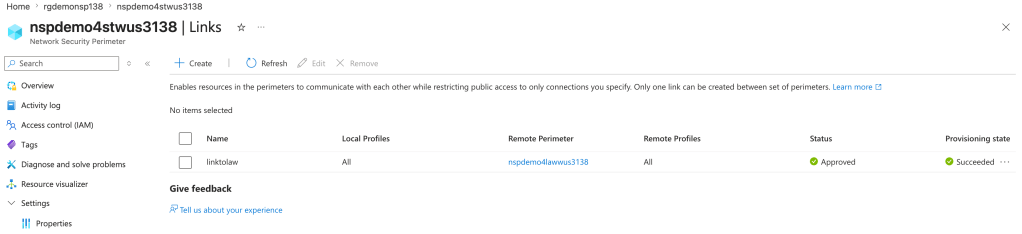
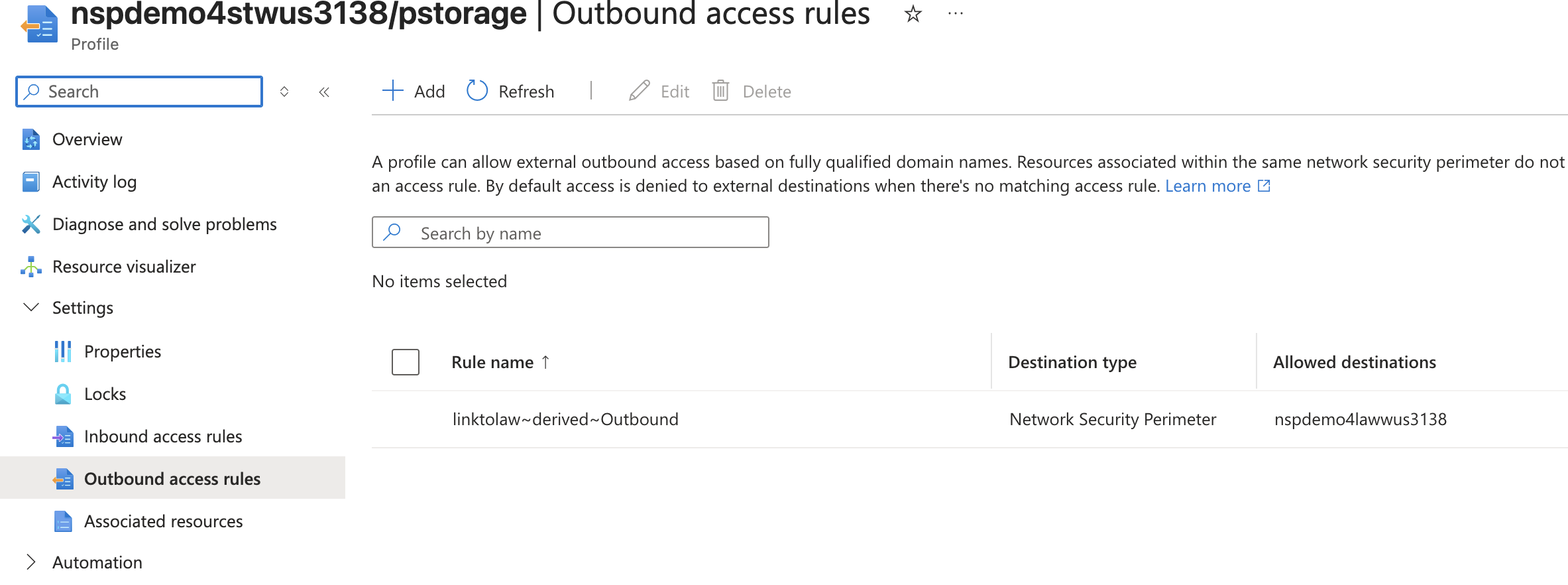
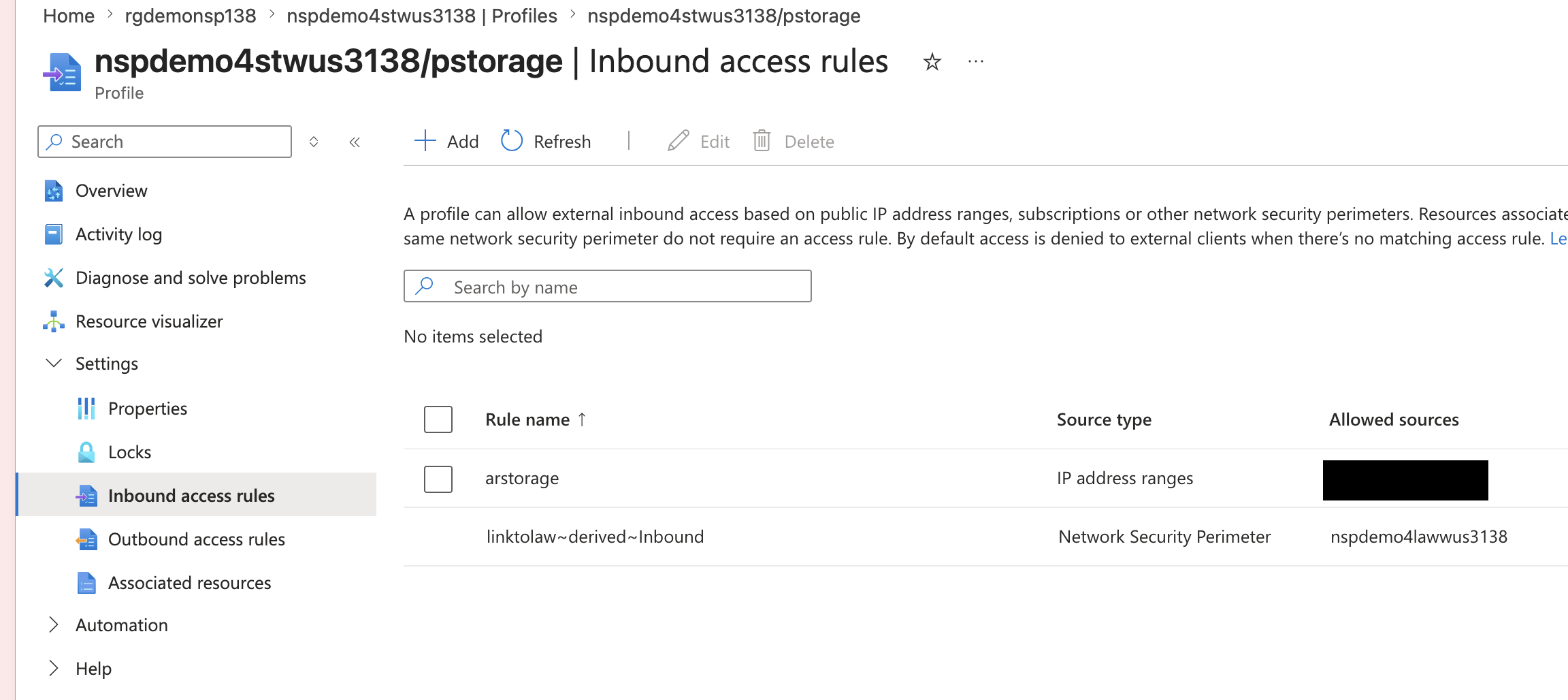
In this new design we create a Network Security Perimeter with a single profile. In this profile there is an access rule which allows customer egress IP addresses for human users or non-human (in case users interact with an app which interacts with LLM). Each resource is associated to that profile within the NSP which allows non-human traffic between PaaS services since it’s all within the same NSP. No additional rules are required which prevents the PaaS services from accepting or initiating any network flows outside of what the access rules and communication with each other within the NSP.

In this design you control your inbound IP access with a single access rule and you get a standard manner to manage outbound access. No more worries about whether the product group baked in an outbound network control, every service in the NSP gets one. Logging? Hell yeah we got your logging for both inbound and outbound in a standard schema.

Once it’s setup you get you can monitor both inbound and outbound network calls using the NSPAccessLogs. It’s a great way to understand under the hood how these patterns work because the NSP logs surface the source resource, destination resource, and the operation being performed as seen below.

NSP logs surfacing operations

One thing to note, at least in East US 2 where I did my testing, outbound calls that are actually allowed since all resources are within the NSP falsley record as hitting the DenyAll rule. Looking back at my notes, this has been an issue since back in March 2025 so maybe that’s just the way it records or the issue hasn’t yet been remediated.

The other thing to note is when I initially set this all up I got an error in both AI Foundry’s chunking/loading method and AI Search’s. The error complains that an additional header of xms_az_nwperimid was passed and the consuming app wouldn’t allow it. Oddly enough, a second attempt didn’t hit the same error. If you run into this error, try again and open a support ticket so whatever feature on the backend is throwing that error can be cleaned up.

Summing it up

So yeah… NSPs make PaaS to PaaS flows like this way easier for all customers. It especially makes implementing basic network security controls far more simple for customers new to Azure that may not have a mature platform landing zone sitting around.

Here are your takeaways for today:

  1. NSPs give you standard inbound/outbound network controls for PaaS and standardized log schema.
  2. NSPs are especially beneficial to new customers who need to execute quickly with basic network security controls.
  3. Take note as of the date of this blog Azure OpenAI Service support for NSPs in public preview. You will need to enable the preview flag on the subscription before you go mucking with it in a POC environment. Do not use it in production until it’s generally available. Instructions are in the link.
  4. I did basic testing for this post testing ingestion, searching, and submitting prompts that reference the extra data source property. Ensure you do your own more robust testing before you go counting on this working for every one of your scenarios.
  5. If you want to muck around with it yourself, you can use the code in this repo to deploy a similar lab as I’ve built above. Remember to enable the preview flag and wait a good day before attempting to deploy the code.

Well folks, that wraps up this post. In my final post on NSPs, I’ll cover a use case for NSPs to help assist with troubleshooting common connectivity issues.

Thanks!