Office 365 Groups Naming Policies – Part 1

Office 365 Groups Naming Policies – Part 1

Groups…  It’s a term every business user consuming technology has heard at some point in time.  Most users only experience groups when they’re unable to access a specific application or file and the coworker sitting next to them informs them they need to call IT and get added to the department group.  Those of us who work on the technology side of the fence are very familiar with the benefits groups bring to the table when controlling access to data.  We are also quite familiar with the challenges they can bring when managing them at scale.

Something as simple as a lack of an enforced naming convention can create serious pain for an organization if it relies heavily upon the naming convention to determine the function and owner of a group.  The pain bleeds through IT and into the business as workers struggle with long wait times for on-boarding new employees due to IT trying to determine which groups the users need to be in.  When it comes time to perform an access review, business owners may waste valuable time trying to determine if removing an employee from a specific group will impact that employee’s ability to fulfill their job responsibilities.

In the on-premises world organizations deal with the challenge of naming conventions in different ways.  Most rely upon first or second level help desk to create groups according to the organization’s naming standard.  This method introduces the risk of human error and presents challenges when the group information for a particular application is sourced from a variety of different identity backends which force the staff to learning multiple tools.  Others make use of identity management (IDM) systems that automate the creation of groups and enforce the naming convention.  This method is very effective but also very costly due to high costs in implementing and operating an IDM.  A very small minority of organizations have evolved to the point where the naming conventions are no longer important due to robust reporting systems and entitlement databases.

Very few organizations are able to successfully execute the third method, which leaves them with the first or second.  The introduction of the software-as-a-service (SaaS) has made the first and second methods of enforcing a naming convention much more complicated.  Using the first method of leveraging help desk staff to create the groups manually is no longer scalable and the second method of using a centralized IDM system is often limited by the vendor’s ability to write connectors to the wide variety of APIs in use across the thousands of SaaS vendors.  All is not lost, as it seems some vendors have begun to recognize the challenge this can introduce to their customers.

If your organization is a consumer of Office 365, you’ve more than likely begun to use Office 365 Groups.  Office 365 groups offer a variety of features not found in the traditional security/distribution group or shared mailbox.  Take a look at this link for a comparison chart that documents the features.  One important thing to note is Office 365 Groups can only be only created in Azure Active Directory (AAD).  You cannot synchronize an on-premises Active Directory Domain Services security or distribution group to AAD and convert it to an Office 365 Group.  This means you can’t leverage an existing solution for enforcing naming conventions unless that solution has a connector into Azure AD.  Given features Office 365 provide and that they are the construct used by Microsoft Teams, you may make the decision to allow your users to create Office 365 Groups on the fly in order to allow them to take full advantage of collaboration tools available in Office 365.  To quote Peter Venkman, “Human sacrifice, dogs and cats living together… mass hysteria!”.

Calm down my friend.  Microsoft has a solution coming in the pipeline that will solve your Office 365 Groups naming convention woes.  In my next post I’ll demonstrate the feature and walkthrough how to test the feature out while it is in preview.

Integrating Azure AD and AWS – Part 3

Update: In November 2019 AWS introduced support for integration between Azure AD and AWS SSO.  The integration offers a ton more features, including out of the box support for multiple AWS accounts.  I highly recommend you go that route if you’re looking to integrate the two platforms.  Check out my series on the new integration here.

Welcome!  This entry continues my series in the integration of Azure AD and AWS.  In my first entry I covered what the advantages of the integration are.  In the second entry I walked through my lab configuration and went over what happens behind the scenes when an application is added to Azure AD from the application gallery.  In this post I’m going to walk through some of the configuration we need to do in both Azure AD and AWS.  I’ll also be breaking open the Azure AD and AWS metadata and examining the default assertion sent by Microsoft out of the box.

In my last entry I  added the AWS application to my Azure AD tenant from the Azure AD Application Gallery.  The application is now shown as added in the All Applications view of the Azure Active Directory blade for my tenant.

pic1.png

After selecting AWS from the listing of applications I’m presented with a variety of configuration options.  Starting with Properties we’re provided with some general information and configuration options.  We need to ensure that the application is enabled for users to sign-in and that it’s visible to users so we can select it from the access panel later on.  Notice also that that I’m configuring the application to require the user be assigned to the application.pic2

On the Users and groups page I’ve assigned Rick Sanchez to the application to allow the account access and display it on the access panel.

pic3

After waiting about 10 minutes (there is a delay in the time it takes for the application to appear in the application panel) I log into the Access Panel as Rick Sanchez and we can see that the AWS app has been added for Rick Sanchez.

pic4

Back to the properties page of the AWS application, my next stop is the Single sign-on page. Here I drop down the Single Sign-on Mode drop box and select SAML-based Sign-on option. Changing the mode to SAML-based Sign-on exposes a ton of options. The first option that caught my eye was the Amazon Web Services (AWS) Domain and URLs. Take notice of the note that says Amazon Web Services (AWS) is pre-integrated with Azure AD and requires no mandatory URL settings. Yeah, not exactly true as we progress through this series.

pic5.png

Further down we see the section that allows us to configure the unique user identifier and additional attributes.   By default Microsoft includes the name, givenName, surName, and emailAddress claims.  I’ll need to make some changes there to pass the claims Amazon requires, but let’s hold off on that for now.

pic6.png

Next up a copy of the Azure AD metadata (IdP metadata) is provided for download.  Additionally some advanced options are available which provide the capability to sign the SAML response, assertion, or both as well as switching the hash algorithm between SHA1 and SHA256.

pic7.png

Now like any nerd, I want to poke around the IdP metadata and see what the certificate Azure AD is using to sign looks like.  Opening up the metadata in a web browser parses the XML and makes the format look pretty.  From there I grab the contents X509Certificate tag (the base-64 encoded public-key certificate), dump it to Notepad, and renam it with a file extension of cer.  Low and behold, what do we see but a self-signed certificate.  This is a case where I can see the logic that the operational overhead is far greater than the potential security risk.  I mean really, does anyone want to deal with the challenge of hundreds of thousands of customers not understanding the basics of public key infrastructure and worrying about revocation, trust chains, and the like?  You get a pass Microsoft… This time anyway.

pic8.png

Before I proceed with the next step in the configuration, let’s take a look at what the assertion looks like without any of the necessary configuration.  For this I’ll use Fiddler to act as a man-in-the-middle between the client and the web.  In session 6 of the screenshot below we see that the SAML response was returned to the web browser from Azure.

pic9.png

Next up we extract that information with the Text Wizard, base-64 decode it, copy it to Notepad, save it as an XML file, and open it with IE.  The attributes containing values of interest are as follows:

  • Destination – The destination is the service provider assertion consumer URI

pic10.png

  • NameID – This is the unique identifier of the used by the service provider to identify the user accessing the service

pic11.png

  • Recipient– The recipient attribute references the service the assertion is intended for.  Oasis security best practices for SAML require the service provider to verify this attribute match the URI for the service provider assertion consumer URI

pic12.png

  • Audience – The audience attribute in the audienceRestriction section mitigates the threat of the assertion being stolen and used to impersonate a user.  Oasis security best practices require the service provider to verify this when the assertion is received to ensure it is recognizes the identifier.  The way in which this is accomplished is the value in the audience attribute is checked against the service provider EntityID attribute.

pic13.png

Additionally we have some interesting claims including tenantid, objectidentifier of the user object in Azure AD, name, surname, givenname, displayname, identityprovider, and authnmethosreferences.  I don’t think any of these need further explanation.

pic14.png

Let’s now take a look at the AWS (service provider in SAML terms) metadata.  The AWS metadata is available for download from here.  After it’s downloaded it can be opened with IE.

pic15.png

The fields of interest in this set of metadata is:

  • EntityID – The entityID is the unique identifier AWS will provide in its authentication requests.  Let’s note the value of urn:amazon:webservices for later as it will come in handy due to some issues with Microsoft’s default settings.

pic16

  • NameIDFormat – This tells me both transient and persistent are accepted.  I won’t go into details on Name ID format, you can review that for yourself in the Oasis standard.  Suffice to say the Name ID format required by the service provider can throw some wrenches into integrations when using a more basic security token service (STS) like AD FS.

pic17

  • AssertionConsumerService – This is where our browser will post back the SAML assertion after a successful authentication.  Note the URI in the location field.

pic18.png

  • RequestedAttributes – This provides us with a listing of all the attributes AWS will accept in an assertion.  Note that the only two required attributes are Role and RoleSessionName.

We’ve added the AWS application to Azure AD, granted a user access to the application, and have started the SAML setup within Azure AD (Identity Provider).  Let’s continue that setup by configuring which attributes Azure AD will include in the assertions delivered to AWS.  From review of the AWS metadata we know that we need to  send claims of Role and RoleSessionName.  The RoleE will match to an an AWS IAM Role handling authorization of what we can do within AWS and the RoleSessionName provides a unique identifier for the user asserting the entitlement.

Back in the Azure AD Portal I’m going to click the option to View and edit all other user attributes.  The exposes the attributes Microsoft sends by default.  These include givenName, suName, emailAddress, and name.  Since the AWS metadata only requires RoleSessionName and Role, I’m going to delete the other attributes.  No sense in exposing additional information that isn’t needed!

pic19.png

After the extra attributes are deleted I create the two required attributes as seen in the screenshot below.

pic20.png

I’m now going to bounce over to the AWS Management Console.  After logging in I navigate to the Services menu and choose IAM.

pic21.png

On the IAM menu I choose the Identity providers menu item and hit the Create Provider button.

pic22.png

On the next screen I’m required to configure the identity provider settings.  I choose SAML from the drop-down box enter a provider name of MAAD and upload the IdP metadata I downloaded from Azure AD referenced earlier in the blog entry and hit the Next Step button.

pic23.png

On the next page I verify the provider name and the type of identity provider and hit the Create button.  Once that is complete I see the new entry listed in identity providers list.  Easy right?

pic24.png

We have an identity provider, but that identity provider needs some IAM roles to be associated with the identity provider that my fictional users can assert.  For that I go to the Roles section and hit the Create Role button.

pic25.png

On the next screen I select the SAML button as the type of trusted entity since the role is going to be asserted via the SAML trust with Azure AD.  Here I select the MAAD provider and choose the option to allow the users to access both the AWS Management Console and the API and then hit the Next: Permissions button.

pic26.png

As I referenced in my first entry to this series, the role I’m going to create is going to be capable of managing all EC2 instances.  For that I choose the AmazonEC2FullAccess policy template and then hit the Next:Review button.

pic267.png

On the last screen I name the new role AzureADEC2Admins, write a short description, and hit the Create Role button.

pic28.png

The new role is created and can be seen associated to the identity provider representing the trust between AWS and Azure AD.

pic29.png

Let’s sum up what we did for this entry.  We examined the key settings Microsoft exposes for configuration with the AWS integration.  We examined the Azure AD (IdP) and AWS (SP) metadata to understand which settings are important to this integration and what those settings do.  We examined an assertion generated out of Azure AD prior to any of the necessary customization being completed to understand what a canned assertion looks like.  Finally, we completed a majority of the tasks we need to complete on the AWS side to create the SAML trust on the AWS end and to create a role JoG users can asserts.  Are your eyes bleeding yet?

In my last post in this series I’ll walk through the rest of the configuration needed on the Azure AD end.  This will include going over some of the mistakes the Microsoft tutorial makes as well as covering configuration of Azure AD’s provisioning integration as to what it means and how we can effectively configure it.  Finally, we’ll put all the pieces of the puzzle together, assert our identity, and review logs at AWS to see what they look like when a federated user performs actions in AWS.

The journey continues in my fourth entry.

Integrating Azure AD and AWS – Part 2

Update: In November 2019 AWS introduced support for integration between Azure AD and AWS SSO.  The integration offers a ton more features, including out of the box support for multiple AWS accounts.  I highly recommend you go that route if you’re looking to integrate the two platforms.  Check out my series on the new integration here.

Today I will continue the journey into the integration between Azure AD and Amazon Web Services.  In my first entry I covered the reasons why you’d want to integrate Azure AD with AWS and provided a high-level overview of how the solution works.  The remaining entries in this series will cover the steps involved in completing the integration including deep dives into the inner workings of the solution.

Let me start out by talking about the testing environment I’ll be using for this series.

lab.png

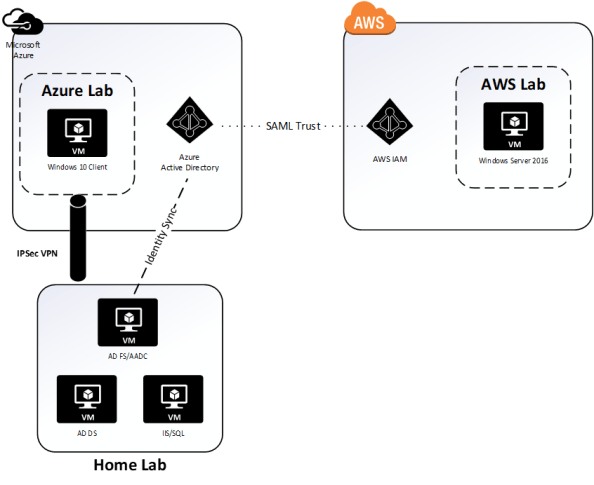
The environment includes three virtual machines (VMs) running on Windows Server 2016 Hyper V on a server at my house.  The virtual machines consists three servers running Windows Server 2016 with one server acting as a domain controller for the journeyofthegeek.local Active Directory (AD) forest, another server running Active Directory Federation Services (AD FS) and Azure AD Connect (AADC), and the third server running MS SQL Server and IIS.  The IIS instance hosts a .NET sample federated application published by Microsoft.

In Microsoft Azure I have a single Vnet configured for connectivity to my on-premises lab through a site-to-site IPSec virtual private network (VPN) I’ve setup with pfSense.  Within the Vnet exists a single VM running Windows 10 that is domain-joined to the journeyofthegeek.local AD domain.  The Azure AD tenant providing the identity backend for the Microsoft Azure subscription is synchronized with the journeyofthegeek.local AD domain using Azure AD Connect and is associated with the domain journeyofthegeek.com.  Authentication to the Azure AD tenant is federated using my instance of AD FS.  I’m not synchronizing passwords and am using an alternate login ID with the user principal name being synchronized to Azure AD being stored in the AD attribute msDS-CloudExtensionAttribute1.  The reason I’m still configured to use an alternate login ID was due to some testing I needed to do for a previous project.

I created a single test user in the journeyofthegeek.local Active Directory domain named Rick Sanchez with a user principal name (UPN) of rick.sanchez@journeyofthegeeklocal and msDS-CloudExtensionAttribute1 of  rick.sanchez@journeyofthegeek.com.  The only attribute to note that the user has populated is the mail attribute which has the value of rick.sanchez@journeyofthegeek.com.  The user is being synchronized to Azure AD via the Azure AD Connect instance.

In AWS I have a single elastic compute cloud (EC2) instance running Windows Server 2016 within a virtual private cloud (VPC).  I’ll be configuring Azure AD as an identity provider associated with the AWS account and will be associating an AWS IAM role named AzureADEC2Admins.  The role will grant full admin rights over the management of the EC2 instances associated to the account via the AmazonEC2FullAccess permissions policy.

Let’s begin shall we?

The first step I’ll be taking is to log into the Azure Portal as an account that is a member of the global admins and navigate to the Azure Active Directory blade.  From there I select Enterprise Applications blade and hit the New Application link.

entapps.png

I then search the application gallery for AWS, select the AWS application, accept the default name, and hit the Add button.  Azure AD will proceed to add the application and will then jump to a quick start page.  So what exactly does it mean to add an application to Azure AD?  Good question, for that we’ll want to use the Azure AD cmdlets.  You can reference this link.

Before we jump into running cmdlets, let’s talk very briefly about the concept of application identities in AAD.  If you’ve managed Active Directory Domain Services (AD DS), you’re very familiar with the concept of service accounts.  When you needed an application (let’s call it a non-human to be more in-line with industry terminology) to access AD-integrated resources directly or on-behalf of a user you would create a security principal to represent the non-human.  That security principal could be a user object, managed service account object, or group managed service account object.  You would then grant that security principal rights and permissions over the resource or grant it the right to impersonate a user and access the resource on the user’s behalf.  The part we want to focus in on is the impersonation or delegation to access a resource on the behalf of a user.  In AD DS that delegation is accomplished through the Kerberos protocol.

When we shift over to AAD the same basic concepts still exist of creating a security principal to represent the application and granting that application direct or delegated access to a resource.  The difference is the protocol handling the access shifts from Kerberos to OAuth 2.0.  One thing many people become confused about is thinking that OAuth handles authentication.  It doesn’t.  It has nothing do with authentication and everything to do with authorization, or more clearly delegation.  When we add an application the AAD a service principal object and sometimes application object (in AWS instance both are created) are created in the AAD tenant to represent the application.  I’m going to speak to the service principal object for the AWS integration, but you can read through this link for a good walkthrough on application and service principal objects and how they differ.

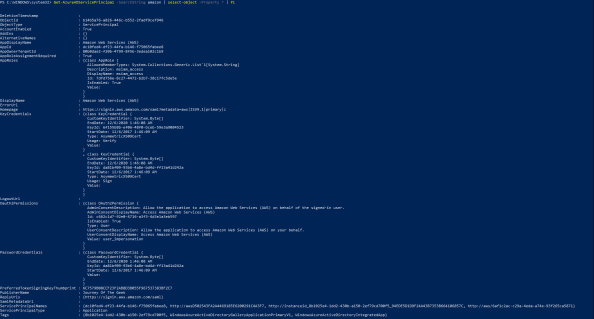
Now back to AWS.  So we added the application and we now have a service principal object in our tenant representing AWS.  Here is a few of the attributes for the object pulled via PowerShell.

awsservice.png

Review of the attributes for the object provide a few pieces of interesting information.   We’ll get to experiment more with what these mean when we start doing Fiddler captures, but let’s talk a bit about them now.  The AppRoles attribute provides a single default role of msiam_access.  Later on we’ll be adding additional roles that will map back to our AWS IAM roles.

Next up we have the KeyCredentials which contains two entries.  This attribute took me a while to work out.  In short, based upon the startDate, I think these two entries are referencing the self-signed certificate included in the IdP metadata that is created after the application is added to the directory.  I’ll cover the IdP metadata in the next entry.

The Oauth2Permissions are a bit funky for this use case since we’re not really allowing the application to access AWS on our behalf, but rather asking it to produce a SAML assertion asserting our identity.  Maybe the delegation can be thought of as delegating Azure AD the right to create logical security tokens representing our users that can be used to assert an identity to AWS.

The PasswordCredentials contains a single entry which shares the same KeyID as the KeyCredential.  As best I can figure from reading the documentation is this would normally contain entries for client keys when not using certificate authentication.  Given that it contains a single entry with the same KeyID as the KeyCredential for signing, I can only guess it will contain an entry even with a certificate is used to authenticate the application.

The last attributes of interest are the PreferredTokenSigningKeyThumbprint which references the certificate within the IdP metadata and the replyURLs which is the assertion consumer URI for AWS.

So yeah, that’s what happens in those 2 or 3 seconds the AWS application is registered with Azure AD.  I found it interesting how the service principal object is used to represent trust between Azure AD and AWS and all the configuration information attached to the object after the application is simply added.  It’s nice to have some of the configuration work done for us out of the box, but there is much more to do.

In the next entry I’ll walk through the Quick Start for the AWS application configuration and explore the metadata Azure AD creates.

The journey continues in my third entry.

Azure AD Pass-through Authentication – How does it work? Part 1

Hi everyone. I decided to take a break from the legacy and jump back to modern. Today I’m going to do some digging into Microsoft’s Azure AD Pass-through Authentication solution. The feature was introduced into public preview in December of 2016 and was touted as the simple and easy alternative to AD FS. Before I jump into the weeds of pass-through authentication, let’s do a high level overview of each option.

I will first cover the AD FS (Active Directory Federation Services) solution. When AD FS is used a solution for authentication to Azure Active Directory, it’s important to remember that AD FS is simply a product that enables the use of a technology to solve a business problem. In this instance the technology we are using is modern authentication (sometimes referred to as claims-based authentication) to solve the business problem of obtaining some level of assurance that a user is who they say they are.

When Azure AD and AD FS are integrated to enable the use of modern authentication, the Windows Services Federation Language (WS-FED) standard is used. You are welcome to read the standard for details, but the gist of WS-FED is a security token service generates logical security tokens (referred to assertions) which contain claims. The claims are typically pulled from a data store (such as Active Directory) and contain information about the user’s identity such as logon ID or email address. The data included in claims has evolved significantly over the past few years to include other data about the context of the user’s device (such as a trusted or untrusted device) and user’s location (coming from a trusted or untrusted IP range). The assertions are signed by the security token service (STS) and delivered to an application (referred to as the relying party) which validates the signature on the assertion, consumes the claims from the assertion, and authorizes the user access to the application.

You may have noticed above that we never talked about a user’s credentials. The reason for that is the user’s credentials aren’t included in the assertion. Prior to the STS generating the assertion, the user needs to authenticate to the STS. When AD FS is used, it’s common for the user to authenticate to the STS using Kerberos. Those of you that are familiar with Active Directory authentication know that a user obtains a Kerberos ticket-granting-ticket during workstation authentication to a domain-joined machine. When the user accesses AD FS (in this scenario the STS) the user provides a Kerberos service ticket. The process to obtain that service ticket, pass it to AD FS, getting an assertion, and passing that assertion back to the Azure AD (relying party in this scenario) is all seamless to the user and results in a true single sign-on experience. Additionally, there is no need to synchronize a user’s Active Directory Domain Services password to Azure AD, which your security folk will surely love.

The challenge presented with using AD FS as a solution is you have yet another service which requires on-premises infrastructure, must be highly available, and requires an understanding of the concepts I have explained above. In addition, if the service needs to be exposed to the internet and be accessible by non-domain joined machines, a reverse proxy (often Microsoft Web Application Proxy in the Microsoft world) which also requires more highly available infrastructure and the understanding of concepts such as split-brain DNS.

Now imagine you’re Microsoft and companies want to limit their on-premises infrastructure and the wider technology mark is slim in professionals that grasp all the concepts I have outlined above. What do you do? Well, you introduce a simple lightweight solution that requires little to no configuration or much understanding of what is actually happening. In come Azure AD Pass-through authentication.

Azure AD Pass-through authentication doesn’t require an STS or a reverse proxy. Nor does it require synchronization of a user’s Active Directory Domain Service password to Azure AD. It also doesn’t require making changes to any incoming flows in your network firewall. Sounds glorious right? Microsoft thinks this as well, hence why they’ve been pushing it so hard.

The user experience is very straightforward where the user plugs in their Active Directory Domain Services username and password at the Azure AD login screen. After the user hits the login screen, the user is logged in and go about their user way. Pretty fancy right? So how does Microsoft work this magic? It’s actually quite complicated but ingeniously implemented to seem incredibly simplistic.

The suspense is building right? Well, you’ll need to wait until my next entry to dig into the delicious details. We’ll be using a variety of tools including a simple packet capturing tool, a web proxy debugging tool, and an incredibly awesome API monitoring tool.

See you next post!