Azure AI Studio – Chat Playground and API Management

This is part of my series on GenAI Services in Azure:

  1. Azure OpenAI Service – Infra and Security Stuff
  2. Azure OpenAI Service – Authentication
  3. Azure OpenAI Service – Authorization
  4. Azure OpenAI Service – Logging
  5. Azure OpenAI Service – Azure API Management and Entra ID
  6. Azure OpenAI Service – Granular Chargebacks
  7. Azure OpenAI Service – Load Balancing
  8. Azure OpenAI Service – Blocking API Key Access
  9. Azure OpenAI Service – Securing Azure OpenAI Studio
  10. Azure OpenAI Service – Challenge of Logging Streaming ChatCompletions
  11. Azure OpenAI Service – How To Get Insights By Collecting Logging Data
  12. Azure OpenAI Service – How To Handle Rate Limiting
  13. Azure OpenAI Service – Tracking Token Usage with APIM
  14. Azure AI Studio – Chat Playground and APIM
  15. Azure OpenAI Service – Streaming ChatCompletions and Token Consumption Tracking
  16. Azure OpenAI Service – Load Testing

Hello again folks!

Today, I’m going to be posting my first post in a series on Azure AI Studio. I’ll let the true AI professionals give you the gory details and features of the service. The way my small brain thinks of the service is a platform built on top of AML (Azure Machine Learning) to make building applications that use Generative AI more developer-friendly. You can build and test applications, deploy third-party models, and organize applications into “projects” which can be secured to a specific project team but share resources across an organization via the concept of a hub. I’ll cover more on those pieces in a future blog post, but for today I want to focus on a pattern I was messing around that I think would be appealing to most folks.

One of the neat features of AI Studio is the Chat Playground. The Chat Playground is a web interface for interacting with models you have deployed to Azure AI Studio. You can send prompts and receive completions, adjust parameters such as temperature, and even get a code sample of the code being run by the web interface. The models that can e deployed include OpenAI models deployed to an AOAI (Azure OpenAI Service) instance or third-party models like Meta’s Llama deployed to a serverless endpoint or self-managed compute (in AML called managed online endpoint). For the purposes of this post I’m going to be focusing on OpenAI models deployed to an AOAI instance.

Azure AI Studio Chat Playground

You’re probably looking at this and thinking, “Yeah that is cool… a similar functionality exists in Azure OpenAI Studio and it does the same thing.” That’s correct it does, but for many organizations using the Azure OpenAI Studio’s Chat Playground isn’t an option for a number of different reasons both operational and security-related.

From an operational perspective, the Azure OpenAI Studio’s Chat Playground is designed to communicate directly with the endpoint for an AOAI instance. As I’ve covered in previous posts, this can be problematic. One reason is you’re limited to the quota within the instance which could cause you to hit limits quickly if you direct a whole ton of users to it. Typically, you will load balance across multiple instances deployed to multiple regions across multiple subscriptions as I discuss in my post on load balancing AOAI. The other problem is dealing with internal chargebacks. If I have multiple BUs (business units) hammering away at an instance, I don’t have any easy to determine who which folks in what BU consumed what. While metrics are token usage are captured in the metrics streamed from an instance, there is no way to associate that usage with an individual.

On the security side, communicating directly with the AOAI instance means I can’t review the prompts and responses being sent and received by the service. Many regulated organizations have requirements for these to be captured for review to ensure the service is being used appropriately and sensitive data isn’t being sent that hasn’t been approved to be sent. Additionally, availability of the AOAI instance could be affected by one user going nuts and consuming the full quota.

The challenges outlined above have driven many customers to insert a control point. The industry seems determined to coin this architectural component a Gen AI Gateway so I’ll play along. For you fellow old folks, all a Gen AI Gateway really is an API Gateway with some Gen AI-related features slapped on top of it. It sits between the front-facing user application and the models processing the prompts and responses. The GenAI-specific features available within the gateway help to address the operational and security challenges I’ve outlined above. If you’re curious about the specifics on this, you can check out my post on load balancing, logging, tracking token usage, rate limiting, and extracting useful information from the conversation such as prompts and responses.

Example design and process flow of a Gen AI Gateway

In the image above I’ve included an example of how APIM (Azure API Management) could be used to provide such functionality. Within the customer base I work with at Microsoft, many customers have built something that functions similar to what you see above. A design like this helps to address the operational and security challenges I’ve outlined above.

Wonderful right? Now what the **** does this have to do with AI Studio’s Chat Playground? Well, unlike the Azure OpenAI Studio’s Chat Playground, AI Studio’s offering does support modifying the endpoint to point to your generative AI gateway. How you do this isn’t super intuitive, but it does work. Whether you go this route is totally up to you. Ok, disclaimer is done, let’s talk about how you do this.

One thing to understand about using AI Studio’s Chat Playground is it works the same way that Azure OpenAI Studio’s version works in regards to where the TCP connections are sourced from when making calls to the model. As can be seen in the Fiddler capture below, the TCP connections made when you submit a prompt from the Chat Playground are sourced from the user’s endpoint.

Fiddler capture showing Chat Completion coming from user endpoint

This makes our life much easier because we likely control the path that user’s packet takes and the DNS the user uses which means we can direct that user’s packet to a Gen AI Gateway. For the purposes of this post, my goal is to funnel these prompts and completions through an APIM instance I have in place which has some APIM policy snippets that do some checks and balances and a call a small app (based off an awesome solution assembled by my buddy Shaun Callighan) which logs prompts and responses and calculates token metrics. The data processed by the app are then sent to an Event Hub, processed by Stream Analytics, and dumped into CosmosDB.

APIM between Chat Playground and AOAI

When you want to connect to an AOAI instance from AI Studio’s Chat Playground you add it as a connection. These connections can created at the hub level (think of this as a logical container for the projects) and then shared across projects. When adding the connection you can browse for the instance you want to connect to or enter manually.

Adding a connection to an AOAI instance

If you were to do that you won’t be able to create a deployment of a model or access a deployment of a model deployed in the instances behind it. This is because AI Studio is making calls to the Azure management plane to enumerate the deployments within the instance. Since there isn’t an AOAI with the hostname of your AOAI instance, you’ll be unable to add deployments or pick a deployment from the Chat Playground.

To work around this, you need to add a connection to one of your AOAI instances. This will be your “stub” instance that we’ll modify the endpoint of to point to API Management. If you’re load balancing across multiple AOAI instances behind APIM, you need to ensure that you’ve already created your model deployments and you’ve named them consistently across all of the AOAI instances you’re load balancing to. In the image below, I modify the endpoint to point to my APIM instance. The azure-openai-log-helper path is added to send it to a specific API I have setup on APIM that handles logging. For your environment, you’ll likely just need the hostname.

Modifying the endpoint name

Now before you go running and trying to use the Chat Playground, you’ll have to make a change to the APIM policy. Since the user’s browser is being told to make the call to this endpoint from a different domain (AI Studio’s domain) we need to ensure there is a CORS policy in place on the APIM instance to allow for this, otherwise it will be blocked by APIM. If you forget about this policy you’ll get a back a 200 from the APIM instance but nothing will be in the response.

Your CORS policy could look like the below:

        <cors>
            <allowed-origins>
                <origin>https://ai.azure.com/</origin>
                <origin>https://ai.azure.com</origin>
            </allowed-origins>
            <allowed-methods preflight-result-max-age="300">
                <method>POST</method>
                <method>OPTIONS</method>
            </allowed-methods>
            <allowed-headers>
                <header>authorization</header>
                <header>content-type</header>
                <header>request-id</header>
                <header>traceparent</header>
                <header>x-ms-client-request-id</header>
                <header>x-ms-useragent</header>
            </allowed-headers>
        </cors>

Once you’ve modified your APIM policy with the CORS update, you’ll be good to go! Your requests will now flow through APIM for all the GenAI Gateway goodness.

Chat Completion from AI Studio Chat Playground flowing through APIM

When messing with this I ran into a few things I want to call out:

  1. Do not forget the CORS policy. If you run into a 200 response from APIM with no content, it’s probably the CORS snippet.
  2. If you have a validate-jwt snippet in your APIM policy that includes validating the claim includes cognitivesservices, remove that. The claim passed by AI Studio includes a trailing forward slash which won’t likely match what you get back if you’re using the MSAL library in code. You could certainly include some logic to handle it, but honestly the security benefit is so little from checking the claim just make it easy on yourself and remove the check for the claim. Keep the check that validate-jwt snippet but restrict it to checking the tenant ID in the token.
  3. Chat Playground will pass the content property as the prompt as an array (this is the more modern approach to allow for multi-modal models like GPT-4o which can handle images and audio). If you have an APIM policy in place to parse the request body and extract information you’ll need to update it to also handle when content is passed as an array.
  4. Chat Playground allows for the user to submit an image along with text in the prompt. Ensure your APIM policy is capable of handling prompts like that. Dealing with human users being able to submit images to an LLM and ensuring you’re reviewing that image for DLP and calculating token consumption for streaming Chat Completion is a whole other blog topic that I’m not going to do today. Key thing is you want to account for that. Block images or ensure your policy is capable of handling it if you’re deploying 4o or 4 Vision.

Well folks that sums up this post. I realize this solution is a bit funky, and I’m not gonna tell you to use it. I’m simply putting it out there as an option if you have a business need strong enough to provide a ChatGPT-style solution but don’t have the bandwidth or time to whip up your own application.

Enjoy!

VirtualNetwork Service Tag and Network Security Groups

Hello fellow geeks!

Earlier this week I was messing around with Kubernetes SSHing into the nodes and I ran into an interesting quirk of NSGs (Network Security Groups). I noticed that traffic I did not expect to be allowed through the NSG was making it through. A bit of digging let me down the path of a documented, but not well known, behavior of the VirtualNetwork service tag when used in NSG security rules. Today I’m going to walk through that behavior, why you should care, and what you can do to avoid being surprised like I was.

NSGs are layer four stateful firewalls that operate at the SDN (software-defined network). They serve a similar purpose and function in much the same way as AWS Security Groups. NSGs are used for microsegmentation within and across Virtual Networks typically supplementing the centralized control that is provided by a security appliance such as Azure Firewall or a Palo Alto firewall. They are associated to a subnet (best practice) or NIC (network interface) (few use cases for this). Each contains a collection of security rules, which includes default rules and user-defined rules. NSG security rules are processed by priority and are matched based on a 5-tuple.

As described in the previous link, service tags can be used within NSG security rules to simplify access to Azure resources. Service tags contain a summarized list of IPs that is managed by Microsoft. This makes life far easier, because whitelisting the IPs to something like Azure Storage Rules would be a nightmarish task that would require customer-created automation to keep up to date as IPs are added or removed to the underlining service. The benefit of service tags does come with a consideration as we’ll see in this post.

Each subnet or NIC can have one NSG applied to it, but the NSG can be applied to multiple subnets or NICs. In the instance of NSGs being applied at both the subnet and NIC, the processing for inbound traffic is detailed here and for outbound here.

Now that you know the basics of NSGs, let me talk a bit about the lab. For this lab I used my simple hub and spoke lab with a few modifications. I have added an Ubuntu VM running in the application subnet (snet-app) in the workload spoke virtual network. I’ve also temporarily removed the UDR from the custom route table on the application subnet. The NSG applied to the spoke contains only the default NSG rules. The lab architecture can be seen below.

Lab environment

Reviewing the NSG applied to the application subnet, the three default inbound rules are present as expected. The rule I’m going to look more deeply at is the AllowVnetInBound rule highlighted below. Specifically, I’m going to show you how to look at the IPs behind a service tag.

Default Inbound NSG Security Rules

To see the IPs associated with a service tag, I’m going to use the Effective security rules tool in Azure’s Network Watcher. If you’re unfamiliar with Network Watcher, you’re missing out. It contains a plethora of useful tools to help diagnose network connectivity. The Effective security rules tool looks at the NSGs applied to a NIC at both the subnet and NIC level to provide you with a holistic view of the what traffic is allowed and combined between NSGs applied at each level.

Effective security rules tool in Network Watcher

One of the lesser known features of the tool is it gives you the ability to look at the IPs included within a service tag for a specific NSG security rule. In the image below you will see that the IPs included in the VirtualNetwork service tag are the workload virtual network IP range (10.2.0.0/16), the peered transit virtual network IP range (10.0.0.0/16), and the Azure “magic IP” 168.63.129.16. This is likely what you expected to see in the VirtualNetwork tag.

VirtualNetwork service tag contents without UDR

Remember when I said I removed the UDR for the default route from the custom route table applied to the application subnet? I then added that route back in, pointed it to the Azure Firewall, waited about 2 minutes, then re-ran the Effective security rules tool.

VirtualNetwork service tag contents with UDR of default route

My first reaction to seeing all IP addresses now allowed through the VirtualNetwork tag was pretty much the Scanners head explosion GIF (classic if you haven’t seen it). It turns out this behavior is documented. The VirtualNetwork service tag has the following explanation:

The virtual network address space (all IP address ranges defined for the virtual network), all connected on-premises address spaces, peered virtual networks, virtual networks connected to a virtual network gateway, the virtual IP address of the host, and address prefixes used on user-defined routes. This tag might also contain default routes.

https://docs.microsoft.com/en-us/azure/virtual-network/service-tags-overview#available-service-tags

The part of that excerpt you need to care about is the piece about it includes the address prefixes on user-defined routes. This means that the prefixes in the UDRs you place on a custom route table applied to the subnet are added to the VirtualNetwork service tag in the NSG security rules used by the NSGs applied to your resource. I’m not sure why this behavior was implemented, but it can impact separation of duties where you’d have a networking team managing the routing within route tables and the security team managing which traffic is allowed in or out with NSGs. If someone has control over the routing tables, they can influence the VirtualNetwork service tag prefixes, which will influence the behavior of the default NSG security rules and others using that tag.

If you’re like me, your first level of panic was around the risk of this allowing traffic from the public Internet inbound to the resource if the resource had a public IP. You can rest easy in that my testing showed this is not possible even with an additional UDR in place to assure symmetric flow of traffic to the Internet endpoint coming in directly via the public IP. It’s likely Microsoft is doing some type of filtering at the SDN layer excluding traffic identified as being sourced from the Internet from being included in this security rule.

It gets more interesting when you use the IP Flow Verify tool in Network Watcher. Here I picked a random public IP and tested an inbound flow. The tool reports the flow as being allowed by the default AllowVnetInBound rule. Take note of this behavior because it could lead to confusion with your Information Security team or third-party auditors.

IP Flow Verify showing flow is allowed

The second level of panic I had was that this rule would allow any endpoint that has connectivity to my Virtual Network (such as other Virtual Networks attached as spokes to the hub Virtual Network) full connectivity to the endpoints behind the NSG. This concern is actually legitimate and was the reason I originally went down the rabbit hole. Traffic from a VM in the Shared Services Virtual Network is allowed full network connectivity the VM in the application subnet since the Virtual Network service tag includes the all IPv4 addresses (note this traffic was allowed through the Azure Firewall).

So why should you care about any of this? You should care because the programmed behavior of adding prefixes from UDRs to the VirtualNetwork service tag means those with control over the custom route tables (typically the networking team) have the ability to affect which traffic is allowed through an NSG if any NSG security rules use the VirtualNetwork service tag. From a separation of duties perspective, this is very far from optimal. Additionally, since most hub and spoke architectures use a UDR with a default route of 0.0.0.0/0, unless you have a user-defined deny security rule in place, you are affected by this. Lastly, it goes to show that tools such as IP Flow Verify which work on evaluating the SDN rule set can produce confusing results.

There are some great ways to mitigate this risk thankfully. You could use Azure Policy to audit, deny, or remediate NSGs that are deployed without a default deny option. There are some great examples of remediation in the community GitHub. Funneling workload-to-workload and user-to-workload traffic through a security appliance such as Azure Firewall running in the transit Virtual Network is another great risk mitigator. Lastly, tightly controlling access to your route tables and limiting use of the VirtualNetwork service tags are other options.

Well folks, that wraps up this post. Hopefully the information was useful and you can leverage some of it to more tightly secure your Azure environment.

Have a great week!

A Pattern for App Services with Private Endpoints

A Pattern for App Services with Private Endpoints

Hello again fellow geeks.

Last year Microsoft announced the general availability of Private Endpoint support for App Services. This was a feature I was particularly excited about because when combined with regional Vnet integration, it offered an alternative to an ASE (App Service Environment) for customers who wanted to run internally-facing applications or who didn’t feel comfortable exposing their publicly facing application directly via a public IP.

Over the past year I created a few different labs that demonstrated these features including a web app and function app. Each lab was built around a hub and spoke architecture where the application was serving as an internally-facing application. Given my recent post on Azure Firewall Premium, and the fact I still had the lab environment up and running, I thought it would be interesting to switch the virtual machine out and switch App Services in, which resulted in the lab environment pictured below.

Lab environment

I established the following goals for the lab environment:

  1. Perform IDPS on traffic to the web app
  2. Mediate and inspect traffic initiated from the web app to third-party APIs
  3. Expose a web application to the Internet without giving it a direct public IP address

To accomplish these goals I was able to re-use much of the pattern I described in my last post.

The first step in the process was to create a very simple hub and spoke architecture as pictured above. The environment would consist of a transit Vnet (virtual network), shared services Vnet, and spoke Vnet. The transit Vnet would contain the guts of the solution with an Azure Firewall Premium SKU instance and Azure Application Gateway v2 instance. In the shared services Vnet I used a Windows Server VM (virtual machine) running the DNS Server service and providing DNS resolution for the environment. I could have taken a shortcut here and used Azure Firewall’s DNS proxy capability, but I like to leave the options open for conditional forwarding which Azure Firewall and Azure Private DNS do not support at this time. Finally, in the spoke Vnet I created two subnets. One subnet hosted the private endpoint for App Services and the other subnet was delegated to App Services to support regional Vnet integration.

Once all components were in place, I deployed a simple Python web application I wrote. All it does it queries two public APIs, one for the current time and the other for a random Breaking Bad quote (greatest show of all time!). I took the cheating way out and deployed the app directly via Visual Studio using the Azure App Service add-in prior to deploying the private endpoint and regional Vnet integration capabilities. This allowed me to test the app to validate it was still working as intended while also allowing me to deploy the app from my home machine. Deploying a private endpoint for app services locks down not only access to the running application but also to the SCM (source control management) endpoint that is used for deploying code to the app.

The next step was to create the Azure Private DNS Zone for app services which is named privatelink.azurewebsites.net. I then linked this zone to my shared services Vnet and setup the DNS server running in that Vnet with a standard forward to 168.63.129.16. This setup allows DNS queries made to the Private DNS zone to be resolved by the DNS server. I’ve written extensively about how DNS works with Azure Private Link so I won’t go into any more detail on that flow. Last step in the DNS process is to configure each Vnet to use the DNS server IP in its DNS Server settings. This also needs to configured directly on the Azure Firewall.

Now that the infrastructure would be able to resolve queries to the Private DNS Zone used by App Services, it was time to create the private endpoint for the web app. This registered the appropriate DNS records in the Private DNS Zone for my web app. With the private endpoint created, the last step was to enable Vnet integration.

Private DNS Zone with records for App Service instance

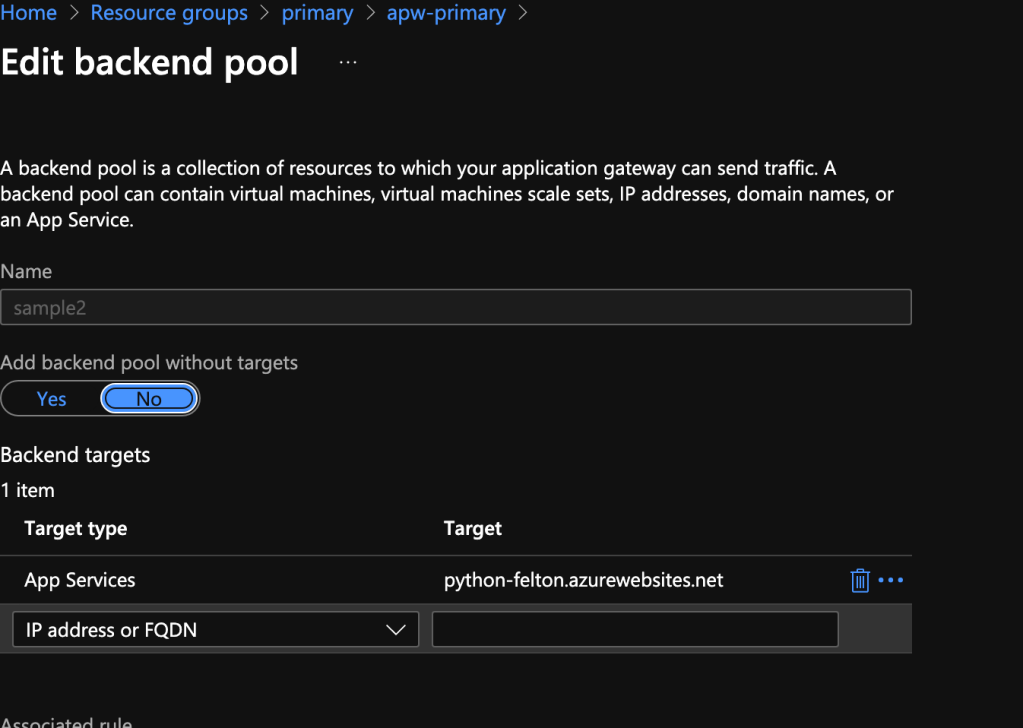
At this point I had all the guts of my solution and it was time to configure traffic to flow the way I wanted it to flow. Before I could begin work in Azure I needed to do the work outside of Azure. This involved creating an A record in my DNS hosting provider to point the public DNS name of my web app to the AGW’s (Application Gateway) public IP. This name can be whatever you want as long as you provide a certificate to the AGW such that it will identify itself as that name to the user. The AGW configuration is very straightforward and this tutorial will get you most of the way there. One thing to note is you’ll need to set the backend to point to the name given to the app service. This allows you to take advantage of the certificate Microsoft automatically provisions to the given app service.

App Gateway backend config

Since I wanted to route traffic destined for the web app through the Azure Firewall Premium instance, I needed to ensure the AGW trusted the certificate served up by Azure Firewall. This is done by modifying the HTTP setting used in the AGW rule for the app. Here you can upload the root certificate that issued the Azure Firewall Premium intermediate certificate.

App Gateway HTTP Setting

Now that the AGW is configured, I needed to create a route table for the subnet the AGW has its private IP address in. In this route table I disabled BGP (border gateway protocol) propagation to ensure the default route since this AGW v2 requires a default route pointing directly to the Internet. Now this is where it gets interesting from a routing perspective. Whenever you create a private endpoint for a service, a system route is added to the route table of all the subnets within the private endpoint’s vnet (virtual network) as well as any vnet the private endpoint’s vnet is peered with. If I want traffic from the AGW to route through the Azure Firewall, I need to override that system route with a /32 UDR. As you can imagine, this can become extremely tedious at scale and even risks hitting the max routes per route table depending on the scale we’re talking about. On the positive side, the issues around this are something Microsoft is aware of so hopefully that means this will be addressed at some point. In the meantime you’ll need to use the /32 route in a pattern such as this.

App Gateway route table

Azure Firewall Premium needs to be configured to allow traffic from the AGW to the web app and inspect this traffic. You can check out my last post for instructions on configured Azure Firewall to perform these activities.

Excellent, work is done right? Nope! If we influence routing on one side, we have to ensure the other side routes the same way. Toss a route table on the private endpoint subnet you say? Sorry, that isn’t supported my friend. Instead I needed to enable the Azure Firewall instance to SNAT (source NAT) traffic to the spoke Vnet. This ensures routing is symmetric and will eliminate any potential connection issues by creating only the UDR on the AGW subnet.

Incoming traffic flow

Lastly, I needed to create and apply a route table to the subnet I delegated to App Services for regional Vnet integration. This route table can be very simple and be configured with a single UDR for the default route pointing to the Azure Firewall private IP. This results in the traffic flow below:

Outgoing Internet traffic flow

This one was another fun pattern to solve. I got a chance to mess around more with AGW and also get a pattern I had theorized would work actually working. I find implementing the pretty pictures I draw helps drive home the benefits and considerations of such a pattern. With this pattern specifically, it suffers from similar considerations as the pattern in my last post. These include:

  • Challenges with observability
  • Operational overhead of certificate management
  • Possible latency issues depending on latency requirements and traffic patterns

This pattern tacks on more operational overhead by requiring that /32 route be added to the AGW route table each time a new app service is provisioned with a private endpoint. Observability further suffers when tracing a packet flow end-to-end due to the additional layer of SNAT required via Azure Firewall. One thing to note about this is you may be able to get around the SNAT requirement for web-specific traffic because of the transparent proxy functionality behind Azure Firewall application rules. I want to highlight I have not tested this myself and I typically tend to SNAT for this use case in my lab because many of my customers may use similar patterns but with a 3rd party firewall.

So there you go folks, another pattern to add to your inventory. Hopefully we’ll see the /32 issue issue private endpoints resolved sometime in the near future. Have a great weekend!

Experimenting with Azure Arc

Experimenting with Azure Arc

Hello fellow geeks! Life got busy this year and I haven’t had much time to post. I’ve been been working on some fun side projects including an enterprise-like environment for Azure, some security control mappings, and some reusable artifacts to simplify customer journeys into Azure. Outside of those efforts, I’ve spent some time addressing technical skill gaps, one of which was Azure Arc which is the topic of this post today.

Azure Arc is Microsoft’s attempt to extend the Azure management plane and Azure capabilities to resources running on-premises and other clouds. As the date of this blog these resources include Windows and Linux machines and Kubernetes clusters running on-premises or in another cloud like AWS (Amazon Web Services). Integrating these resources with Azure Arc projects them into the Azure management plane making them resources of Azure.

Azure resources

Once the resources are projected into Azure many capabilities of the platform can be used to assist with managing the resources. Examples include installing VM (virtual machine) extensions Microsoft Monitoring Agent extension to deliver logs and metrics to Azure Monitor, tracking changes and the software inventory of a machine using Azure Automation, or even auditing a machine’s compliance to a specific set of controls using Azure Policy. On the Kubernetes side you can monitor your on-premises clusters using Azure Container Insights or even deploy an App Service on your on-premises cluster. These capabilities continue to grow so check the official documentation for up to date information.

One of the interesting capabilities of Azure Arc that captured my eye was the ability to use a system-assigned management identity. I’ve written in the past about managed identities so I’ll stick to covering the very basics of them today. A managed identity is simply some Microsoft-managed automation on top of an Azure AD service principal, which is best explained as a security principal used for non-humans. One of the primary benefits managed identities provider over traditional service principals is automatic credential rotation. If you come from the AWS world, managed identities are similar to AWS IAM roles.

Those of you that manage service principals of scale are surely familiar with the pain of having to work with application owners to rotate the credentials of service principals in use within corporate applications. Beyond the operational overhead, the security risk exists for an attacker to obtain the service principal credentials and use them outside of Azure. Since service principals are not yet subject to Azure AD Conditional access, rotation of credentials becomes a critical control to have in place. Both this operational overhead and security risk make the automated rotation of credentials capability of managed identities a must have.

Managed identities are normally only available for use by resources running in Azure like Azure VMs, App Service instances, and the like. In the past, if you were coming from outside of Azure such as on-premises or another cloud like AWS, you’d be forced to use a service principal and struggle with the challenges I’ve outlined above. Azure Arc introduces the ability to leverage managed identities from outside of Azure.

This made me very curious as to how this was being accomplished for a machine running outside of Azure. The official documentation goes into some detail. The documentation explains a few key items:

  • A system-assigned managed identity is provisioned for the Arc-enabled server when the server is onboarded to Arc
  • The Azure Instance Metadata Service (IDMS) is configured with the managed identity’s service principal client id and certificate
  • Code running on the machine can request an access token from the IDMS
  • The IDMS challenges the application code to prove it is privileged enough to obtain the access token by requiring it provide a secret to attest that it is highly privileged

This information left me with a few questions:

  1. What exactly is the challenge it’s hitting the application with?
  2. Since the service principal is using a certificate-based credential, the private key has to be stored on the machine. If so where and how easy would it be for an attacker to steal it?
  3. How easy would it be to steal the identity of the Azure Arc machine in order to impersonate it on another machine?

To answer these questions I decided to deploy Azure Arc to a number of Windows and Linux machines I have running on my home instance of Hyper-V. That would give me god access to each machine and the ability to deploy whatever toolset I wanted to take a peek behind the curtains. Using the service-principal onboarding process I deployed Azure Arc to a number of Windows and Linux machines running in my home lab. Since I’m stronger in Windows, I decided I’d try to extract the service principal credentials from a Windows machine and see if I could use them on Azure Arc-enabled Linux machine.

The technical overview documentation covers how Windows and Linux machines connect into Azure Arc and communicate. There are three processes that run to support Arc connectivity which include the Azure Hybrid Instance Metadata Service (HIMDS), Guest Configuration Arc Service, and Guest Configuration Extension Service. The service I was most interested in was the HIDMS service which is in charge of authenticating and obtaining access tokens from Azure.

To better understand the service, I first referenced the service in the Services MMC (Microsoft Management Console). This gave me the path to the executable. Poking around the source directory showed some dsc logs and the location of the processes involved with Azure Arc but nothing too interesting.

HIMDS Service

My next stop was the configuration information. As documented in the technical overview documentation, the configuration data is stored in a json file in the %ProgramData%\AzureConnectedMachineAgent\Config directory. The key pieces of information we can extract from this file are the tenant id, subscription id, certificate thumbprint the service principal is using and most importantly the client id. That’s a start!

{"subscriptionId":"XXXXXXXX-XXXX-XXXX-XXXX-XXXXXXXXXXXX","resourceGroup":"rg-onpremlab","resourceName":"SERVERWSQL01","tenantId":"XXXXXXXX-XXXX-XXXX-XXXX-XXXXXXXXXXXX","location":"eastus2","vmId":"XXXXXXXX-XXXX-XXXX-XXXX-XXXXXXXXXXXX","vmUuid":"XXXXXXXX-XXXX-XXXX-XXXX-XXXXXXXXXX","certificateThumbprint":"be90bae2484ff6d495XXXXXXXXXXXXX","clientId":"XXXXXXXXX-XXXX-XXXX-XXXX-XXXXXXXXXXXX","cloud":"AzureCloud","privateLinkScope":"","namespace":"","correlationId":"XXXXXX-XXXX-XXXX-XXXX-XXXXXXXXXXX"}

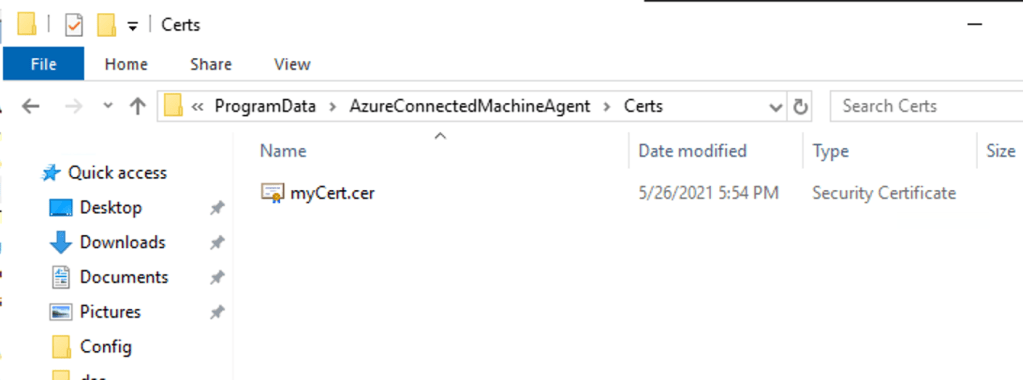
I then wondered what else might be stored through this directory hierarchy. Popping up a directory, I came saw the Certs subdirectory. Could it really be this easy? Would this directory contain the private-key certificate? Navigating into the directory does indeed show a certificate file. However, attempting to open the certificate up using the Crypto Shell Extensions resulted in an error stating it’s not a valid certificate. No big deal, maybe the extension is wrong right? I then took the file and ran it through a few Python scripts I have to enumerate certificate data, but unfortunately no certificate format I tried worked. After a quick discussion with my good friend Armen Kaleshian, we both came to the conclusion that the certificate is more than likely wrapped with some type of symmetric encryption.

Service Principal certificate

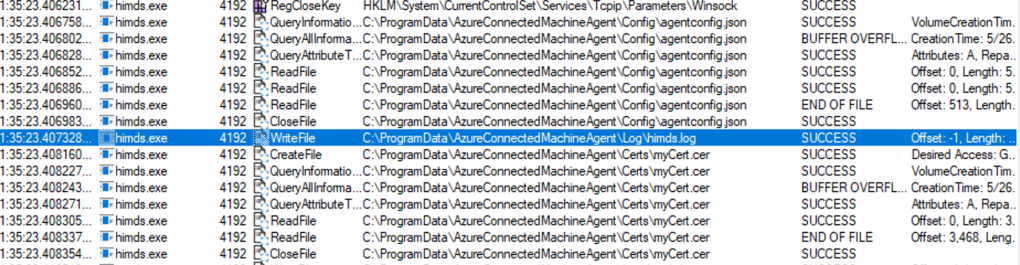
At this point I decided to take a step back and observe the HIMDS process to ensure this file is being used by the process, and if so, whether I could figure where the key that was used to wrap the certificate was stored. For that I used Process Monitor (the old tools are still the best!). After restarting the HIMDS service and sifting through the capture information, I found the mentions of the process reading the certificate file after reading from the agent config. In the past I’ve seen applications store the symmetric key used to wrap information like this in the registry, but I could not find any obvious calls to the registry indicating this. After a further conversation with Armen, we theorized the symmetric key might be stored in the himds.exe executable itself which would mean every Azure Arc instance would be using the same key to wrap the certificate. This would mean all one would have to do is move the certificate and configuration file to a new machine and one would be able to use the credentials to impersonate the machine’s managed identity (more on that later).

Procmon capture of himds.exe

At this point I was fairly certain I had answered question number 2, but I wanted to explore question number 3 a bit more. For this I leveraged the PowerShell code sample provided in the documentation. Breaking down the code, I observed a web request is made to the IDMS endpoint. From the response from the IDMS endpoint, a returned header is extracted which contains the directory name a file is stored in. The contents of this file are extracted and then included as an authorization header using basic authentication. The resulting response from the IDMS contains the access token used to communicate with the relevant Microsoft cloud API.

$apiVersion = "2020-06-01"
$resource = "https://management.azure.com/"
$endpoint = "{0}?resource={1}&api-version={2}" -f $env:IDENTITY_ENDPOINT,$resource,$apiVersion
$secretFile = ""
try
{
    Invoke-WebRequest -Method GET -Uri $endpoint -Headers @{Metadata='True'} -UseBasicParsing
}
catch
{
    $wwwAuthHeader = $_.Exception.Response.Headers["WWW-Authenticate"]
    if ($wwwAuthHeader -match "Basic realm=.+")
    {
        $secretFile = ($wwwAuthHeader -split "Basic realm=")[1]
    }
}
Write-Host "Secret file path: " $secretFile`n
$secret = cat -Raw $secretFile
$response = Invoke-WebRequest -Method GET -Uri $endpoint -Headers @{Metadata='True'; Authorization="Basic $secret"} -UseBasicParsing
if ($response)
{
    $token = (ConvertFrom-Json -InputObject $response.Content).access_token
    Write-Host "Access token: " $token
}

By default the security principal doesn’t have any permissions in the ARM (Azure Resource Manager) API, so I granted it reader rights on the resource group and wrote some simple Python code to query for a list of resources in the in a resource group. I was able to successfully obtain the access token and got back a list of resources.

# Import standard libraries
import os
import sys
import logging
import requests
import json

# Create a logging mechanism
def enable_logging():
    stdout_handler = logging.StreamHandler(sys.stdout)
    handlers = [stdout_handler]
    logging.basicConfig(
        level=logging.INFO,
        format='%(asctime)s - %(name)s - %(levelname)s - %(message)s',
        handlers = handlers
    )

def get_access_token(resource, api_version="2020-06-01"):
    logging.debug('Attempting to obtain access token...')
    try:
        response = requests.get(
            url = os.getenv('IDENTITY_ENDPOINT'),
            params = {
                'api-version': api_version,
                'resource': resource
            },
            headers = {
                'Metadata': 'True'
            }
        )
        
        secret_file = response.headers['Www-Authenticate'].split('Basic realm=')[1]
        with open(secret_file, 'r') as file:
            key = file.read()
        
        response = requests.get(
            url = os.getenv('IDENTITY_ENDPOINT'),
            params = {
                'api-version': api_version,
                'resource': resource
            },
            headers = {
                'Metadata': 'True',
                'Authorization': f"Basic {key}"
            }
        )
        logging.debug("Access token obtain successfully")
        return json.loads(response.text)['access_token']

    except Exception:
        logging.error('Unable to obtain access token. Error was: ', exc_info=True)

def main():
    try:

        # Setup variables
        API_VERSION = '2021-04-01'

        # Enable logging
        enable_logging()

        # Obtain a credential from the system-assigned managed identity
        token = get_access_token(resource='https://management.azure.com/')

        # Setup query parameters
        params = {
            'api-version': API_VERSION
        }

        # Setup header
        header = {
            'Content-Type': 'application/json',
            'Authorization': f"Bearer {token}"
        }

        # Make call to ARM API
        response = requests.get(url='https://management.azure.com/subscriptions/XXXXXXXX-XXXX-XXXX-XXXX-XXXXXXXXXXXX/resourceGroups/rg-onpremlab/resources',headers=header, params=params)
        print(response.text)

    except Exception:
        logging.error('Execution error: ', exc_info=True)

if __name__ == "__main__":
    main()

This indicated to me that the additional challenge introduced with the IDMS running on Arc requires the process to obtain a secret generated by the IDMS that is placed in the %PROGRAMDATA\AzureConnectedMachineAgent\Tokens directory. This directory is locked down for access to the security principal the himds service runs as, SYSTEM, the Administrators group, and most importantly the Hybrid agent extension applications group. After the secret is obtain from the file in this directory, it is used as a secret to perform basic authentication with the IDMS service to obtain the access token. As the official documentation states, this is the group you would need to add the security principal running any processes you wanted to use the local IDMS. Question 1 had now been answered.

Tokens directory permissions

That left me with question 3. Based on what I learned so far, an attacker who compromised the machine or a security principal with sufficient permissions on the machine to access the %PROGRAMDATA%\AzureConnectedMachineAgent\ subdirectories could obtain the configuration of the agent and the encrypted certificate. Compromise could also come in the form of compromise of a process that was running as a security principal which was a member of the Hybrid agent extension applications group. Even with the data collected from the agentconfig.json file and the certificate file, the attacker would still be short of the symmetric key used to unwrap the certificate to make it available for use.

Here I took a gamble and tested the theory Armen and I had that the symmetric key was stored in the himds executable. I copied the agentconfig.json file and certificate file and move them to another machine. To eliminate the possibility of the configuration and credentials file being specific to the Windows operating system, I spun up an Ubuntu VM in my Hyper-V cluster. I then installed and configured the agent with a completely separate Azure AD tenant.

Once that was complete, I moved the agentconfig.json and myCert file from the existing Windows machine to the new Ubuntu VM and replaced the existing files. Re-running the same Python script (substituting out the variables for the actual URIs listed in the technical overview) I received back the same listing of resources from the resource group. This proved that if you’re able to get access to both the agentconfig.json and myCert files on an Azure Arc-enabled machine, you can move them to any other machine (regardless of operating system) and re-use them to impersonate source machine and exercise any permissions its been granted access.

Let’s sum up the findings:

  1. The agentconfig.json file contains sensitive information including the tenant id, subscription id, and client id of the service principal associated with the Azure Arc-enabled machine.
  2. The credential for the service principal is stored as a certificate file in the myCert file in the %PROGRAMDATA%\AzureConnectedMachineAgent\certs directory. This file is probably wrapped with some type of symmetric encryption.
  3. The challenge the documentation speaks to involves the creation of a password by the HIMDS process which is then stored in the %PROGRAMDATA%\AzureConnectedMachineAgent\tokens directory. This directory is locked down to privileged users. The password contained in the file created by the HIMDS process is then passed back in a request to the IDMS service running on the machine using the basic HTTP authentication where it is validated and an access token is returned. This is used a method to prove the process requesting the token is privileged.
  4. The agentconfig.json and myCert file can be moved from one Arc-enabled machine to another to be used to impersonate the source machine. This provided further evidence that the symmetric key used to encrypt the certificate file (myCert) is hardcoded into the executable.

It should come as no surprise to you follow old folks that the resulting findings stress the importance traditional security controls. A few recommendations I’d make are as follows:

  • Least Privilege
    • If you’re going to use the managed identity available to an Arc-enabled server for applications running on that machine, ensure you’re granting that managed identity only the permissions it requires and nothing beyond it.
    • Limit the human and non-human actors who have administrator privileges on Azure Arc-enabled machines.
    • Tightly control which security principals are members of the Hybrid agent extension applications group.
  • Logging and monitor
    • Log managed identity sign-ins and monitor for suspicious activity. Until Conditional Access is extended to service principals, it can’t be leveraged to further restrict where these security principals can be used from.
    • Log and monitor the security events on the Azure Arc-enabled servers
  • Patching and Updating
  • Identity and Access Management
    • Create a process to review the use case and security risks of applications that want to leverage this functionality.
    • Perform access reviews to validate any additional permissions granted to these managed identities are still warranted, and if not, remove them.

Nothing in the above is new or fancy but all things you should be doing today. The biggest take away you need here is by extending the Azure management plane you get great new features but you also introduce a potential new risk where a compromised Azure Arc-enabled machine outside of Azure could be used to impact the security of your Azure implementation. If you’re using service principals today (or hell, if you’re simply having users access Azure from their desktops or laptops) you already have this risk, but it’s always worthwhile understanding the different vectors available to attackers.

At the end of the day I love this feature. It is leagues better than how most organizations are handling service principal usage outside of Azure today where the credentials are often hardcoded into code into code, dumped into a file in an unsecured directory, or never rotated for years. There are tradeoffs, but as I said earlier, none of the mitigations are things you shouldn’t already be doing today. Outside of this capability, there are a lot of benefits to Azure Arc and I’ll be very interested to see how Microsoft grows this offering and extends it beyond.

Thanks!