Deploying Resources Across Multiple Azure tenants

Hello fellow geeks! Today I’m going to take a break from my AI Foundry series and save your future self some time by walking you through a process I had to piece together from disparate links, outdated documentation, and experimentation. Despite what you hear, I’m a nice guy like that!

The Problem

Recently, I’ve been experimenting with AVNM (Azure Virtual Network Manager) IPAM (IP address management) solution which is currently in public preview. In the future I’ll do a blog series on the product, but today I’m going to focus on some of the processes I went through to get a POC (proof-of-concept) working with this feature across two tenants. The scenario was a management and managed tenant concept where the management tenant is the authority for the pools of IP addresses the managed tenant can draw upon for the virtual networks it creates.

Let’s first level set on terminology. When I say Azure tenant, what I’m really talking about is the Entra ID tenant the Microsoft Azure subscriptions are associated with. Every subscription in Azure can be associated with only one Entra ID tenant. Entra ID provides identity and authentication services to associated Azure subscriptions. Note that I excluded authorization, because Azure has its own authorization engine in Azure RBAC (role-based access control).

Relationship between Entra ID tenant and Azure resources

Without deep diving into AVNM, its IPAM feature uses the concepts of “pools” which are collections of IP CIDR blocks. Pools can have a parent and child relationship where one large pool can be carved into smaller pools. Virtual networks in the same regions as the pool can be associated with these pools (either before or after creation of the virtual network) to draw down upon the CIDR block associated with the range. You also have the option of creating an object called a Static CIDR which can be used to represent the consumption of IP space on-premises or another cloud. For virtual networks, as resources are provisioned into the virtual networks IPAM will report how many of the allocated IP addresses in a specific pool are being used. This allows you to track how much IP space you’ve consumed across your Azure estate.

AVNM IPAM Resources

My primary goal in this scenario was to create a virtual network in TenantB that would draw down on an AVNM address pool in TenantA. This way I could emulate a parent company managing the IP allocation and usage across its many child companies which could be spread across multiple Azure tenants. To this I needed to

  1. Create an AVNM instance in TenantA
  2. Setup the cross-tenant AVNM feature in both tenants.
  3. Create a multi-tenant service principal in TenantB.
  4. Create a stub service principal in TenantA representing the service principal in TenantB.
  5. Grant the stub service principal the IPAM Pool User Azure RBAC role.
  6. Create a new virtual network in TenantB and reference the IPAM pool in TenantA.

My architecture would similar to image below.

Multi-Tenant AVNM IPAM Architecture

With all that said, I’m now going to get into the purpose of this post which is focusing steps 3, 4, and 6.

Multi-Tenant Service Principals

Service principals are objects in Entra ID used to represent non-human identities. They are similar to an AWS IAM user but cannot be used for interactive login. The whole purpose is non-interactive login by a non-human. Yes, even the Azure Managed Identity you’ve been using is a service principal under the hood.

Unlike Entra ID users, service principals can’t be added to another tenant through the Entra B2B feature. To make a service principal available across multiple tenants you need to create what is referred to as a multi-tenant service principal. A multi-tenant service principal exist has an authoritative tenant (I’ll refer to this as the trusted tenant) where the service principal exists as an object with a credential. The service principal has an attribute named appid which is a unique GUID representing the app across all of Entra. Other tenants (I’ll refer to these as trusting tenants) can then create a stub service principal in their tenant by specifying this appid at creation. Entra ID will represent this stub service principal in the trusted tenant as an Enterprise Application within Entra.

Multi-Tenant Service Principal in Trusted Tenant

For my use case I wanted to have my multi-tenant service principal stored authoritatively TenantB (the managed tenant) because that is where I would be deploying my virtual network via Terraform. I had an existing service principal I was already using so I ran the command below to update the existing service principal to support multi-tenancy. The signInAudience attribute is what dictates whether a service principal is single-tenant (AzureADMyOrg) or multi-tenant (AzureADMultipleOrgs).

az login --tenant <TENANTB_ID>
az ad app update --id "d34d51b2-34b4-45d9-b6a8-XXXXXXXXXXXX" --set signInAudience=AzureADMultipleOrgs

Once my service principal was updated to a multi-tenant service principal I next had to provision it into TenantA (management tenant) using the command below.

az login --tenant <TENANTA_ID>
az ad sp create --id "d34d51b2-34b4-45d9-b6a8-XXXXXXXXXXXX"

The id parameter in each command is the appId property of the service principal. By creating a new service principal in TenantA with the same appId I am creating the stub service principal for my service principal in TenantB.

Many of the guides you’ll find online will tell you that you need to grant Admin Consent. I did not find this necessary. I’m fairly certain it’s not necessary because the service principal does not need any tenant-wide permissions and won’t be acting on behalf of any user. Instead, it will exercise its direct permissions against the ARM API (Azure Resource Manager) based on the Azure RBAC role assignments created for it.

Once these commands were run, the service principal appeared as an Enterprise Application in TenantA. From there I was able to log into TenantA and create an RBAC role assignment associating the IPAM Pool user role to the service principal.

Creating The New VNet in TenantB with Terraform… and Failing

At this point I was ready to create the new virtual network in TenantB with an address space allocated from an IPAM pool in TenantA. Like any sane human being writing Terraform code, my first stop was to the reference document for the AzureRm provider. Sadly my spirits were quickly crushed (as often happens with that provider) the provider module (4.21.1) for virtual networks does not yet support the ipamPoolPrefixAllocations property. I chatted with the product group and support for it will be coming soon.

When the AzureRm provider fails (as it feels like it often does with any new feature), my fallback was to AzApi provider. Given that the AzApi is a very light overlay on top of the ARM REST API, I was confident I’d be able to use it with the proper ARM REST API version to create my virtual network. I wrote my code and ran my terraform apply only to run into an error.

Forbidden({"error":{"code":"LinkedAuthorizationFailed","message":"The client has permission to perform action 'Microsoft.Network/networkManagers/ipamPools/associateResourcesToPool/action' on scope '/subscriptions/97515654-3331-440d-8cdf-XXXXXXXXXXXX/resourceGroups/rg-demo-avnm/providers/Microsoft.Network/virtualNetworks/vnettesting', however the current tenant '6c80de31-d5e4-4029-93e4-XXXXXXXXXXXX' is not authorized to access linked subscription '11487ac1-b0f2-4b3a-84fa-XXXXXXXXXXXX'."}})

When performing cross-tenant activities via the ARM API, the platform needs to authenticate the security principal to both Entra tenants. From a raw REST API call this can be accomplished by adding the x-ms-authorization-auxiliary header to the headers in the API call. In this header you include a bearer token for the second Entra ID tenant that you need to authenticate to.

Both the AzureRm and AzApi providers support this feature through the auxiliary_tenant_ids property of the provider. Passing that property will cause REST calls to be made to the Entra ID login points for each tenant to obtain an access token. The tenant specified in the auxiliary_tenant_ids has its bearer token passed in the API calls in the x-ms-authorization-auxiliary header. Well, that’s the way it’s supposed to work. However, after some Fiddler captured I noticed it was not happening with AzApi v2.1.0 and 2.2.0. After some Googling I turned up this Github repository issue where someone was reporting this as far back as February 2024. It was supposed resolved in v1.13.1, but I noticed a person posting just a few weeks ago that it was still broken. My testing also seemed to indicate it is still busted.

What to do now? My next thought was to use the AzureRm provider and pass an ARM template using the azurerm_resource_group_deployment module. I dug deep into the recesses of my brain to surface my ARM template skills and I whipped up a template. I typed in terraform apply and crossed my fingers. My Fiddler capture showed both access tokens being retrieved (YAY!) and being passed in the underlining API call, but sadly I was foiled again. I had forgotten that ARM templates to not support referencing resources outside the Entra ID tenant the deployment is being pushed to. Foiled again.

My only avenue left was a REST API call. For that I used the az rest command (greatest thing since sliced bread to hit ARM endpoints). Unlike PowerShell, the az CLI does not support any special option for auxiliary tenants. Instead, I need to run az login to each tenant and store the second tenant’s bearer token in a variable.

az login --service-principal --username "d34d51b2-34b4-45d9-b6a8-XXXXXXXXXXXX" --password "CLIENT_SECRET" --tenant "<TENANTB_ID>"

az login --service-principal --username "d34d51b2-34b4-45d9-b6a8-XXXXXXXXXXXX" --password "CLIENT_SECRET" --tenant "<TENANTA_ID>"

auxiliaryToken=$(az account get-access-token \
--resource=https://management.azure.com/ \
--tenant "<TENANTA_ID>" \
--query accessToken -o tsv)

Once I had my bearer tokens, the next step was to pass my REST API call.

az rest --method put \
--uri "https://management.azure.com/subscriptions/97515654-3331-440d-8cdf-XXXXXXXXXXXX/resourceGroups/rg-demo-avnm/providers/Microsoft.Network/virtualNetworks/vnettesting?api-version=2022-07-01" \
--headers "x-ms-authorization-auxiliary=Bearer ${auxiliaryToken}" \
--body '{
"location": "centralus",
"properties": {
"addressSpace": {
"ipamPoolPrefixAllocations": [
{
"numberOfIpAddresses": "100",
"pool": {
"id": "/subscriptions/11487ac1-b0f2-4b3a-84fa-XXXXXXXXXXXX/resourceGroups/rg-avnm-test/providers/Microsoft.Network/networkManagers/test/ipamPools/main"
}
}
]
}
}
}'

I received a 200 status code which meant my virtual network was created successfully. Sure enough the new virtual network in TenantB and in TenantA I saw the virtual network associated to the IPAM pool.

Summing It Up

Hopefully the content above saves someone from wasting far too much time trying to get cross tenant stuff to work in a non-interactive manner. While my end solution isn’t what I’d prefer to do, it was my only option due to the issues with the Terraform providers. Hopefully, the issue with the Az Api provider is remediated soon. For AVNM IPAM specifically, AzureRm providers will be here soon so the usage of Az Api will likely not be necessary.

What I hope you took out of this is a better understanding of how cross tenant actions like this work under the hood from an identity, authentication, and authorization perspective. You should also have a better understanding of what is happening (or not happening) under the hood of those Terraform providers we hold so dear.

TLDR;

When performing cross tenant deployments here is your general sequence of events:

  1. Create a multi-tenant service principal in Tenant A.
  2. Create a stub service principal in Tenant B.
  3. Grant the stub service principal in Tenant B the appropriate Azure RBAC permissions.
  4. Obtain an access token from both Tenant A and Tenant B.
  5. Package one of the access tokens in the x-ms-authorization-auxiliary header in your request and make your request. You can use the az rest command like I did above or use another tool. Key thing is to make sure you pass it in addition to the standard Authorization header.
  6. ???
  7. Profit!

Thanks for reading!

AI Foundry – Identity, Authentication and Authorization

This is a part of my series on AI Foundry:

Updates:

  • 3/17/2025 – Updated diagrams to include new identities and RBAC roles that are recommended as a minimum

Yes, I’m going to re-use the outline from my Azure OpenAI series. You wanna fight about it? This means we’re going to now talk about one of the most important (as per usual) and complicated (oh so complicated) topic in AI Foundry: identity, authentication, and authorization. If you haven’t read my prior two posts, you should take a few minutes and read through them. They’ll give you the baseline you’ll need to get the most out of this post. So put on your coffee, break out the metal clips to keep your eyes open Clockwork Orange-style, and prepare for a dip into the many ways identity, authN, and authZ are handled within the service.

As I covered in my first post Foundry is made up of a ton of different services. Each of these services plays a part in features within Foundry, some may support multiple forms of authentication, and most will be accessed by the many types of identities used within the product. Understanding how each identity is used will be critical in getting authorization right. Missing Azure RBAC role assignments is the number one most common misconfiguration (right above networking, which is also complicated as we’ll see in a future post).

Azure AI Foundry Components

Let’s start first with identity. There will generally be four types of identities used in AI Foundry. These identities will be a combination of human identities and non-human identities. Your humans will be your AI Engineers, developers, and central IT and will use their Entra ID user identities. Your non-humans will include the AI Foundry hub, project, and compute you provision for different purposes. In general, identities are used in the following way (this is not inclusive of all things, just the ones I’ve noticed):

  • Humans
    • Entra ID Users
      • Actions within Azure Portal
      • Actions within AI Foundry Studio
        • Running a prompt flow from the GUI
        • Using the Chat Playground to send prompts to an LLM
        • Running the Chat-With-Your-Data workflow within the Chat Playground
        • Creating a new project within a hub
      • Actions using Azure CLI such as sending an inference to a managed online endpoint that supports Entra ID authentication
  • Non-Humans
    • AI Foundry Hub Managed Identity
      • Accessing the Azure Key Vault associated with the Foundry instance to create secrets or pull secrets when AI Foundry connections are created using credentials versus Entra ID
      • Modify properties of the default Azure Storage Account such as setting CORS policies
      • Creating managed private endpoints for hub resources if a managed virtual network is used
    • AI Foundry Project Managed Identity
      • Accessing the Azure Key Vault associated with the Foundry instance to create secrets or pull secrets when AI Foundry connections are created using credentials versus Entra ID
      • Creating blob containers for project where project artifacts such as logs and metrics are stored
      • Creating file share for project where project artifacts such as user-created Prompt Flow files are stored
    • Compute
      • Pulling container image from Azure Container Registry when deploying prompt flows that require custom environments
      • Accessing default storage account project blob container to pull data needed to boot
      • Much much more in this category. Really depends on what you’re doing

Alright, so you understand the identities that will be used and you have a general idea of how they’ll be used to perform different tasks within the Foundry ecosystem. Let’s now talk authentication.

The many identities of AI Foundry

Authentication in Foundry isn’t too complicated (in comparison to identity and authorization). Authenticating to the Azure Portal and the Foundry Studio is always going to be Entra ID-based authentication. Authentication to other Azure resources from the Foundry is where it can get interesting. As I covered in my prior post, Foundry will typically support two methods of authentication: Entra ID and API key based (or credentials as you’ll see it often referred to as in Foundry). If at all possible, you’ll want to lean into Entra ID-based authentication whenever you access a resource from Foundry. As we’ll see in the next section around authorization, this will have benefits. Besides authorization, you’ll also get auditability because the logs will show the actual security principal that accessed the resource.

If you opt to use credential-based authentication for your connections to Azure resources, you’ll lose out in a few different areas. When credential-based authentication is used, users will access connected resources within Foundry using the keys stored in the Foundry connection object. This means the user assumes whatever permissions the key has (which is typically all data-plane permissions but could be more restrictive in instances like a SAS token). Besides the authorization challenges, you’ll also lose out on traceability. AI Foundry (and the underlining Azure Machine Learning) has some authorization (via Azure RBAC roles) that is used to control access to connections, but very little in the way auditing who exercised what connection when. For these reasons, you should use Entra ID where possible.

Ready for authorization? Nah, not yet. Before we get into authorization, it’s important to understand that these identities can be used in generally two ways: direct or indirect (on-behalf-of). For example, let’s say you run a Prompt Flow from AI Foundry interface, while the code runs on a serverless compute provisioned in a Microsoft managed network (more on that in a future post), the identity context it uses to access downstream resources is actually yours. Now if you deploy that same prompt to a managed online-endpoint, the code will run on that endpoint and use the managed identity assigned to the compute instance. Not so simple is it?

So how do you know which identity will be used? Observe my general guidance from up above. If you’re running things from the GUI, likely your identity, if you’re deploying stuff to compute likely the identity associated with the compute. The are exceptions to the rule. For example, when you attempt to upload data for fine-tuning or using the on-your-own-data feature in the Chat Playground, and your default storage account is behind a private endpoint your identity will be used to access the data, but the managed identity associated with the project is used to access the private endpoint resource. Why it needs access to the Private Endpoint? I got no idea, it just does. If you don’t, good luck to you poor soul because you’re going to have hell of time troubleshooting it.

Another interesting deviation is when using the Chat Playground Chat With Your Data feature. If you opt to add your data and build the index directly within AI Foundry, there will be a mixed usage of the user identity, AI Search managed identity (which communicates with the embedding models deployed in the AI Services or Azure OpenAI instance to create the vector representations of the chunks in the index), and AI Services or Azure OpenAI managed identity (creates index and data sources in AI Search). It can get very complex.

The image below represents most of the flows you’ll come across.

The many AI Foundry authentication flows and identity patterns

Okay, now authorization? Yes, authorization. I’m not one for bullshitting, so I’ll just tell you up front authorization in Foundry can be hard. It gets even harder when you lock down networking because often the error messages you will receive are the same for blocked traffic and failed authorization. The complexities of authorization is exactly why I spent so much time explaining identity and authentication to you. I wish I could tell you every permission in every scenario, but it would take many, many, posts to do that. Instead, I’d advise you to do (sometimes I fail to do this) which is RTFM (go ahead and Google that). This particular product group has made strong efforts to document required permissions, so your first stop should always be the Foundry public documentation. In some instances, you will also need to access the Azure Machine Learning documentation (again, this is built on top of AML) because there are sometimes assumptions that you’ll do just that because you should know this is a feature its inheriting from AML (yeah, not fair but it’s reality).

In general, at an absolute minimum, the permissions assigned to the identities below will get you started as of the date of this post (updated 3/17/2025).

As I covered in my prior posts, the AI Foundry Hub can use either a system-assigned or user-assigned managed identity. You won’t hear me say this often, but just use the system-assigned managed identity if you can for the hub. The required permissions will be automatically assigned and it will be one less thing for you to worry about. Using the permissions listed above should work for a user-assigned managed identity as well (this is on my backburner to re-validate).

A project will always use a system assigned managed identity. The only permission listed above that you’ll need to manually grant is Reader over the Private Endpoint for the default storage account. This is only required if you’re using private endpoint for your default storage account. There may be additional permissions required by the project depending on the activities you are performing and data you are accessing.

On the user side the permissions above will put you in a good place for your typical developer or AI engineer to use most of the features within Foundry. If you’re interacting with other resources (such as an AI Search Index when using the on-your-own-data feature) you’ll need to ensure the user is granted appropriate permissions to those resources as well (typically Search Service Contributor – management plane to list indexes and create indexes and Search Index Data Contributor – data plane create and view records within an index. If your user is fine-tuning a model that is deployed within the Azure OpenAI or AI Service instance, they may additionally need the Azure OpenAI Service Contributor role (to upload the file via Foundry for fine-tuning). Yeah, lots of scenarios and lots of varying permissions for the user, but that covers the most common ones I’ve run into.

Lastly, we have the compute identities. There is no standard here. If you’ve deployed a prompt flow to a managed identity, the compute will need the permissions to connect to the resources behind the connections (again assuming Entra-ID is configured for the connection, if using credential Azure Machine Learning Workspace Secrets Reader on the project is likely sufficient). Using a prompt flow that requires a custom environment may require an image be pushed to the Azure Container Registry which the compute will pull so it will need the Acr Pull RBAC role assignment on the registry.

Complicated right? What happens when stuff doesn’t work? Well, in that scenario you need to look at the logs (both Azure Activity Log and diagnostic logging for the relevant service such as blob, Search, OpenAI and the like). That will tell you what the user is failing to do (again, only if you’re using Entra ID for your connections) and help you figure out what needs to be added from a permissions perspective. If you’re using credentials for your connections, the most common issue with them is with the default storage account where the storage account has had the storage access keys disabled.

Here are the key things I want you to take away from this:

  1. Know the identity being used. If you don’t know which identity is being used, you’ll never get authorization right. Use the of the downstream service logs if you’re unsure. Remember, management plane stuff in Azure Activity Log and data plane stuff in diagnostic logs.
  2. Use Entra ID authentication where possible. Yeah it will make your Azure RBAC a bit more challenging, but you can scope the access AND understand who the hell is doing what.
  3. RTFM where possible. Most of this is buried in the public documentation (sometimes you need to put on your Indiana Jones hat). Remember that if you don’t find it in Foundry documentation, look to Azure Machine Learning.
  4. Use the above information as general guide to get the basic environment setup. You’ll build from that basic foundation.

Alrighty folks, your eyes are likely heavy. I hope this helps a few souls out there who are struggling with getting this product up and running. If you know me, you know I’m no fan boy, but this particular product is pretty damn awesome to get us non-devs immediately getting value from generative AI. It may take some effort to get this product running, but it’s worth it!

Thanks and see you next post!

Authentication in Azure OpenAI Service

This is part of my series on the Azure OpenAI Service:

  1. Azure OpenAI Service – Infra and Security Stuff
  2. Azure OpenAI Service – Authentication
  3. Azure OpenAI Service – Authorization
  4. Azure OpenAI Service – Logging
  5. Azure OpenAI Service – Azure API Management and Entra ID
  6. Azure OpenAI Service – Granular Chargebacks
  7. Azure OpenAI Service – Load Balancing
  8. Azure OpenAI Service – Blocking API Key Access
  9. Azure OpenAI Service – Securing Azure OpenAI Studio
  10. Azure OpenAI Service – Challenge of Logging Streaming ChatCompletions
  11. Azure OpenAI Service – How To Get Insights By Collecting Logging Data
  12. Azure OpenAI Service – How To Handle Rate Limiting
  13. Azure OpenAI Service – Tracking Token Usage with APIM
  14. Azure AI Studio – Chat Playground and APIM
  15. Azure OpenAI Service – Streaming ChatCompletions and Token Consumption Tracking
  16. Azure OpenAI Service – Load Testing

Updates:

  • 1/18/2024 to reference considerable library changes with new API version. See below for details
  • 4/3/2023 with simpler way to authenticate with Azure AD via Python SDK

Hello again!

1/18/2024 Update – Hi folks! There were some considerable changes to the OpenAI Python SDK which offers an even simpler integration with the Azure OpenAI Service. While the code in this post is a bit dated, I feel the thought process is still important so I’m going to preserve it as is! If you’re looking for examples of how to authenticate with the Azure OpenAI Service using the Python SDK with different types of authentication (service principal vs managed identity) or using the REST API, I’ve placed a few examples in this GitHub repository. Hope it helps!

Days and nights have been busy diving deeper into the AI landscape. I’ve been reading a great book by Tom Taulli called Artificial Intelligence Basics: A Non-Technical Introduction. It’s been a huge help in getting down the vocabulary and understanding the background to the technology from the 1950s on. In combination with the book, I’ve been messing around a lot with Azure’s OpenAI Service and looking closely at the infrastructure and security aspects of the service.

In my last post I covered the controls available to customers to secure their specific instance of the service. I noted that authentication to the service could be accomplished using Azure Active Directory (AAD) authentication. In this post I’m going to take a deeper look at that. Be ready to put your geek hat on because this post will be getting down and dirty into the code and HTTP transactions. Let’s get to it!

Before I get into the details of how supports AAD authentication, I want to go over the concepts of management plane and data plane. Think of management plane for administration of the resource and data plane for administration of the data hosted within the resource. Many services in Azure have separate management planes and data planes. One such service is Azure Storage which just so happens to have similarities with authentication to the OpenAI Service.

When a customer creates an Azure Storage Account they do this through interaction with the management plane which is reached through the ARM API hosted behind management.azure.come endpoint. They must authenticate against AAD to get an access token to access the API. Authorization via Azure RBAC then takes place to validate the user, managed identity, or service principal has permissions on the resource. Once the storage account is created, the customer could modify the encryption key from a platform managed key (PMK aka key managed by Microsoft) to a customer managed key (CMK), enable soft delete, or enable network controls such as the storage firewall. These are all operations against the resource.

Once the customer is ready to upload blob data to the storage account, they will do this through a data plane operation. This is done through the Blob Service API. This API is hosted behind the blob.core.windows.net endpoint and operations include creation of a blob or deletion of a blob. To interact with this API the customer has two means of authentication. The first method is the older method of the two and involves the use of static keys called storage account access keys. Every storage account gets two of these keys when a storage account is provisioned. Used directly, these keys grant full access to all operations and all data hosted within the storage account (SAS tokens can be used to limit the operations, time, and scope of access but that won’t be relevant when we talk the OpenAI service). Not ideal right? The second method is the recommended method and that involves AAD authentication. Here the security principal authenticates to AAD, receives an access token, and is then authorized for the operation via Azure RBAC. Remember, these are operations against the data hosted within the resource.

Authentication in Management Plane vs Data Plane in Azure Storage

Now why did I give you a 101 on Azure Storage authentication? Well, because the Azure OpenAI Service works in a very similar way.

Let’s first talk about the management plane of the Azure OpenAI Service. Like Azure Storage (and the rest of Azure’s services) it is administered through the ARM API behind the management.azure.com endpoint. Customers will use the management plane when they want to create an instance of the Azure OpenAI Service, switch it from a PMK to CMK, or setup diagnostic settings to redirect logs (I’ll cover logging in a future post). All of these operations will require authentication to AAD and authorization via Azure RBAC (I’ll cover authorization in a future post).

Simple right? Now let’s move to the complexity of the data plane.

Two API keys are created whenever a customer creates an Azure OpenAI Service instance. These API keys allow the customer full access to all data plane operations. These operations include managing a deployment of a model, managing training data that has been uploaded to the service instance and used to fine tune a model, managing fine tuned models, and listing available models. These operations are performed against the Azure OpenAI Service API which lives behind a unique label with an FQDN of openai.azure.com (such as myservice.openai.azure.com). Pretty much all the stuff you would be doing through the Azure OpenAI Studio. If you opt to use these keys you’ll need to remember control access to these keys via securing management plane authorization aka Azure RBAC.

Azure OpenAI Service API Keys

In the above image I am given the option to regenerate the keys in the case of compromise or to comply with my organization’s key rotation process. Two keys are provided to allow for continued access to the service while other key is being rotated.

Here I have simple bit of code using the OpenAI Python SDK. In the code I provide a prompt to the model and ask it to complete it for me and use one of the API keys to authenticate to it.

import logging
import sys
import os
import openai

def main():
    # Setup logging
    try:
        logging.basicConfig(
            level=logging.ERROR,
            format='%asctime)s - %(name)s - %(levelname)s - %(message)s',
            handlers=[logging.StreamHandler(sys.stdout)]
        )
    except:
        logging.error('Failed to setup logging: ', exc_info=True)

    try:

        # Setup OpenAI Variables
        openai.api_type = "azure"
        openai.api_base = os.getenv('OPENAI_API_BASE')
        openai.api_version = "2022-12-01"
        openai.api_key = os.getenv('OPENAI_API_KEY')

        response = openai.Completion.create(
            engine=os.getenv('DEPLOYMENT_NAME'),
            prompt='Once upon a time'
        )

        print(response.choices[0].text)

    except:
        logging.error('Failed to respond to prompt: ', exc_info=True)


if __name__ == "__main__":
    main()

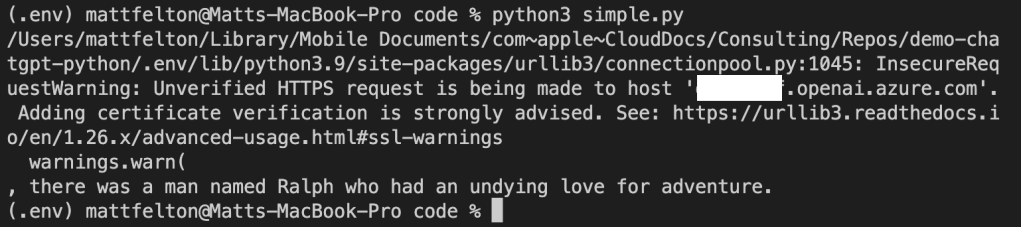
The model gets creative and provides me with the response below.

If you look closely you’ll notice an warning about the security of my session. The reason I’m getting that error is shut off certificate verification in the OpenAI library in order to intercept the calls with Fiddler. Now let me tell you, shutting off certificate verification was a pain in the ass because the developers of the SDK are trying to protect users from the bad guys. Long story short, the Azure Python SDK doesn’t provide an option to turn off certificate checking like say the Azure Python SDK (which you can pass a kwarg of verify=False to turn it off in the request library used underneath). While the developers do provide a property called verify_ssl_certs, it doesn’t actually do anything. Since most Python SDKs use the requests library underneath the hood, I went through the library on my machine and found the api_requestor.py file. Within this file I modified the _make_session function which is creating a requests Sessions object. Here I commented out the developers code and added the verify=False property to the Session object being created.

Turning off certificate verification in OpenAI Python SDK

Now don’t go and do this in any environment that matters. If you’re getting a certificate verification failure in your environment you should be notifying your information security team. Certificate verification is an absolute must to ensure the identity of the upstream server and to mitigate the risk of man-in-the-middle attacks.

Once I was able to place Fiddler in the middle of the HTTPS session I was able to capture the conversation. In the screenshot below, you can see the SDK passing the api-key header. Take note of that header name because it will become relevant when we talk AAD authentication. If you’re using OpenAI’s service already, then this should look very familiar to you. Microsoft was nice enough to support the existing SDKs when using one of the API keys.

At this point you’re probably thinking, “That’s all well and good Matt, but I want to use AAD authentication for all the security benefits AAD provides over a static key.” Yeah yeah, I’m getting there. You can’t blame me for nerding out a bit with Fiddler now can you?

Alright, so let’s now talk AAD authentication to the data plane of the Azure OpenAI Service. Possible? Yes, but with some caveats. The public documentation illustrates an example of how to do this using curl. However, curl is great for a demonstration of a concept, but much more likely you’ll be using an SDK for your preferred programming language. Since Python is really the only programming language I know (PowerShell doesn’t count and I don’t want to show my age by acknowledging I know some Perl) let me demonstrate this process using our favorite AAD SDK, MSAL.

For this example I’m going to use a service principal, but if your code is running in Azure you should be using a managed identity. When creating the service principal I granted it the Cognitive Services User RBAC role on the resource group containing the Azure OpenAI Service instance as suggested in the documentation. This is required to authorize the service principal access to data plane operations. There are a few other RBAC roles for the service, but as I said earlier, I’ll cover authorization in a future post. Once the service principal was created and assigned the appropriate RBAC role, I modified my code to include a function which calls MSAL to retrieve an access token with the access scope of Cognitive Services, which the Azure OpenAI Service falls under. I then pass that token as the API key in my call to the Azure OpenAI Service API.

import logging
import sys
import os
import openai
from msal import ConfidentialClientApplication

def get_sp_access_token(client_id, client_credential, tenant_name, scopes):
    logging.info('Attempting to obtain an access token...')
    result = None
    print(tenant_name)
    app = ConfidentialClientApplication(
        client_id=client_id,
        client_credential=client_credential,
        authority=f"https://login.microsoftonline.com/{tenant_name}",
    )
    result = app.acquire_token_for_client(scopes=scopes)

    if "access_token" in result:
        logging.info('Access token successfully acquired')
        return result['access_token']
    else:
        logging.error('Unable to obtain access token')
        logging.error(f"Error was: {result['error']}")
        logging.error(f"Error description was: {result['error_description']}")
        logging.error(f"Error correlation_id was: {result['correlation_id']}")
        raise Exception('Failed to obtain access token')

def main():
    # Setup logging
    try:
        logging.basicConfig(
            level=logging.ERROR,
            format='%asctime)s - %(name)s - %(levelname)s - %(message)s',
            handlers=[logging.StreamHandler(sys.stdout)]
        )
    except:
        logging.error('Failed to setup logging: ', exc_info=True)

    try:
        # Obtain an access token
        token = get_sp_access_token(
            client_id = os.getenv('CLIENT_ID'),
            client_credential = os.getenv('CLIENT_SECRET'),
            tenant_name = os.getenv('TENANT_ID'),
            scopes = "https://cognitiveservices.azure.com/.default"
        )
    except:
        logging.error('Failed to obtain access token: ', exc_info=True)

    try:
        # Setup OpenAI Variables
        openai.api_type = "azure"
        openai.api_base = os.getenv('OPENAI_API_BASE')
        openai.api_version = "2022-12-01"
        openai.api_key = token

        response = openai.Completion.create(
            engine=os.getenv('DEPLOYMENT_NAME'),
            prompt='Once upon a time'
        )

        print(response.choices[0].text)

    except:
        logging.error('Failed to summarize file: ', exc_info=True)


if __name__ == "__main__":
    main()

Let’s try executing that and see what happens.

Uh-oh! What happened? If you recall from earlier the API key is passed in the api-key header. However, to use the access token provided by AAD we have to pass it in the authorization header as seen in the example in Microsoft public documentation.

curl ${endpoint%/}/openai/deployments/YOUR_DEPLOYMENT_NAME/completions?api-version=2022-12-01 \
-H "Content-Type: application/json" \
-H "Authorization: Bearer $accessToken" \
-d '{ "prompt": "Once upon a time" }'

Thankfully there is a solution to this one without requiring you to modify the OpenAI SDK. If you take a look in the api_requestor.py file again in the library you will see it provides the ability to override the headers passed in the request.

With this in mind, I made a few small modifications. I removed the api_key property and added an Authorization header to the request to the Azure OpenAI Service API which includes the access token received back from AAD.

import logging
import sys
import os
import openai
from msal import ConfidentialClientApplication

def get_sp_access_token(client_id, client_credential, tenant_name, scopes):
    logging.info('Attempting to obtain an access token...')
    result = None
    print(tenant_name)
    app = ConfidentialClientApplication(
        client_id=client_id,
        client_credential=client_credential,
        authority=f"https://login.microsoftonline.com/{tenant_name}",
    )
    result = app.acquire_token_for_client(scopes=scopes)

    if "access_token" in result:
        logging.info('Access token successfully acquired')
        return result['access_token']
    else:
        logging.error('Unable to obtain access token')
        logging.error(f"Error was: {result['error']}")
        logging.error(f"Error description was: {result['error_description']}")
        logging.error(f"Error correlation_id was: {result['correlation_id']}")
        raise Exception('Failed to obtain access token')

def main():
    # Setup logging
    try:
        logging.basicConfig(
            level=logging.ERROR,
            format='%asctime)s - %(name)s - %(levelname)s - %(message)s',
            handlers=[logging.StreamHandler(sys.stdout)]
        )
    except:
        logging.error('Failed to setup logging: ', exc_info=True)

    try:
        # Obtain an access token
        token = get_sp_access_token(
            client_id = os.getenv('CLIENT_ID'),
            client_credential = os.getenv('CLIENT_SECRET'),
            tenant_name = os.getenv('TENANT_ID'),
            scopes = "https://cognitiveservices.azure.com/.default"
        )
    except:
        logging.error('Failed to obtain access token: ', exc_info=True)

    try:
        # Setup OpenAI Variables
        openai.api_type = "azure"
        openai.api_base = os.getenv('OPENAI_API_BASE')
        openai.api_version = "2022-12-01"

        response = openai.Completion.create(
            engine=os.getenv('DEPLOYMENT_NAME'),
            prompt='Once upon a time',
            headers={
                'Authorization': f'Bearer {token}'
            }
            

        )

        print(response.choices[0].text)

    except:
        logging.error('Failed to summarize file: ', exc_info=True)


if __name__ == "__main__":
    main()

Running the code results in success!

4/3/2023 Update – Poking around today looking at another aspect of the service, I came across this documentation on an even simpler way to authenticate with Azure AD without having to use an override. In the code below, I specify an openai.api_type of azure_ad which allows me to pass the token direct via the openai_api_key property versus having to pass a custom header. Definitely a bit easier!

import logging
import sys
import os
import openai
from msal import ConfidentialClientApplication

def get_sp_access_token(client_id, client_credential, tenant_name, scopes):
    logging.info('Attempting to obtain an access token...')
    result = None
    print(tenant_name)
    app = ConfidentialClientApplication(
        client_id=client_id,
        client_credential=client_credential,
        authority=f"https://login.microsoftonline.com/{tenant_name}",
    )
    result = app.acquire_token_for_client(scopes=scopes)

    if "access_token" in result:
        logging.info('Access token successfully acquired')
        return result['access_token']
    else:
        logging.error('Unable to obtain access token')
        logging.error(f"Error was: {result['error']}")
        logging.error(f"Error description was: {result['error_description']}")
        logging.error(f"Error correlation_id was: {result['correlation_id']}")
        raise Exception('Failed to obtain access token')

def main():
    # Setup logging
    try:
        logging.basicConfig(
            level=logging.ERROR,
            format='%asctime)s - %(name)s - %(levelname)s - %(message)s',
            handlers=[logging.StreamHandler(sys.stdout)]
        )
    except:
        logging.error('Failed to setup logging: ', exc_info=True)

    try:
        # Obtain an access token
        token = get_sp_access_token(
            client_id = os.getenv('CLIENT_ID'),
            client_credential = os.getenv('CLIENT_SECRET'),
            tenant_name = os.getenv('TENANT_ID'),
            scopes = "https://cognitiveservices.azure.com/.default"
        )
        print(token)
    except:
        logging.error('Failed to obtain access token: ', exc_info=True)

    try:
        # Setup OpenAI Variables
        openai.api_type = "azure_ad"
        openai.api_base = os.getenv('OPENAI_API_BASE')
        openai.api_key = token
        openai.api_version = "2022-12-01"

        response = openai.Completion.create(
            engine=os.getenv('DEPLOYMENT_NAME'),
            prompt='Once upon a time '
        )

        print(response.choices[0].text)

    except:
        logging.error('Failed to summarize file: ', exc_info=True)


if __name__ == "__main__":
    main()

Let me act like I’m ChatGPT and provide you a summary of what we learned today.

  • The Azure OpenAI Service has both a management plane and data plane.
  • The Azure OpenAI Service data plane supports two methods of authentication which include static API keys and Azure AD.
  • The static API keys provide full permissions on data plane operations. These keys should be rotated in compliance with organizational key rotation policies.
  • The OpenAI SDK for Python (and I’m going to assume the others) sends an api-key header by default. This behavior can be overridden to send an Authorization header which includes an access token obtained from Azure AD.
  • It’s recommended you use Azure AD authentication where possible to leverage all the bells and whistles of Azure AD including the usage of managed identities, improved logging, and conditional access for service principal-based access.

Well folks, that concludes this post. I’ll be uploading the code sample above to my GitHub later this week. In the next batch of posts I’ll cover the authorization and logging aspects of the service.

I hope you got some value and good luck in your AI journey!

Identifying Orphaned Managed Identities

Hello again fellow geeks!

Recently I was giving a customer an overview of Azure Managed Identities and came across an interesting find while building a demo environment. If you’re unfamiliar with managed identities, check out my prior series for an overview. Long story short, managed identities provide a solution for non-human identities where you don’t have to worry about storing, securing, and rotating the credentials. For those of you coming from AWS, managed identities are very similar to AWS Roles. They come in two flavors, user-assigned and system-assigned. For the purposes of this post, I’ll be focusing on system-assigned.

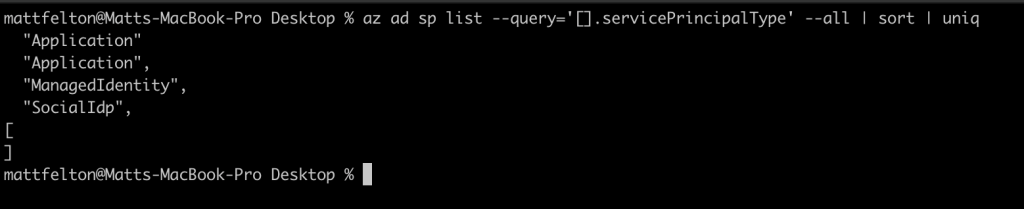
Under the hood, a managed identity is essentially a service principal with some orchestration on top of it. Interestingly enough, there are a number of different service principal types. Running the command below will spit back the different types of service principals that exist in your Azure AD tenant.

az ad sp list --query='[].servicePrincipalType' --all | sort | uniq
Service principal types

If you’re interested in seeing the service principals associated with managed identities in your Azure AD tenant, you can run the command below.

az ad sp list --query="[?servicePrincipalType=='ManagedIdentity']" --all

Managed identities include a property called alternativeNames which is an array. In my testing I observed two values within this array. The first value is “isExplicit=True” or “isExplicit=False” which is set to True for user-assigned managed identities and False when it’s a system-assigned managed identity. If you want to see all system-assigned managed identities for example, you can run the command below.

az ad sp list --query="[?servicePrincipalType=='ManagedIdentity' && alternativeNames[?contains(@,'isExplicit=False')]]" --all

The other value in this array is the resource id of the managed identity in the case of a user-assigned managed identity. With a system-assigned managed identity this is the resource id of the Azure resource the system-assigned managed identity is associated with.

System-assigned managed identity

So why does any of this matter? Before we get to that, let’s cover the major selling point of a system-assigned managed identity when compared to a user-assigned managed identity. With a system-assigned managed identity, the managed identity (and its service principal) share the lifecycle of the resource. This means that if you delete the resource, the service principal is cleaned up… well most of the time anyway.

Sometimes this cleanup process doesn’t happen and you’re left with orphaned service principals in your directory. The most annoying part is you can’t delete these service principals (I’ve tried everything including calls direct to the ARM API) and the only way to get them removed is to open a support ticket. Now there isn’t a ton of risk I can think of with having these orphaned service principals left in your tenant since I’m not aware of any means to access the credential associated with it. Without the credential no one can authenticate as it. Assuming the RBAC permissions are cleaned up, it’s not really authorized to do anything within Azure either. However, beyond dirtying up your directory, it’s an identity with a credential that shouldn’t be there anymore.

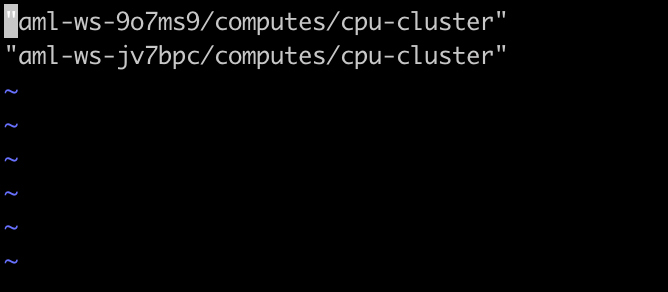
I wanted an easy way to identify these orphaned system-assigned managed identities so I could submit a support ticket and get it cleaned up before it started cluttering up my demonstration tenant. This afternoon I wrote a really ugly bash script to do exactly that. The script uses some of the az cli commands I’ve listed above to identify all the system-assigned managed identities and then uses az cli to determine if the resource exists. If the resource doesn’t exist, it logs the displayName property of the system-assigned managed identity to a text file. Quick and dirty, but does the job.

Orphaned system-assigned managed identities

Interestingly enough, I had a few peers run the script on their tenants and they all had some of these orphaned system-assigned managed identities, so it seems like this problem isn’t restricted to my tenants. Again, I personally can’t think of a risk of these identities remaining in the directory, but it does point to an issue with the lifecycle management processes Microsoft is using in the backend.

Well folks that’s it! Have a great night!