The “Real” Root Management Group

2/11/2025 Update – This action is now captured in the Entra ID Audit Logs! I’d recommend putting an alert in ASAP to track this moving forward.

Hello fellow geek!

Today I’m going to cover a topic that isn’t well understood in the Azure community and can present significant risk to your Azure estate. Sit back, grab your Friday morning coffee, and prepare to learn about the “real” root management group.

Microsoft made an interesting identity-based choice when architecting Azure. That choice was to have all Azure subscriptions share a common identity management plane in what we have known as Azure AD (Azure Active Directory) and which has recently been renamed Entra ID. The shared identity management plane in Azure creates a single authority for identity data and authentication while maintaining separate authorization boundaries between Azure subscriptions. This concept may differ for those of you coming from AWS (Amazon Web Services) where every AWS account has a unique identity management plane that has its own identity data store, authentication boundary, and authorization boundary. Microsoft’s decision comes with benefits and considerations.

The atomic unit for resources in Microsoft Azure is the Azure subscription which acts as an authorization boundary, limits boundary, and compliance boundary. Each Azure subscription can be associated to a single Entra ID tenant. Once a subscription is associated to an Entra ID tenant the subscription will use tenant as a source of identity data and authentication provider. This dependency on Entra ID creates an interesting security risk around authorization.

Before I dive into the details of this, let me briefly explain the concept of management groups. A management group in Azure is a logical container for Azure Subscriptions which allow for you to enforce configuration “how a resource looks” (Azure Policy) and authorization “what a user can do” (Azure RBAC) across one or more subscriptions. Prior to management groups, these things had to be managed at the individual subscription level or below (resource group or individual resource). Every subscription added to an Entra ID tenant exists under the Tenant Root Management Group by default, but this can be changed. Customers can can create additional management groups underneath the Tenant Root Management Group as per their needs (great guidance on this here).

If you’ve used Azure for any length of time the above is likely all review for you. However, as Yoda said, “there is another”. Above the Tenant Root Management Group exists another management group called root or “/”. As seen in the visual below, the root management group is the glue that sticks Entra ID authorization to Azure authorization together. Let’s dig into how this works.

Entra ID and Microsoft Azure Authorization

In Entra ID there is a role called Global Administrator. For those of you unfamiliar with this role, it is the god role of Entra ID and all services associated with an Entra ID tenant such as M365 and, yes, Azure. Holding this role in Entra ID does not give you permissions in Azure, but there is a path to give yourself permissions and become the god of your Azure estate.

Users who hold the Global Administrator have the ability to grant themselves access on the root “/” management group. They can do this through an option in the Entra ID blade of the Azure Portal called Access Management for Azure Resources or Elevate Access. This is also available via the Azure REST API using the elevateAccess endpoint. The value of this toggle switch shown in the Portal is the value for the current user context (user logged into the Portal). You cannot view this toggle switch for other users, but we can tell if it’s been toggled on as I will show later.

Option for Global Admins to assert control over Azure

When a Global Administrator toggles this option either through the Portal or through the REST API an Azure RBAC Role Assignment for the User Access Administrator is created at the root “/” management group.

User Access Administrator role assignment as result of global administrator elevate access

The User Access Administrator is a highly privileged role granting the user full permissions over the Microsoft.Authorization resource provider (as seen below). These permissions allow the user to create additional role assignments on for any Azure RBAC Role on any Azure management, subscription, resource group, or resource within the Entra ID tenant. Yes… yikes.

{
    "id": "/providers/Microsoft.Authorization/roleDefinitions/18d7d88d-d35e-4fb5-a5c3-7773c20a72d9",
    "properties": {
        "roleName": "User Access Administrator",
        "description": "Lets you manage user access to Azure resources.",
        "assignableScopes": [
            "/"
        ],
        "permissions": [
            {
                "actions": [
                    "*/read",
                    "Microsoft.Authorization/*",
                    "Microsoft.Support/*"
                ],
                "notActions": [],
                "dataActions": [],
                "notDataActions": []
            }
        ]
    }
}

As I mentioned earlier, the Portal will only show you the value of the toggle switch for the ElevateAccess feature for the currently logged in user. You may now be thinking “How the heck can I enforce this if I can’t view it in the Portal?”. The good news is this toggle seems to be some backend orchestration where the platform checks whether the user has the User Access Administrator RBAC Role Assignment on the root “/” management group. This means you don’t need to care about that visual toggle switch, you only need to care about the actual permission. You can list out the the users that have the role assignment at root using the cli command below.

az role assignment list --scope "/" --query "[?roleDefinitionName=='User Access Administrator'].{Username:principalName, ObjectId:objectId}" --output table

Awesome, so you know who has it. Why should you care? Listen, I gonna be nice and assume you’re asking this because it’s a Friday and your brain is fried. The reason you should care is this gives your users who have access to the Entra ID Global Administrators Role the ability to make themselves god of your Azure estate. This includes owners over the resources for management plane operations which can, in almost every instance, lead to owner of the data contained within the resources within the data plane. You SHOULD NOT have a role assignment for User Access Administrator on the root “/” management group. There a few instances where you need this permission temporarily to grant other permissions, but I will cover that at the end of this post. For now, know that if you have that permission there you shouldn’t.

In most enterprises there is a separate team managing Entra ID from the team managing Azure in order to maintain separation of duties. Access to the Global Administrator role opens up the risk for the user to assert access and control over data that is outside of their roles and responsibilities. While there is no way to stop this from happening, you should be monitoring for when it occurs. So how might you do this?

If you’re used Azure, you should be familiar with Azure Activity Logs. The Activity Logs contain log entries for create, update, and delete operations on the Azure management plane. Activity Logs exist at a number of scopes including Subscription, Management Group, and Directory. While Subscription and Management Group Activity Logs supports integration with Azure Monitor Diagnostic Logs, Directory Activity Logs do not and those are the logs new role assignments to the root “/” management group are recorded in. This means you need to write custom code to manually pull down those logs via the REST API in order to capture and alert on them in your favorite SIEM. Yuck right? Well there is an easier way to alert on this.

Directory-level Azure Activity Logs

A while back Microsoft introduced support for Azure Monitor to make log queries against the Azure Resource Graph. I’m not going to do a deep dive into ARG (Azure Resource Graph). All you need to know for the purpose of this post is it’s a service you can tap into to pull down information about Azure resources, including role assignments.

Let me walk through how this works.

I can issue an Kusto query through Azure Monitor to query ARG to see what role assignments for User Access Administrator exist on the root “/” management group using the query below (note this will require you have appropriate read permissions at root “/”).

arg("").AuthorizationResources
| where properties.scope == "/"
| where properties.roleDefinitionId == "/providers/Microsoft.Authorization/RoleDefinitions/18d7d88d-d35e-4fb5-a5c3-7773c20a72d9"

This Kusto query will query the ARG authorizationresources category for any role assignments on the root “/” management group that have the role definition id for User Access Administrator. Each resulting log entry denotes a role assignment on root. Here we can see I have two role assignments on the root for User Access Administrator. Bad Matt.

Query to pull role assignments for User Access Administrator on root “/” management group

Back in October 2023 Microsoft introduced into public preview support to create Azure Alerts for Azure Monitor Log queries against ARG. This means you can create an Azure Alert based on this custom log query. If there is a role assignment for User Access Administrator on the root “/” management group, an alert will be fired. Let me walk through the setup of that alert, because it’s a little bit funky.

First thing you will need to do is create an action group and you can use this documentation to that. Once you have your action group you’ll want to navigate to the Alerts blade in the Azure Portal and then to the alert rules

Alert Rules in Azure Portal

Select the option to create a new Alert Rule. In the scope section you can select a subscription. If you are using a similar subscription design as to the Azure Cloud Adoption Framework, selecting the Management subscription would be a good choice. I don’t believe the choice matters much because the alert is on the root management group and not a resource within a subscription.

On the condition screen you will choose the Custom log search option for the Signal name. The query you’ll put in there is below.

arg("").AuthorizationResources
| where properties.scope == "/"
| where properties.roleDefinitionId == "/providers/Microsoft.Authorization/RoleDefinitions/18d7d88d-d35e-4fb5-a5c3-7773c20a72d9"

You will will also need to configure the measurements. You can use the settings I have below or customize it to your liking.
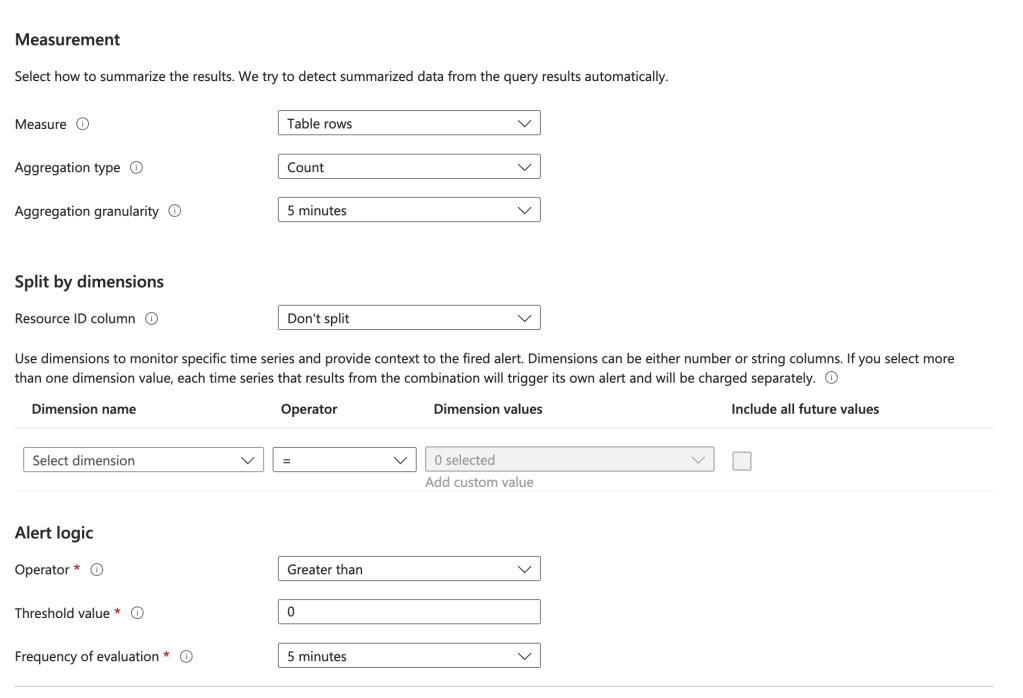
Measurements for alert

On the Actions screen choose Select action groups and select the action group you configured before.

On the Details screen you can set the severity to whatever you want. I’d recommend 0 since this is a significant escalation of privilege. You will also need to configure the alert with a managed identity. It will need an identity to authenticate and be authorized to ARG. Choose whichever managed identity type makes sense for your organization.

Adding a managed identity to the alert

Add whatever tags you want on the next screen and create the alert.

Done right? No, we now need to give the managed identity permissions on the root management group to read the role assignments.

I promised earlier I’d tell you the instance where you need to use this elevation. The are very few instances where you need to do this. One instance is when you are first building out your management group structure. In that scenario, no one has permission over the root or tenant root management group so no one can create new management groups. You will need to elevate a user with Global Administrator to the User Access Administrator role on the root “/” in that situation so that use can then grant another user account owned by the Azure team (ideally non-human, but vaulted is good too) User Access Administrator on the Tenant Root Management Group. When complete, the Global Administrator should toggle that switch back to off to remove the RBAC role assignment. This Microsoft article explains a few other scenarios you may need to temporary grant this role to grant permissions at the root “/”.

Now back to setting up the alert rule. Next up you need to grant the managed identity you assigned to the alert rule the permission at the root “/” management group so it can query the role assignments (see, a use case!). You can find the object id of the managed identity in the identity section of the Alert in the Portal. What role you assign it is up to you. I’m doing Reader because I’m lazy, but you could certainly craft a custom role if you’d like to (don’t forget to remove your permissions once you’ve completed this!).

az role assignment create --assignee-object-id "4f984694-b43c-4528-87e9-68aeab7478a3" --scope "/" --role "Reader"

You’re good to go! You now have an alert that will fire anytime there is any role assignment for User Access Administrator on the root “/” management group. Again, there should never be a role assignment for that role unless you’re temporarily using it for one of the use cases above.

The key things I want you to take away from this this post is the critical role Entra ID plays across all of the Microsoft Clouds. It’s important to understand how privilege in one product (Entra ID) can lead to privilege in another (Azure). Now you have a quick and easy security win you can crank out before Thanksgiving. Enjoy!

Authentication in Azure OpenAI Service

This is part of my series on the Azure OpenAI Service:

  1. Azure OpenAI Service – Infra and Security Stuff
  2. Azure OpenAI Service – Authentication
  3. Azure OpenAI Service – Authorization
  4. Azure OpenAI Service – Logging
  5. Azure OpenAI Service – Azure API Management and Entra ID
  6. Azure OpenAI Service – Granular Chargebacks
  7. Azure OpenAI Service – Load Balancing
  8. Azure OpenAI Service – Blocking API Key Access
  9. Azure OpenAI Service – Securing Azure OpenAI Studio
  10. Azure OpenAI Service – Challenge of Logging Streaming ChatCompletions
  11. Azure OpenAI Service – How To Get Insights By Collecting Logging Data
  12. Azure OpenAI Service – How To Handle Rate Limiting
  13. Azure OpenAI Service – Tracking Token Usage with APIM
  14. Azure AI Studio – Chat Playground and APIM
  15. Azure OpenAI Service – Streaming ChatCompletions and Token Consumption Tracking
  16. Azure OpenAI Service – Load Testing

Updates:

  • 1/18/2024 to reference considerable library changes with new API version. See below for details
  • 4/3/2023 with simpler way to authenticate with Azure AD via Python SDK

Hello again!

1/18/2024 Update – Hi folks! There were some considerable changes to the OpenAI Python SDK which offers an even simpler integration with the Azure OpenAI Service. While the code in this post is a bit dated, I feel the thought process is still important so I’m going to preserve it as is! If you’re looking for examples of how to authenticate with the Azure OpenAI Service using the Python SDK with different types of authentication (service principal vs managed identity) or using the REST API, I’ve placed a few examples in this GitHub repository. Hope it helps!

Days and nights have been busy diving deeper into the AI landscape. I’ve been reading a great book by Tom Taulli called Artificial Intelligence Basics: A Non-Technical Introduction. It’s been a huge help in getting down the vocabulary and understanding the background to the technology from the 1950s on. In combination with the book, I’ve been messing around a lot with Azure’s OpenAI Service and looking closely at the infrastructure and security aspects of the service.

In my last post I covered the controls available to customers to secure their specific instance of the service. I noted that authentication to the service could be accomplished using Azure Active Directory (AAD) authentication. In this post I’m going to take a deeper look at that. Be ready to put your geek hat on because this post will be getting down and dirty into the code and HTTP transactions. Let’s get to it!

Before I get into the details of how supports AAD authentication, I want to go over the concepts of management plane and data plane. Think of management plane for administration of the resource and data plane for administration of the data hosted within the resource. Many services in Azure have separate management planes and data planes. One such service is Azure Storage which just so happens to have similarities with authentication to the OpenAI Service.

When a customer creates an Azure Storage Account they do this through interaction with the management plane which is reached through the ARM API hosted behind management.azure.come endpoint. They must authenticate against AAD to get an access token to access the API. Authorization via Azure RBAC then takes place to validate the user, managed identity, or service principal has permissions on the resource. Once the storage account is created, the customer could modify the encryption key from a platform managed key (PMK aka key managed by Microsoft) to a customer managed key (CMK), enable soft delete, or enable network controls such as the storage firewall. These are all operations against the resource.

Once the customer is ready to upload blob data to the storage account, they will do this through a data plane operation. This is done through the Blob Service API. This API is hosted behind the blob.core.windows.net endpoint and operations include creation of a blob or deletion of a blob. To interact with this API the customer has two means of authentication. The first method is the older method of the two and involves the use of static keys called storage account access keys. Every storage account gets two of these keys when a storage account is provisioned. Used directly, these keys grant full access to all operations and all data hosted within the storage account (SAS tokens can be used to limit the operations, time, and scope of access but that won’t be relevant when we talk the OpenAI service). Not ideal right? The second method is the recommended method and that involves AAD authentication. Here the security principal authenticates to AAD, receives an access token, and is then authorized for the operation via Azure RBAC. Remember, these are operations against the data hosted within the resource.

Authentication in Management Plane vs Data Plane in Azure Storage

Now why did I give you a 101 on Azure Storage authentication? Well, because the Azure OpenAI Service works in a very similar way.

Let’s first talk about the management plane of the Azure OpenAI Service. Like Azure Storage (and the rest of Azure’s services) it is administered through the ARM API behind the management.azure.com endpoint. Customers will use the management plane when they want to create an instance of the Azure OpenAI Service, switch it from a PMK to CMK, or setup diagnostic settings to redirect logs (I’ll cover logging in a future post). All of these operations will require authentication to AAD and authorization via Azure RBAC (I’ll cover authorization in a future post).

Simple right? Now let’s move to the complexity of the data plane.

Two API keys are created whenever a customer creates an Azure OpenAI Service instance. These API keys allow the customer full access to all data plane operations. These operations include managing a deployment of a model, managing training data that has been uploaded to the service instance and used to fine tune a model, managing fine tuned models, and listing available models. These operations are performed against the Azure OpenAI Service API which lives behind a unique label with an FQDN of openai.azure.com (such as myservice.openai.azure.com). Pretty much all the stuff you would be doing through the Azure OpenAI Studio. If you opt to use these keys you’ll need to remember control access to these keys via securing management plane authorization aka Azure RBAC.

Azure OpenAI Service API Keys

In the above image I am given the option to regenerate the keys in the case of compromise or to comply with my organization’s key rotation process. Two keys are provided to allow for continued access to the service while other key is being rotated.

Here I have simple bit of code using the OpenAI Python SDK. In the code I provide a prompt to the model and ask it to complete it for me and use one of the API keys to authenticate to it.

import logging
import sys
import os
import openai

def main():
    # Setup logging
    try:
        logging.basicConfig(
            level=logging.ERROR,
            format='%asctime)s - %(name)s - %(levelname)s - %(message)s',
            handlers=[logging.StreamHandler(sys.stdout)]
        )
    except:
        logging.error('Failed to setup logging: ', exc_info=True)

    try:

        # Setup OpenAI Variables
        openai.api_type = "azure"
        openai.api_base = os.getenv('OPENAI_API_BASE')
        openai.api_version = "2022-12-01"
        openai.api_key = os.getenv('OPENAI_API_KEY')

        response = openai.Completion.create(
            engine=os.getenv('DEPLOYMENT_NAME'),
            prompt='Once upon a time'
        )

        print(response.choices[0].text)

    except:
        logging.error('Failed to respond to prompt: ', exc_info=True)


if __name__ == "__main__":
    main()

The model gets creative and provides me with the response below.

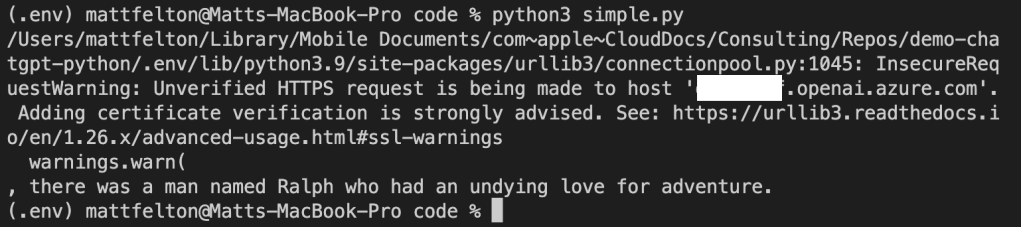
If you look closely you’ll notice an warning about the security of my session. The reason I’m getting that error is shut off certificate verification in the OpenAI library in order to intercept the calls with Fiddler. Now let me tell you, shutting off certificate verification was a pain in the ass because the developers of the SDK are trying to protect users from the bad guys. Long story short, the Azure Python SDK doesn’t provide an option to turn off certificate checking like say the Azure Python SDK (which you can pass a kwarg of verify=False to turn it off in the request library used underneath). While the developers do provide a property called verify_ssl_certs, it doesn’t actually do anything. Since most Python SDKs use the requests library underneath the hood, I went through the library on my machine and found the api_requestor.py file. Within this file I modified the _make_session function which is creating a requests Sessions object. Here I commented out the developers code and added the verify=False property to the Session object being created.

Turning off certificate verification in OpenAI Python SDK

Now don’t go and do this in any environment that matters. If you’re getting a certificate verification failure in your environment you should be notifying your information security team. Certificate verification is an absolute must to ensure the identity of the upstream server and to mitigate the risk of man-in-the-middle attacks.

Once I was able to place Fiddler in the middle of the HTTPS session I was able to capture the conversation. In the screenshot below, you can see the SDK passing the api-key header. Take note of that header name because it will become relevant when we talk AAD authentication. If you’re using OpenAI’s service already, then this should look very familiar to you. Microsoft was nice enough to support the existing SDKs when using one of the API keys.

At this point you’re probably thinking, “That’s all well and good Matt, but I want to use AAD authentication for all the security benefits AAD provides over a static key.” Yeah yeah, I’m getting there. You can’t blame me for nerding out a bit with Fiddler now can you?

Alright, so let’s now talk AAD authentication to the data plane of the Azure OpenAI Service. Possible? Yes, but with some caveats. The public documentation illustrates an example of how to do this using curl. However, curl is great for a demonstration of a concept, but much more likely you’ll be using an SDK for your preferred programming language. Since Python is really the only programming language I know (PowerShell doesn’t count and I don’t want to show my age by acknowledging I know some Perl) let me demonstrate this process using our favorite AAD SDK, MSAL.

For this example I’m going to use a service principal, but if your code is running in Azure you should be using a managed identity. When creating the service principal I granted it the Cognitive Services User RBAC role on the resource group containing the Azure OpenAI Service instance as suggested in the documentation. This is required to authorize the service principal access to data plane operations. There are a few other RBAC roles for the service, but as I said earlier, I’ll cover authorization in a future post. Once the service principal was created and assigned the appropriate RBAC role, I modified my code to include a function which calls MSAL to retrieve an access token with the access scope of Cognitive Services, which the Azure OpenAI Service falls under. I then pass that token as the API key in my call to the Azure OpenAI Service API.

import logging
import sys
import os
import openai
from msal import ConfidentialClientApplication

def get_sp_access_token(client_id, client_credential, tenant_name, scopes):
    logging.info('Attempting to obtain an access token...')
    result = None
    print(tenant_name)
    app = ConfidentialClientApplication(
        client_id=client_id,
        client_credential=client_credential,
        authority=f"https://login.microsoftonline.com/{tenant_name}",
    )
    result = app.acquire_token_for_client(scopes=scopes)

    if "access_token" in result:
        logging.info('Access token successfully acquired')
        return result['access_token']
    else:
        logging.error('Unable to obtain access token')
        logging.error(f"Error was: {result['error']}")
        logging.error(f"Error description was: {result['error_description']}")
        logging.error(f"Error correlation_id was: {result['correlation_id']}")
        raise Exception('Failed to obtain access token')

def main():
    # Setup logging
    try:
        logging.basicConfig(
            level=logging.ERROR,
            format='%asctime)s - %(name)s - %(levelname)s - %(message)s',
            handlers=[logging.StreamHandler(sys.stdout)]
        )
    except:
        logging.error('Failed to setup logging: ', exc_info=True)

    try:
        # Obtain an access token
        token = get_sp_access_token(
            client_id = os.getenv('CLIENT_ID'),
            client_credential = os.getenv('CLIENT_SECRET'),
            tenant_name = os.getenv('TENANT_ID'),
            scopes = "https://cognitiveservices.azure.com/.default"
        )
    except:
        logging.error('Failed to obtain access token: ', exc_info=True)

    try:
        # Setup OpenAI Variables
        openai.api_type = "azure"
        openai.api_base = os.getenv('OPENAI_API_BASE')
        openai.api_version = "2022-12-01"
        openai.api_key = token

        response = openai.Completion.create(
            engine=os.getenv('DEPLOYMENT_NAME'),
            prompt='Once upon a time'
        )

        print(response.choices[0].text)

    except:
        logging.error('Failed to summarize file: ', exc_info=True)


if __name__ == "__main__":
    main()

Let’s try executing that and see what happens.

Uh-oh! What happened? If you recall from earlier the API key is passed in the api-key header. However, to use the access token provided by AAD we have to pass it in the authorization header as seen in the example in Microsoft public documentation.

curl ${endpoint%/}/openai/deployments/YOUR_DEPLOYMENT_NAME/completions?api-version=2022-12-01 \
-H "Content-Type: application/json" \
-H "Authorization: Bearer $accessToken" \
-d '{ "prompt": "Once upon a time" }'

Thankfully there is a solution to this one without requiring you to modify the OpenAI SDK. If you take a look in the api_requestor.py file again in the library you will see it provides the ability to override the headers passed in the request.

With this in mind, I made a few small modifications. I removed the api_key property and added an Authorization header to the request to the Azure OpenAI Service API which includes the access token received back from AAD.

import logging
import sys
import os
import openai
from msal import ConfidentialClientApplication

def get_sp_access_token(client_id, client_credential, tenant_name, scopes):
    logging.info('Attempting to obtain an access token...')
    result = None
    print(tenant_name)
    app = ConfidentialClientApplication(
        client_id=client_id,
        client_credential=client_credential,
        authority=f"https://login.microsoftonline.com/{tenant_name}",
    )
    result = app.acquire_token_for_client(scopes=scopes)

    if "access_token" in result:
        logging.info('Access token successfully acquired')
        return result['access_token']
    else:
        logging.error('Unable to obtain access token')
        logging.error(f"Error was: {result['error']}")
        logging.error(f"Error description was: {result['error_description']}")
        logging.error(f"Error correlation_id was: {result['correlation_id']}")
        raise Exception('Failed to obtain access token')

def main():
    # Setup logging
    try:
        logging.basicConfig(
            level=logging.ERROR,
            format='%asctime)s - %(name)s - %(levelname)s - %(message)s',
            handlers=[logging.StreamHandler(sys.stdout)]
        )
    except:
        logging.error('Failed to setup logging: ', exc_info=True)

    try:
        # Obtain an access token
        token = get_sp_access_token(
            client_id = os.getenv('CLIENT_ID'),
            client_credential = os.getenv('CLIENT_SECRET'),
            tenant_name = os.getenv('TENANT_ID'),
            scopes = "https://cognitiveservices.azure.com/.default"
        )
    except:
        logging.error('Failed to obtain access token: ', exc_info=True)

    try:
        # Setup OpenAI Variables
        openai.api_type = "azure"
        openai.api_base = os.getenv('OPENAI_API_BASE')
        openai.api_version = "2022-12-01"

        response = openai.Completion.create(
            engine=os.getenv('DEPLOYMENT_NAME'),
            prompt='Once upon a time',
            headers={
                'Authorization': f'Bearer {token}'
            }
            

        )

        print(response.choices[0].text)

    except:
        logging.error('Failed to summarize file: ', exc_info=True)


if __name__ == "__main__":
    main()

Running the code results in success!

4/3/2023 Update – Poking around today looking at another aspect of the service, I came across this documentation on an even simpler way to authenticate with Azure AD without having to use an override. In the code below, I specify an openai.api_type of azure_ad which allows me to pass the token direct via the openai_api_key property versus having to pass a custom header. Definitely a bit easier!

import logging
import sys
import os
import openai
from msal import ConfidentialClientApplication

def get_sp_access_token(client_id, client_credential, tenant_name, scopes):
    logging.info('Attempting to obtain an access token...')
    result = None
    print(tenant_name)
    app = ConfidentialClientApplication(
        client_id=client_id,
        client_credential=client_credential,
        authority=f"https://login.microsoftonline.com/{tenant_name}",
    )
    result = app.acquire_token_for_client(scopes=scopes)

    if "access_token" in result:
        logging.info('Access token successfully acquired')
        return result['access_token']
    else:
        logging.error('Unable to obtain access token')
        logging.error(f"Error was: {result['error']}")
        logging.error(f"Error description was: {result['error_description']}")
        logging.error(f"Error correlation_id was: {result['correlation_id']}")
        raise Exception('Failed to obtain access token')

def main():
    # Setup logging
    try:
        logging.basicConfig(
            level=logging.ERROR,
            format='%asctime)s - %(name)s - %(levelname)s - %(message)s',
            handlers=[logging.StreamHandler(sys.stdout)]
        )
    except:
        logging.error('Failed to setup logging: ', exc_info=True)

    try:
        # Obtain an access token
        token = get_sp_access_token(
            client_id = os.getenv('CLIENT_ID'),
            client_credential = os.getenv('CLIENT_SECRET'),
            tenant_name = os.getenv('TENANT_ID'),
            scopes = "https://cognitiveservices.azure.com/.default"
        )
        print(token)
    except:
        logging.error('Failed to obtain access token: ', exc_info=True)

    try:
        # Setup OpenAI Variables
        openai.api_type = "azure_ad"
        openai.api_base = os.getenv('OPENAI_API_BASE')
        openai.api_key = token
        openai.api_version = "2022-12-01"

        response = openai.Completion.create(
            engine=os.getenv('DEPLOYMENT_NAME'),
            prompt='Once upon a time '
        )

        print(response.choices[0].text)

    except:
        logging.error('Failed to summarize file: ', exc_info=True)


if __name__ == "__main__":
    main()

Let me act like I’m ChatGPT and provide you a summary of what we learned today.

  • The Azure OpenAI Service has both a management plane and data plane.
  • The Azure OpenAI Service data plane supports two methods of authentication which include static API keys and Azure AD.
  • The static API keys provide full permissions on data plane operations. These keys should be rotated in compliance with organizational key rotation policies.
  • The OpenAI SDK for Python (and I’m going to assume the others) sends an api-key header by default. This behavior can be overridden to send an Authorization header which includes an access token obtained from Azure AD.
  • It’s recommended you use Azure AD authentication where possible to leverage all the bells and whistles of Azure AD including the usage of managed identities, improved logging, and conditional access for service principal-based access.

Well folks, that concludes this post. I’ll be uploading the code sample above to my GitHub later this week. In the next batch of posts I’ll cover the authorization and logging aspects of the service.

I hope you got some value and good luck in your AI journey!

Deep Dive into Azure AD and AWS SSO Integration – Part 1

Deep Dive into Azure AD and AWS SSO Integration – Part 1

Hello fellow geeks!

Back in 2017 I did a series of posts on how to integrate Azure AD using the AWS app available in the Azure Marketplace with AWS IAM in order to use Azure AD as an identity provider for an AWS account.  The series has remained quite popular over the past two years, largely because the integration has remained the same without much improvement.  All of this changed last week when AWS released support for integration between Azure AD and AWS SSO.

The past integration between the two platforms functioned, but suffered from three primary challenges:

  1. The AWS app was designed to synchronize identity data between AWS and Azure AD for a single AWS account
  2. The SAML trust between Azure AD and an AWS account had to be established separately for each AWS account.
  3. The application manifest file used by the AWS app to establish a mapping of roles between Azure AD and synchronized AWS IAM roles had a limitation of 1200 which didn’t scale for organizations with a large AWS footprint.

To understand these challenges, I’m going to cover some very basic AWS concepts.

The most basic component an AWS presence is an AWS account.  Like an Azure subscription, it represents a billing relationship, establishes limitations for services, and acts as an authorization boundary.  Where it differs from an Azure subscription is that each AWS account has a separate identity and authentication boundary.

While multiple Azure subscriptions can be associated with a single instance of Azure AD to centralize identity and authentication, the same is not true for AWS.  Each AWS account has its own instance of AWS IAM with its own security principals and no implicit trust with any other account.

Azure Subscription Identity vs AWS Account Identity

Azure Subscription Identity vs AWS Account Identity

Since there is no implicit trust between accounts, that trust needs to be manually established by the customer.  For example, if a customer wants bring their own identities using SAML, they need to establish a SAML trust with each AWS account.

SAML Trusts with each AWS Account

SAML Trusts with each AWS Account

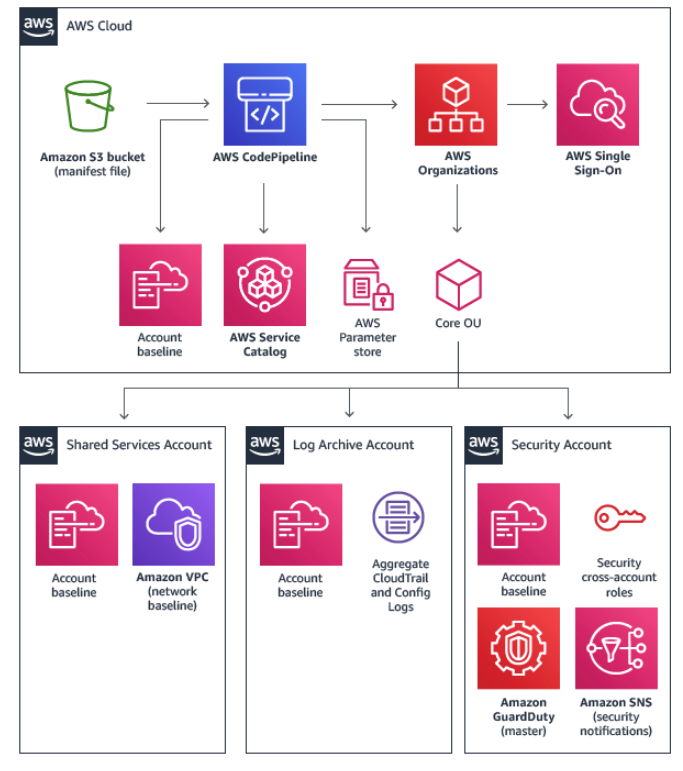
This is nice from a security perspective because you have a very clear security boundary that you can use effectively to manage blast radius.  This is paramount in the cloud from a security standpoint.  In fact, AWS best practice calls for separate accounts to mitigate risks to workloads of different risk profiles.  A common pattern to align with this best practice is demonstrated in the AWS Landing Zone documentation.  If you’re interested in a real life example of what happens when you don’t establish a good radius, I encourage you to read the cautionary tale of Code Spaces.

AWS Landing Zone

AWS Landing Zone

However, it doesn’t come without costs because each AWS IAM instance needs to be managed separately.  Prior to the introduction of AWS SSO (which we’ll cover later), you as the customer would be on the hook for orchestrating the provisioning of security principals (IAM Users, groups, roles, and identity providers) in every account.  Definitely doable, but organizations skilled at identity management are few and far between.

Now that you understand the importance of having multiple AWS accounts and that each AWS account has a separate instance of AWS IAM, we can circle back to the challenges of the past integration.  The AWS App available in the Azure Marketplace has a few significant gaps

The app is designed to simplify the integration with AWS by providing the typical “wizard” type experience Microsoft so loves to provide.  Plug in a few pieces of information and the SAML trust between Azure AD and your AWS account is established on the Azure AD end to support an identity provider initiated SAML flow.  This process is explained in detail in my past blog series.

In addition to easing the SAML integration, it also provides a feature to synchronize AWS IAM roles from an AWS account to the application manifest file used by the AWS app.  The challenges here are two-fold: one is the application manifest file has a relatively small limit of entries; the other is the synchronization process only supports a single AWS account.  These two gaps make it unusable by most enterprises.

Azure AWS Application Sync Process

Azure Marketplace AWS Application Sync Process

Both Microsoft and AWS have put out workarounds to address the gaps.  However, the workarounds require the customer to either develop or run custom code and additional processes and neither addresses the limitation of the application manifest.  This lead to many organizations to stick with their on-premises security token service (AD FS, Ping, etc) or going with another 3rd party IDaaS (Okta, Centrify, etc).  This caused them to miss out on the advanced features of Azure AD, some of which they were more than likely already paying for via the use of Office 365.  These features include adaptive authentication, contextual authorization, and modern multi-factor authentication.

AWS recognized the challenge organizations were having managing AWS accounts at scale and began introducing services to help enterprises manage the ever growing AWS footprint.  The first service was AWS Organizations.  This service allowed enterprises to centralize some management operations, consolidate billing, and group accounts together for billing or security and compliance.  For those of you from the Azure world, the concept is similar to the benefits of using Azure Management Groups and Azure Policy.  This was a great start, but the platform still lacked a native solution for centralized identity management.

AWS Organization

AWS Organization

At the end of 2017, AWS SSO was introduced.  Through integration with AWS Organizations, AWS SSO has the ability to enumerate all of the AWS accounts associated with an Organization and act as a centralized identity, authentication, and authorization plane.

While the product had potential, at the time of its release it only supported scenarios where users and groups were created directly in the AWS SSO directory or were sourced from an AWS Managed AD or customer-managed AD using the LDAP connector.  It lacked support for acting as a SAML service provider to a third-party identity provider.  Since the service lacks the features of most major on-premises security token services and IDaaS providers, many organizations kept to the standard pattern of managing identity across their AWS accounts using their own solutions and processes.

Fast forward to last week and AWS announced two new features for AWS SSO.  The first feature is that it can now act as a SAML service provider to Azure AD (YAY!).  By federating directly with AWS SSO, there is no longer a requirement to federate Azure AD which each individual AWS account.

The second feature got me really excited and that was support for the System for Cross-domain Identity Management (SCIM) specification through the addition of SCIM endpoints.  If you’re unfamiliar SCIM, it addresses a significant gap in IAM in the cloud world, and that is identity management.  If you’ve ever integrated with any type of cloud service, you are more than likely aware of the pains of having to upload CSVs or install custom vendor connectors in order to provision security principals into a cloud identity store.  SCIM seeks to solve that problem by providing a specification for a REST API that allows for management of the lifecycle of security principals.

Support for this feature, along with Azure AD’s longtime support for SCIM, allows Azure AD to handle the identity lifecycle management of the shadow identities in AWS SSO which represent Azure AD Users and Groups.  This is an absolutely awesome feature of Azure AD and I’m thrilled to see that AWS is taking advantage of it.

Well folks, that will close out this entry in the series.  Over the next few posts I’ll walk through what the integration and look behind the curtains a bit with my go to tool Fiddler.

See you next post!


Azure AD Password Protection – Hybrid Deep Dive

Azure AD Password Protection – Hybrid Deep Dive

Welcome back fellow geeks.  Today I’m going to be looking at a brand new capability Microsoft announced entered public preview this week.  With the introduction of Hybrid Azure Active Directory Password Protection Microsoft continues to extend the protection it has based into its Identity-as-a-Service (IDaaS) offering Azure Active  Directory (AAD).

If you’ve administered Windows Active Directory (AD) in an environment with a high security posture, you’re very familiar with the challenges of ensuring the use of “good” passwords.  In the on-premises world we’ve typically used the classic Password Policies that come out of the box with AD which provide the bare minimum.  Some of you may even have leveraged third-party password filters to restrict the usage of commonly used passwords such as the classic “P@$$w0rd”.  While the third-party add-ins filled a gap they also introduce additional operational complexity (Ever tried to troubleshoot a misbehaving password filter?  Not fun) and compatibility issues.  Additionally the filters that block “bad” passwords tend to use a static data set or a data set that has to be manually updated and distributed.

In comes Microsoft’s Hybrid Azure Active Directory Password Protection to save the day.  Here we have a solution that comes directly from the vendor (no more third-party nightmares) that uses the power of telemetry and security data collected from Microsoft’s cloud to block the use of some of the most commonly used passwords (extending that even further with the use of fuzzy logic) as well as custom passwords you can provide to the service yourself.  In a refreshing turn of events, Microsoft has finally stepped back from the insanity (yes I’m sorry it’s insanity for most organizations) of requiring Internet access on your domain controllers.

After I finished reading the announcement this week I was immediately interested in taking a peek behind the curtains on how the solution worked.  Custom password filters have been around for a long time, so I’m not going to focus on that piece of the solution.  Instead I’m going to look more closely at two areas, deployment and operation of the solution.  Since I hate re-creating existing documentation (and let’s face it, I’m not going to do it nearly as well as those who do it for a living) I’ll be referencing back to Microsoft documentation heavily during this post so get your dual monitors powered up.

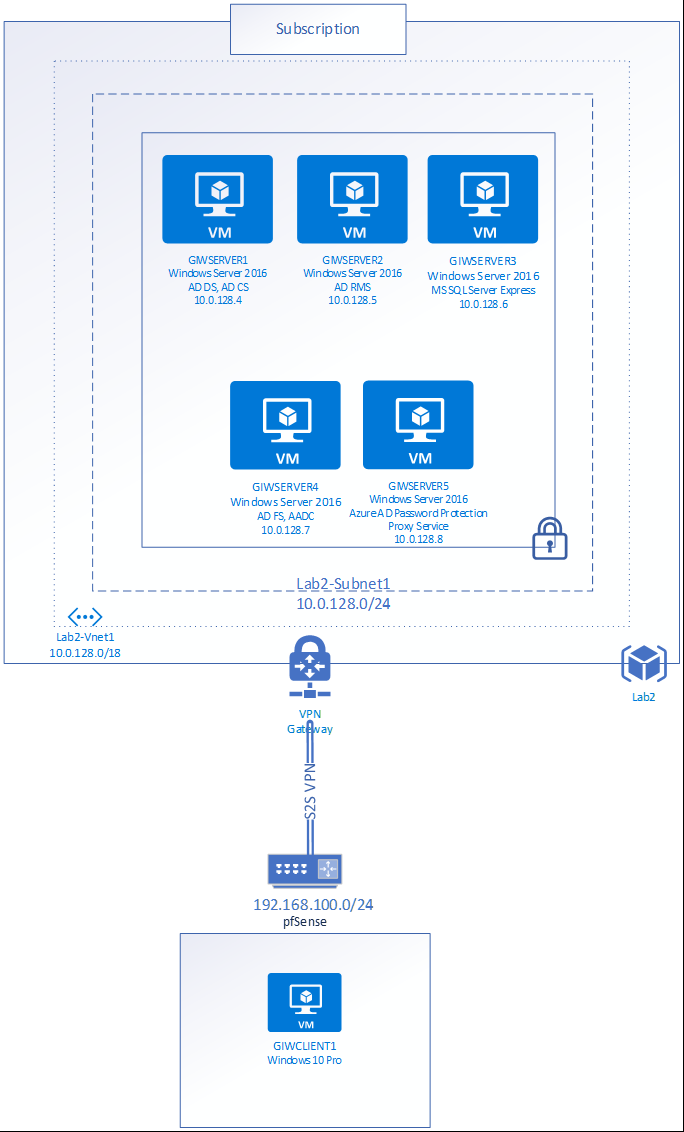
I’ll be using my Geek In The Weeds tenant for this demonstration.  The tenant is synchronized and federated with AAD with Azure Active Directory Connect (AADC) and Active Directory Federation Services (AD FS).  The tenant is equipped with some Office 365 E5 and Enterprise Mobility+Security E5 licenses.  Since I’ll need some Windows Servers for this, I’ll be using the lab seen in the diagram below.

1aadpp1.png

The first thing I needed to do was verify that my AAD tenant was configured for Azure Active Directory Password Protection.  For that I logged into the portal as a global administrator and selected the Azure Active Directory blade.  Scrolling down to the Security section of the menu shows an option named Authentication Methods.

1aadpp2.png

After selecting the option a new blade opens with only one menu item, Password Protection.  Since it’s the option there, it opens right up.  Here we can see the configuration options available for Azure Active Directory Password Protection and Smart Lockout.  Smart Lockout is at this time a feature specific to AAD so I’m not going to cover it.  You can read more about that feature in the Microsoft announcement.  The three options that we’re interested in for this post are within the Custom Banned Passwords and Password protection for Windows Server Active Directory.

1aadpp3.png

The custom banned passwords section allows organizations to add additional blocked passwords beyond the ones Microsoft provides.  This is helpful if organizations have a good grasp on their user’s behavior and have some common words they want to block to keep users from creating passwords using those words.  Right now it’s limited to 1000 words with one word per line.  You can copy and paste from a another document as long as what you paste is a single word per line.

I’d like to see Microsoft lift the cap of 1000 words as well as allowing for programmatic updating of this list.  I can see some real cool opportunities if this is combined with telemetry obtained from on-premises.  Let’s say the organization has some publicly facing endpoints that use a username and password for authentication.  That organization could capture the passwords used during password spray and brute force attacks, record the number of instances of their use, and add them to this list as the number of instances of those passwords reach certain thresholds.  Yes, I’m aware Microsoft is doing practically the same thing (but better) in Azure AD, but not everything within an organization uses Azure AD for authentication.  I’d like to see Microsoft allow for programmatic updates to this list to allow for such a use case.

Let’s enter two terms in the custom banned password list for this demonstration.  Let’s use geekintheweeds and journeyofthegeek.  We’ll do some testing later to see if the fuzzy matching capabilities extend to the custom banned list.

Next up we configuration options have Password protection for Windows Server Active Directory.  This is will be my focus.  Notice that the Enable password protection on Windows Server Active Directory option is set to Yes by default.  This option is going to control whether or not I can register the Azure AD Password Protection proxy service to Azure AD as you’ll see later in the post.  For now let’s set to that to No because it’s always interesting to see how things fail.

I’m going to leave Mode option at Audit for now.  This is Microsoft’s recommendation out of the gates.  It will give you time to get a handle on user behavior to determine how disruptive this will be to the user experience, give you an idea as to how big of a security issue this is for your organization, as well as giving you an idea as to the scope of communication and education you’ll need to do within your organization.

1aadpp4

There are two components we’ll need to install within on-premises infrastructure.  On the domain controllers we’ll be installing the Azure AD Password Protection DC Agent Service and the DC Agent Password Filter dynamic-link library (DLL).  On the member server we’ll be installing the Azure AD Password Protection Proxy Service.  The Microsoft documentation explains what these two services do at a high level.  In short, the DC Agent Password Filter functions like any other password filter and captures the clear text password as it is being changed.  It sends the password to the DC Agent Service which validates the password according to the locally cached copy of password policy that it has gotten from Azure AD.  The DC Agent Service also makes requests for new copies of the password policy by sending the request to the Proxy Service running on the member server which reaches out to Azure AD on the Agent Service’s behalf.  The new policies are stored in the SYSVOL folder so all domain controllers have access to them.  I sourced this diagram directly from Microsoft, so full credit goes to the product team for producing a wonderful visual representation of the process.

1aadpp5

The necessary installation files are sourced from the Microsoft Download Center.  After downloading the two files I distributed the DC Agent to my sole domain controller and the Proxy Service file to the member server.

Per Microsoft instructions we’ll be installing the Proxy Service first.  I’d recommend installing multiple instances of the Proxy Service in a production environment to provide for failover.  During the public preview stage you can deploy a maximum of two proxy agents.

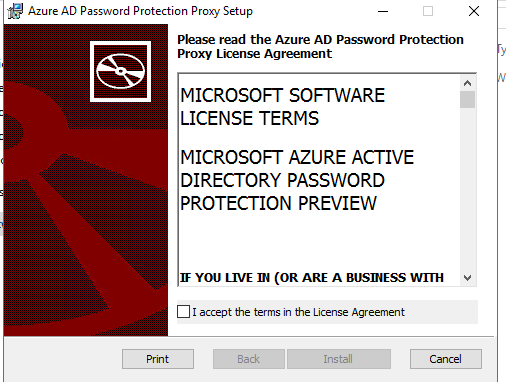
The agent installation could be pushed by your favorite management tool if you so choose.  For the purposes of the blog I’ll be installing it manually.  Double-clicking the MSI file initiates the installation as seen below.

1aadpp6.png

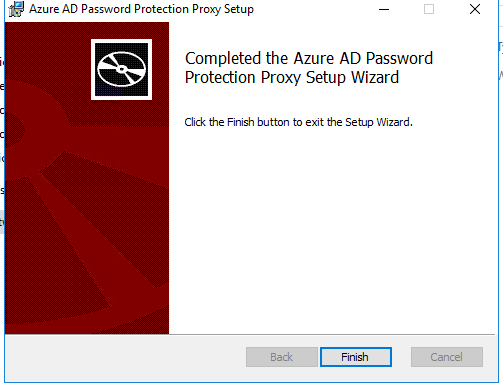
The installation takes under a minute and then we receive confirmation the installation was successful.

1aadpp7.png

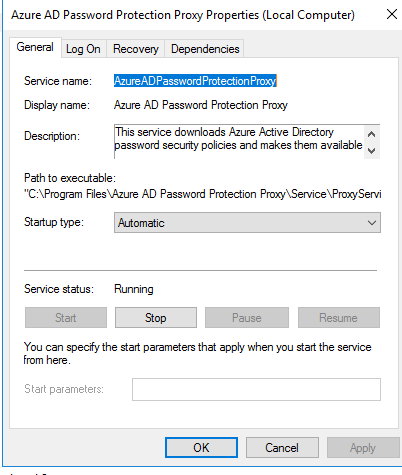
Opening up the Services Microsoft Management Console (MMC) shows the new service having been registered and that it is running. The service runs as Local System.

1aadpp8.png

Before I proceed further with the installation I’m going to startup Fiddler under the Local System security context using PSEXEC.  For that we open an elevated command prompt and run the command below.  The -s parameter opens the application under the LOCAL SYSTEM user context and the -i parameter makes the window interactive.

1aadpp9.png

Additionally we’ll setup another instance of Fiddler that will run under the user’s security context that will be performing the PowerShell cmdlets below.  When running multiple instances of Fiddler different ports needs to be used so agree to the default port suggested by Fiddler and proceed.

Now we need to configure the agent.  To do that we’ll use the PowerShell module that is installed when the proxy agent is installed.  We’ll use a cmdlet from the module to register the proxy with Azure Active Directory.  We’ll need a non-MFA enforced (public preview doesn’t support MFA-enforced global admins for registration) global admin account for this.  The account running the command also needs to be a domain administrator in the Active Directory domain (we’ll see why in a few minutes).

The cmdlet successfully runs.  This tells us the Enable password protection on Windows Server Active Directory option doesn’t prevent registration of the proxy service.   If we bounce back to the Fiddler capture we can see a few different web transactions.

1aadpp10

First we see a non-authenticated HTTP GET sent to https://enterpriseregistration.windows.net/geekintheweeds.com/discover?api-version=1.6.  For those of you familiar with device registration, this endpoint will be familiar.  The endpoint returns a JSON response with a variety of endpoint information.  The data we care about is seen in the screenshot below.  I’m not going to bother hiding any of it since it’s a publicly accessible endpoint.

1aadpp11.png

Breaking this down we can see a security principal identifier, a resource identifier indicating the device registration service, and a service endpoint which indicates the Azure Active Directory Password Protection service.  What this tells us is Microsoft is piggybacking off the existing Azure Active Directory Device Registration Service for onboarding of the proxy agents.

Next up an authenticated HTTP POST is made to https://enterpriseregistration.windows.net/aadpasswordpolicy/<tenantID>/proxy?api-version=1.0.  The bearer token for the global admin is used to authenticate to the endpoint.  Here we have the Proxy Service posting a certificate signing request (CSR) and providing its fully qualified domain name (FQDN).  The request for a CSR tells us the machine must have provisioned a new private/public key pair and once this transaction is complete we should have a signed certificate identifying the proxy.

1aadpp12

The endpoint responds with a JSON response.

1aadpp13.png

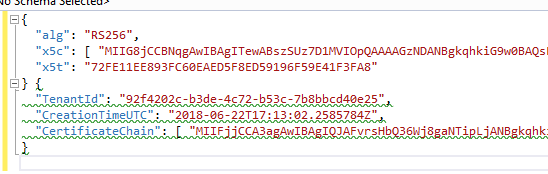
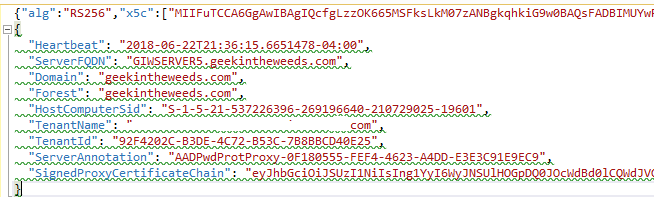
If we open up and base64 decode the value in the SignedProxyCertificateChain we see another signed JSON response. Decoding the response and dropping it into Visual Studio shows us three attributes of note, TenantID, CreationTime, and the CertificateChain.

1aadpp14.png

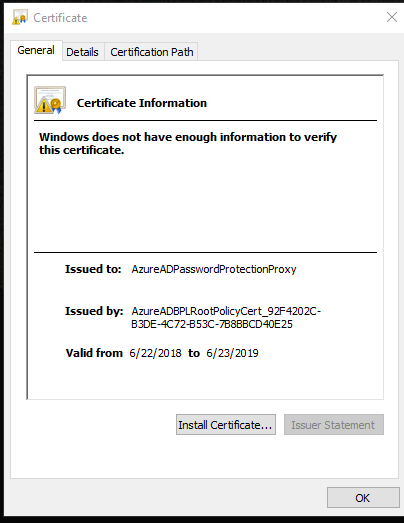
Dropping the value of the CertificateChain attribute into Notepad and saving it as a certificate yields the result below. Note the alphanumeric string after the AzureADBPLRootPolicyCert in the issued to section below.

1aadpp15.png

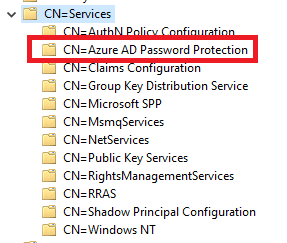
My first inclination after receiving the certificate was to look into the machine certificate stores. I did that and they were empty. After a few minutes of confusion I remembered the documentation stating the registration of the proxy is a onetime activity and that it was mentioned it requires domain admin in the forest root domain and a quick blurb about a service connection point (SCP) and that it needed to be done once for a forest. That was indication enough for me to pop open ADSIEDIT and check out the Configuration directory partition. Sure enough we see that a new container has been added to the CN=Services container named Azure AD Password Protection.

1aadpp16.png

Within the container there is a container named Forest Certs and a service connection point named Proxy Presence. At this point the Forest Certs container is empty and the object itself doesn’t have any interesting attributes set. The Proxy Presence service connection point equally doesn’t have any interesting attributes set beyond the keywords attribute which is set to an alphanumeric string of 636652933655882150_5EFEAA87-0B7C-44E9-B25C-4F665F2E0807. Notice the bolded part of the string has the same pattern as the what was in the certificate included in the CertificateChain attribute. I tried deleting the Azure AD Password Protection container and re-registering to see if these two strings would match, but they didn’t. So I’m not sure what the purpose of that string is yet, just that it probably has some relationship to the certificate referenced above.

The next step in the Proxy Service configuration process is to run the Register-AzureADPasswordProtectionForest cmdlet. This cmdlet again requires the Azure identity being used is a member of the global admins role and that the security principal running the cmdlet has membership in the domain administrators group. The cmdlet takes a few seconds to run and completes successfully.

Opening up Fiddler shows additional conversation with Azure AD.

1aadpp17.png

Session 12 is the same unauthenticated HTTP GET to the discovery endpoint that we saw above.  Session 13 is another authenticated HTTP POST using the global admin’s bearer token to same endpoint we saw after running the last cmdlet.  What differs is the information posted to the endpoint.  Here we see another CSR being posted as well as providing the DNS name, however the attributes are now named ForestCertificateCSR and ForestFQDN.

1aadpp18.png

The endpoint again returns a certificate chain but instead using the attribute SignedForestCertificateChain.

1aadpp19.png

The contents of the attribute look very similar to what we saw during the last cmdlet.

1aadpp20.png

Grabbing the certificate out of the CertificateChain attribute, pasting it into Notepad, and saving as a certificate yields a similar certificate.

1aadpp21.png

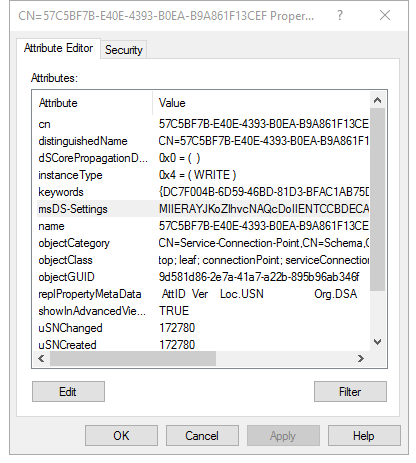
Bouncing back to ADSIEDIT and refreshing the view I saw that the Proxy Presence SCP didn’t change.  We do see a new SCP was created under the Forest Certs container.  Opening up the SCP we have a keywords attribute of {DC7F004B-6D59-46BD-81D3-BFAC1AB75DDB}.  I’m not sure what the purpose of that is yet.  The other attribute we now have set is the msDS-Settings attribute.

1aadpp22.png

Editing the msDS-Settings attribute within the GUI shows that it has no values which obviously isn’t true.  A quick Google search on the attribute shows it’s up to the object to store what it wants in there.

1aadpp23.png

Because I’m nosey I wanted to see the entirety of the attribute so in comes PowerShell.  Using a simple Get-ADObject query I dumped the contents of the attribute to a text file.

1aadpp26.png

The result is a 21,000+ character string.  We’ll come back to that later.

At this point I was convinced there was something I was missing.  I started up WireShark, put a filter on to capture LDAP and LDAPS traffic and I restarted the proxy service.  LDAP traffic was there alright over port 389 but it was encrypted via Kerberos (Microsoft’s typical habit).  This meant a packet capture wouldn’t give me what I wanted so I needed to be a bit more creative.  To get around the encryption I needed to capture the LDAP queries on the domain controller as they were processed.  To do that I used a script. The script is quite simple in that it enables LDAP debug logging for a specific period of time with settings that capture every query made to the device.  It then parses the event log entries created in the Directory Services Event Log and creates a pipe-delimited file.

1aadpp25

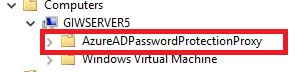
The query highlighted in red is what caught my eye.  Here we can see the service for performing an LDAP query against Active Directory for any objects one level under the GIWSERVER5 computer object and requesting the properties of objectClass, msds-settings, and keywords attributes.  Let’s replicate that query in PowerShell and see what the results look like.

1aadpp26.png

The results, which are too lengthy to paste here are there the computer object has two service connection point objects.  Here is a screenshot from the Active Directory Users and Computers MMC that makes it a bit easier to see.

1aadpp27.png

In the keywords attribute we have a value of {EBEFB703-6113-413D-9167-9F8DD4D24468};Domain=geekintheweeds.com.  Again, I’m not sure what the purpose of the keyword attribute value is.  The msDS-Settings value is again far too large to paste.  However, when I dump the value into the TextWizard in Fiddler and base64 decode it, and dump it into Visual Studio I have a pretty signed JSON web token.

1aadpp28.png

If we grab the value in the x509 Certificate (x5c) header and save it to a certificate, we see it’s the signed using the same certificate we received when we registered the proxy using the PowerShell cmdlets mentioned earlier.

1aadpp29.png

Based upon what I’ve found in the directory, at this point I’m fairly confident the private key for the public private key pair isn’t saved within the directory.  So my next step was to poke around the proxy agent installation directory of

C:\Program Files\Azure AD Password Protection Proxy\.  I went directly to the logs directory and saw the following logs.

1aadpp30.png

Opening up the most recent RegisterProxy log shows a line towards the bottom which was of interest. We can see that the encrypted proxy cert is saved to a folder on the computer running the proxy agent.

1aadpp31.png

Opening the \Data directory shows the following three ppfxe files. I’ve never come across a ppfxe file extension before so I didn’t have a way of even attempting to open it. A Google search on the file extension comes up with nothing. I can only some it is some type of modified PFX file.

1aadpp32.png

Did you notice the RegisterForest log file in the screenshot above? I was curious on that one so I popped it open. Here were the lines that caught my eye.

1aadpp33.png

Here we can see the certificate requested during the Register-AzureADPasswordProtectForest cmdlet had the private key merged back into the certificate, then it was serialized to JSON, encoded in UTF8, encrypted, base64 encoded, and written to the directory to the msDS-Settings attribute.  That jives with what we observed earlier in that dumping that attribute and base-64 decoding it gave us nothing decipherable.

Let’s summarize what we’ve done and what we’ve learned at this point.

  • The Azure Active Directory Password Protection Proxy Service has been installed in GIWSERVER5.
  • The cmdlet Register-AzureADPasswordProtectionProxy was run successfully.
  • When the Register-AzureADPasswordProtectionProxy was run the following actions took place:
    • GIWSERVER5 created a new public/private keypair
    • Proxy service performs discovery against Azure AD to discover the Password Protection endpoints for the tenant
    • Proxy service opened a connection to the Password Protection endpoints for the tenant leveraging the capabilities of the Azure AD Device Registration Service and submits a CSR which includes the public key it generated
    • The endpoint generates a certificate using the public key the proxy service provided and returns this to the proxy service computer
    • The proxy service combines the private key with the public key certificate and saves it to the C:\Program Files\Azure AD Password Protection Proxy\Data directory as a PPFXE file type
    • The proxy service connects to Windows Active Directory domain controller over LDAP port 389 using Kerberos for encryption and creates the following containers and service connection points:
      • CN=Azure AD Password Protection,CN=Configuration,DC=XXX,DC=XXX
      • CN=Forest Certs,CN=Azure AD Password Protection,CN=Configuration,DC=XXX,DC=XXX
        • Writes keyword attribute
      • CN=Proxy Presence,CN=Azure AD Password Protection,CN=Configuration,DC=XXX,DC=XXX
      • CN=AzureADPasswordProtectionProxy,CN=GIWSERVER5,CN=Computers,DC=XXX,DC=XXX
        • Writes signed JSON Web Token to msDS-Settings attribute for
        • Writes keyword attribute (can’t figure out what this does yet)
  • The cmdlet Register-AzureADPasswordProtectionForest was run successfully
  • When the Register-AzureADPasswordProtectionForest was run the following actions took place:
    • GIWSERVER5 created a new public/private keypair
    • Proxy service performs discovery against Azure AD to discover the Password Protection endpoints for the tenant
    • Proxy service opened a connection to the Password Protection endpoints for the tenant leveraging the capabilities of the Azure AD Device Registration Service and submits a CSR which includes the public key it generated
    • The endpoint generates a certificate using the public key the proxy service provided and returns this to the proxy service computer
    • The proxy service combines the private key with the public key certificate and saves it to the C:\Program Files\Azure AD Password Protection Proxy\Data directory as a PPFXE file type
    • The proxy service connects to Windows Active Directory domain controller over LDAP port 389 using Kerberos for encryption and creates the following containers:
      • CN=<UNIQUE IDENTIFIER>,CN=Forest Certs,CN=Azure AD Password Protection,CN=Configuration,DC=XXX,DC=XXX
        • Writes to msDS-Settings the encoded and encrypted certificate it received back from Azure AD including the private key
        • Writes to keyword attribute (not sure on this one either)

Based upon observation and review of the logs the proxy service creates when registering, I’m fairly certain the private key and certificate provisioned during the Register-AzureADPasswordProtectionProxy cmdlet is used by the proxy to make queries to Azure AD for updates on the banned passwords list.  Instead of storing the private key and certificate in the machine’s certificate store like most applications do, it stores them in a PPFXE file format.  I’m going to assume there is some symmetric key stored someone on the machine that is used to unlock the use of that information, but I couldn’t determine it with Rohitab API Monitor or Sysinternal Procmon.

I’m going to theorize the private key and certificate provisioned during the Register-AzureADPasswordProtectionForest cmdlet is going to be used by the DC agents to communicate with the proxy service.  This would make sense because the private key and certificate are stored in the directory and it would make for easy access by the domain controllers.  In my next post I’ll do a deep dive into the DC agent so I’ll have a chance to get more evidence to determine if the theory holds.

On a side note, I attempted to capture the web traffic between the proxy service and Azure AD once the service was installed and registered.  Unfortunately the proxy service doesn’t honor the system proxy even when it’s configured in the global machine.config.  I confirmed that the public preview of the proxy service doesn’t support the usage of a web proxy.  Hopefully we’ll see that when it goes general availability.

Have a great week.