Capturing and Visualizing Office 365 Security Logs – Part 1

Welcome back again my fellow geeks!

I’ve been busy over the past month nerding out on some pet projects.  I thought it would be fun to share one of those pet projects with you.  If you had a chance to check out my last series, I walked through my first Python experiment which was to write a re-usable tool that could be used to pull data from Microsoft’s Graph API (Microsoft Graph).

For those of you unfamiliar with Microsoft Graph, it’s the Restful API (application programming interface) that is used to interact with Microsoft cloud offerings such as Office 365 and Azure.  You’ve probably been interacting with it without even knowing it if through the many PowerShell modules Microsoft has released to programmatically interact with those services.

One of the many resources which can be accessed through Microsoft Graph are Azure AD (Active Directory) security and audit reports.  If you’re using Office 365, Microsoft Azure, or simply Azure AD as an identity platform for SSO (single sign-on) to third-party applications like SalesForce, these reports provide critical security data.  You’re going to want to capture them, store them, and analyze them.  You’re also going to have to account for the window that Microsoft makes these logs available.

The challenge is they are not available via the means logs have traditionally been captured on-premises by using syslogd, installing an SIEM agent, or even Windows Event Log Forwarding.  Instead you’ll need to take a step forward in evolving the way you’re used to doing things. This is what moving to the cloud is all about.

Microsoft allows you to download the logs manually via the Azure Portal GUI (graphical user interface) or capture them by programmatically interacting with Microsoft Graph.  While the former option may work for ad-hoc use cases, it doesn’t scale.  Instead we’ll explore the latter method.

If you have an existing enterprise-class SIEM (Security Information and Event Management) solution such as Splunk, you’ll have an out of box integration.  However, what if you don’t have such a platform, your organization isn’t yet ready to let that platform reach out over the Internet, or you’re interested in doing this for a personal Office 365 subscription?  I fell into the last category and decided it would be an excellent use case to get some experience with Python, Microsoft Graph, and take advantage of some of the data services offered by AWS (Amazon Web Services).   This is the use case and solution I’m going to cover in this post.

Last year I had a great opportunity to dig into operational and security logs to extract useful data to address some business problems.  It was my first real opportunity to examine large amounts of data and to create different visualizations of that data to extract useful trends about user and application behavior.  I enjoyed the hell out of it and thought it would be fun to experiment with my own data.

I decided that my first use case would be Office 365 security logs.  As I covered in my last series my wife’s Office 365 account was hacked.  The damage was minor as she doesn’t use the account for much beyond some crafting sites (she’s a master crocheter as you can see from the crazy awesome Pennywise The Clown she made me for Christmas).

img_4301

The first step in the process was determining an architecture for the solution.  I gave myself a few requirements:

  1. The solution must not be dependent on my home lab infrastructure
  2. Storage for the logs must be cheap and readily available
  3. The credentials used in my Python code needs to be properly secured
  4. The solution must be automated and notify me of failures
  5. The data needs to be available in a form that it can be examined with an analytics solution

Based upon the requirements I decided to go the serverless (don’t hate me for using that tech buzzword 🙂 ) route.  My decisions were:

  • AWS Lambda would run my code
  • Amazon CloudWatch Events would be used to trigger the Lambda once a day to download the last 24 hours of logs
  • Amazon S3 (Simple Storage Service) would store the logs
  • AWS Systems Manager Parameter Store would store the parameters my code used leveraging AWS KMS (Key Management Service) to encrypt the credentials used to interact with Microsoft Graph
  • Amazon Athena would hold the schema for the logs and make the data queryable via SQL
  • Amazon QuickSight would be used to visualize the data by querying Amazon Athena

The high level architecture is pictured below.

untitled

I had never done a Lambda before so I spent a few days looking at some examples and doing the typical Hello World that we all do when we’re learning something new.  From there I took the framework of Python code I put together for general purpose queries to the Microsoft Graph, and adapted it into two Lambdas.  One Lambda would pull Sign-In logs while the other would pull Audit Logs.  I also wanted a repeatable way to provision the Lambdas to share with others and get some CloudFormation practice and brush up on my very dusty Bash scripting.   The results are located here in one of my Github repos.

I’m going to stop here for this post because we’ve covered a fair amount of material.  Hopefully after reading this post you understand that you have to take a new tact with getting logs for cloud-based services such as Azure AD.  Thankfully the cloud has brought us a whole new toolset we can use to automate the extraction and storage of those logs in a simple and secure manner.

In my next post I’ll walk through how I used Athena and QuickSight to put together some neat dashboards to satisfy my nerdy interests and get better insight into what’s happening on a daily basis with my Office 365 subscription.

See you next post and go Pats!

Using Python to Pull Data from MS Graph API – Part 2

Using Python to Pull Data from MS Graph API – Part 2

Welcome back my fellow geeks!

In this series I’m walking through my experience putting together some code to integrate with the Microsoft Graph API (Application Programming Interface).  In the last post I covered the logic behind this pet project and the tools I used to get it done.  In this post I’ll be walking through the code and covering what’s happening behind the scenes.

The project consists of three files.  The awsintegration.py file contains functions for the integration with AWS Systems Manager Parameter Store and Amazon S3 using the Python boto3 SDK (Software Development Kit).  Graphapi.py contains two functions.  One function uses Microsoft’s Azure Active Directory Library for Python (ADAL) and the other function uses Python’s Requests library to make calls to the MS Graph API.  Finally, the main.py file contains the code that brings everything together. There are a few trends you’ll notice with all of the code. First off it’s very simple since I’m a long way from being able to do any fancy tricks and the other is I tried to stay away from using too many third-party modules.

Let’s first dig into the awsintegration.py module.  In the first few lines above I import the required modules which include AWS’s Boto3 library.

import json
import boto3
import logging

Python has a stellar standard logging module that makes logging to a centralized location across a package a breeze.  The line below configures modules called by the main package to inherit the logging configuration from the main package.  This way I was able to direct anything I wanted to log to the same log file.

log = logging.getLogger(__name__)

This next function uses Boto3 to call AWS Systems Manager Parameter Store to retrieve a secure string.  Be aware that if you’re using Parameter Store to store secure strings the security principal you’re using to make the call (in my case an IAM User via Cloud9) needs to have appropriate permissions to Parameter Store and the KMS CMK.  Notice I added a line here to log the call for the parameter to help debug any failures.  Using the parameter store with Boto3 is covered in detail here.

def get_parametersParameterStore(parameterName,region):
    log.info('Request %s from Parameter Store',parameterName)
    client = boto3.client('ssm', region_name=region)
    response = client.get_parameter(
        Name=parameterName,
        WithDecryption=True
    )
    return response['Parameter']['Value']

The last function in this module again uses Boto3 to upload the file to an Amazon S3 bucket with a specific prefix.  Using S3 is covered in detail here.

def put_s3(bucket,prefix,region,filename):
    s3 = boto3.client('s3', region_name=region)
    s3.upload_file(filename,bucket,prefix + "/" + filename)

Next up is the graphapi.py module.  In the first few lines I again import the necessary modules as well as the AuthenticationContext module from ADAL.  This module contains the AuthenticationContext class which is going to get the OAuth 2.0 access token needed to authenticate to the MS Graph API.

import json
import requests
import logging
from adal import AuthenticationContext

log = logging.getLogger(__name__)

In the function below an instance of the AuthenticationContext class is created and the acquire_token_with_client_credentials method is called.   It uses the OAuth 2.0 Client Credentials grant type which allows the script to access the MS Graph API without requiring a user context.  I’ve already gone ahead and provisioned and authorized the script with an identity in Azure AD and granted it the appropriate access scopes.

Behind the scenes Azure AD (authorization server in OAuth-speak) is contacted and the script (client in OAuth-speak) passes a unique client id and client secret.  The client id and client secret are used to authenticate the application to Azure AD which then looks within its directory to determine what resources the application is authorized to access (scope in OAuth-speak).  An access token is then returned from Azure AD which will be used in the next step.

def obtain_accesstoken(tenantname,clientid,clientsecret,resource):
    auth_context = AuthenticationContext('https://login.microsoftonline.com/' +
        tenantname)
    token = auth_context.acquire_token_with_client_credentials(
        resource=resource,client_id=clientid,
        client_secret=clientsecret)
    return token

A properly formatted header is created and the access token is included. The function checks to see if the q_param parameter has a value and it if does it passes it as a dictionary object to the Python Requests library which includes the key values as query strings. The request is then made to the appropriate endpoint. If the response code is anything but 200 an exception is raised, written to the log, and the script terminates.  Assuming a 200 is received the Python JSON library is used to parse the response.  The JSON content is searched for an attribute of @odata.nextLink which indicates the results have been paged.  The function handles it by looping until there are no longer any paged results.  It additionally combines the paged results into a single JSON array to make it easier to work with moving forward.

def makeapirequest(endpoint,token,q_param=None):
 
    headers = {'Content-Type':'application/json', \
    'Authorization':'Bearer {0}'.format(token['accessToken'])}

    log.info('Making request to %s...',endpoint)
        
    if q_param != None:
        response = requests.get(endpoint,headers=headers,params=q_param)
        print(response.url)
    else:
        response = requests.get(endpoint,headers=headers)    
    if response.status_code == 200:
        json_data = json.loads(response.text)
            
        if '@odata.nextLink' in json_data.keys():
            log.info('Paged result returned...')
            record = makeapirequest(json_data['@odata.nextLink'],token)
            entries = len(record['value'])
            count = 0
            while count < entries:
                json_data['value'].append(record['value'][count])
                count += 1
        return(json_data)
    else:
        raise Exception('Request failed with ',response.status_code,' - ',
            response.text)

Lastly there is main.py which stitches the script together.  The first section adds the modules we’ve already covered in addition to the argparse library which is used to handle arguments added to the execution of the script.

import json
import requests
import logging
import time
import graphapi
import awsintegration
from argparse import ArgumentParser

A simple configuration for the logging module is setup instructing it to write to the msapiquery.log using a level of INFO and applies a standard format.

logging.basicConfig(filename='msapiquery.log', level=logging.INFO, format='%(asctime)s - %(name)s - %(levelname)s - %(message)s')
logger = logging.getLogger(__name__)

This chunk of code creates an instance of the ArgumentParser class and configures two arguments.  The sourcefile argument is used to designate the JSON parameters file which contains all the necessary information.

The parameters file is then opened and processed.  Note that the S3 parameters are only pulled in if the –s3 switch was used.

parser = ArgumentParser()
parser.add_argument('sourcefile', type=str, help='JSON file with parameters')
parser.add_argument('--s3', help='Write results to S3 bucket',action='store_true')
args = parser.parse_args()

try:
    with open(args.sourcefile) as json_data:
        d = json.load(json_data)
        tenantname = d['parameters']['tenantname']
        resource = d['parameters']['resource']
        endpoint = d['parameters']['endpoint']
        filename = d['parameters']['filename']
        aws_region = d['parameters']['aws_region']
        q_param = d['parameters']['q_param']
        clientid_param = d['parameters']['clientid_param']
        clientsecret_param = d['parameters']['clientsecret_param']
        if args.s3:
            bucket = d['parameters']['bucket']
            prefix = d['parameters']['prefix']

Next up the get_parametersParameterStore function from the awsintegration module is executed twice.  Once to get the client id and once to get the client secret.  Note that the get_parameters method for Boto3 Systems Manager client could have been used to get both of the parameters in a single call, but I didn’t go that route.

    logging.info('Attempting to contact Parameter Store...')
    clientid = awsintegration.get_parametersParameterStore(clientid_param,aws_region)
    clientsecret = awsintegration.get_parametersParameterStore(clientsecret_param,aws_region)

In these next four lines the access token is obtained by calling the obtain_accesstoken function and the request to the MS Graph API is made using the makeapirequest function.

    logging.info('Attempting to obtain an access token...')
    token = graphapi.obtain_accesstoken(tenantname,clientid,clientsecret,resource)

    logging.info('Attempting to query %s ...',endpoint)
    data = graphapi.makeapirequest(endpoint,token,q_param)

This section creates a string representing the current day, month, and year and prepends the filename that was supplied in the parameters file.  The file is then opened using the with statement.  If you’re familiar with the using statement from C# the with statement is similar in that it ensures resources are cleaned up after being used.

Before the data is written to file, I remove the @odata.nextLink key if it’s present.  This is totally optional and just something I did to pretty up the results.  The data is then written to the file as raw text by using the Python JSON encoder/decoder.

    logging.info('Attempting to write results to a file...')
    timestr = time.strftime("%Y-%m-%d")
    filename = timestr + '-' + filename
    with open(filename,'w') as f:
        
        ## If the data was paged remove the @odata.nextLink key
        ## to clean up the data before writing it to a file

        if '@odata.nextLink' in data.keys():
            del data['@odata.nextLink']
        f.write(json.dumps(data))

Finally, if the s3 argument was passed when the script was run, the put_s3 method from the awsintegration module is run and the file is uploaded to S3.

    logging.info('Attempting to write results to %s S3 bucket...',bucket)
    if args.s3:
        awsintegration.put_s3(bucket,prefix,aws_region,filename)

Exceptions thrown anywhere in the script are captured here written to the log file.  I played around a lot with a few different ways of handling exceptions and everything was so interdependent that if there was a failure it was best for the script to stop altogether and inform the user.  Naftali Harris has an amazing blog that walks through the many different ways of handling exceptions in Python and the various advantages and disadvantages.  It’s a great read.

except Exception as e:
    logging.error('Exception thrown: %s',e)
    print('Error running script.  Review the log file for more details')

So that’s what the code is.  Let’s take a quick look at the parameters file below.  It’s very straight forward.  Keep in mind both the bucket and prefix parameters are only required when using the –s3 option.  Here are some details on the other options:

  • The tenantname attribute is the DNS name of the Azure AD tenant being queries.
  • The resource attribute specifies the resource the access token will be used for.  If you’re going to be hitting the MS Graph API, more than likely it will be https://graph.microsoft.com
  • The endpoint attribute specifies the endpoint the request is being made to including any query strings you plan on using
  • The clientid_param and clientsecret_param attributes are the AWS Systems Manager Parameter Store parameter names that hold the client id and client secret the script was provisioned from Azure AD
  • The q_param attribute is an array of key value pairs intended to story OData query strings
  • The aws_region attribute is the region the S3 bucket and parameter store data is stored in
  • The filename attribute is the name you want to set for the file the script will produce
{
    "parameters":{
        "tenantname": "mytenant.com",
        "resource": "https://graph.microsoft.com",
        "endpoint": "https://graph.microsoft.com/beta/auditLogs/signIns",
        "clientid_param":"myclient_id",
        "clientsecret_param":"myclient_secret",
        "q_param":{"$filter":"createdDateTime gt 2019-01-09"},
        "aws_region":"us-east-1",
        "filename":"sign_in_logs.json",
        "bucket":"mybucket",
        "prefix":"myprefix"
    }
}

Now that the script has been covered, let’s see it action.  First I’m going to demonstrate how it handles paging by querying the MS Graph API endpoint to list out the users in the directory.  I’m going to append the $select query parameter and set it to return just the user’s id to make the output more simple and set the $top query parameter to one to limit the results to one user per page.  The endpoint looks like this https://graph.microsoft.com/beta/users?$top=1&select=id.

I’ll be running the script from an instance of Cloud9.  The IAM user I’m using with AWS has appropriate permissions to the S3 bucket, KMS CMK, and parameters in the parameter store.  I’ve set each of the parameters in the parameters file to the appropriate values for the environment I’ve configured.  I’ll additionally be using the –s3 option.

 

run_script.png

Once the script is complete it’s time to look at the log file that was created.  As seen below each step in the script to aid with debugging if something were to fail.  The log also indicates the results were paged.
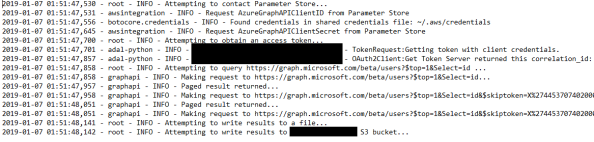
log

The output is nicely formatted JSON that could be further transformed or fed into something like Amazon Athena for further analysis (future post maybe?).
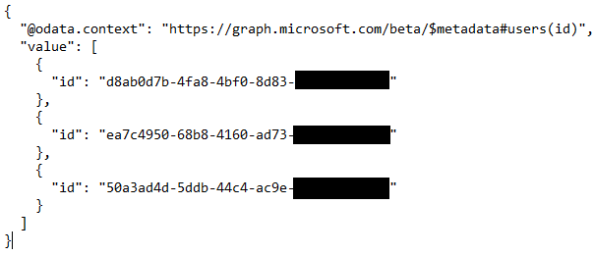
json.png

Cool right?  My original use case was sign-in logs so let’s take a glance that.  Here I’m going to use an endpoint of https://graph.microsoft.com/beta/auditLogs/signIns with a OData filter option of createdDateTime gt 2019-01-08 which will limit the data returned to today’s sign-ins.

In the logs we see the script was successfully executed and included the filter specified.

graphapi_log_sign.png

The output is the raw JSON of the sign-ins over the past 24 hours.  For your entertainment purposes I’ve included one of the malicious sign-ins that was captured.  I SO can’t wait to examine this stuff in a BI tool.
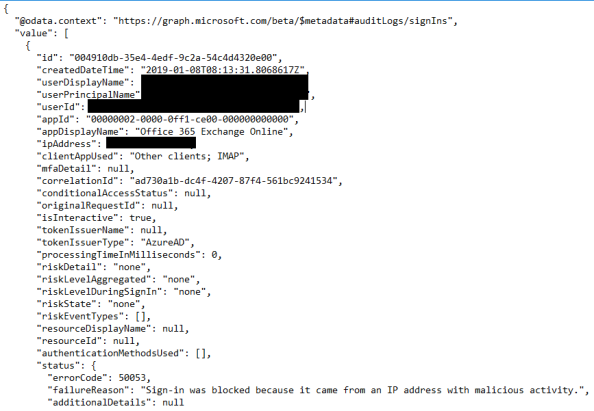
sign_in_json

Well that’s it folks.  It may be ugly, but it works!  This was a fun activity to undertake as a first stab at making something useful in Python.  I especially enjoyed the lack of documentation available on this integration.  It really made me dive deep and learn things I probably wouldn’t have if there were a billion of examples out there.

I’ve pushed the code to Github so feel free to muck around with it to your hearts content.

AWS Managed Microsoft AD Deep Dive Part 6 – Schema Modifications

AWS Managed Microsoft AD Deep Dive  Part 6 – Schema Modifications

Yes folks, we’re at the six post for the series on AWS Managed Microsoft AD (AWS Managed AD.  I’ve covered a lot of material over the series including an overview, how to setup the service, the directory structure, pre-configured security principals, group policies, and the delegated security model, how to configure LDAPS in the service and the implications of Amazon’s design, and just a few days ago looked at the configuration of the security of the service in regards to protocols and cipher suites.  As per usual, I’d highly suggest you take a read through the prior posts in the series before starting on this one.

Today I’m going to look the capabilities within the AWS Managed AD to handle Active Directory schema modifications.  If you’ve read my series on Microsoft’s Azure Active Directory Domain Services (AAD DS) you know that the service doesn’t support the schema modifications.  This makes Amazon’s service the better offering in an environment where schema modifications to the standard Windows AD schema are a requirement.  However, like many capabilities in a managed Windows Active Directory (Windows AD) service, limitations are introduced when compared to a customer-run Windows Active Directory infrastructure.

If you’ve administered an Active Directory environment in a complex enterprise (managing users, groups, and group policies doesn’t count) you’re familiar with the butterflies that accompany the mention of a schema change.  Modifying the schema of Active Directory is similar to modifying the DNA of a living being.  Sure, you might have wonderful intentions but you may just end up causing the zombie apocalypse.  Modifications typically mean lots of application testing of the schema changes in a lower environment and a well documented and disaster recovery plan (you really don’t want to try to recover from a failed schema change or have to back one out).

Given the above, you can see the logic of why a service provider providing a managed Windows AD service wouldn’t want to allow schema changes.  However, there very legitimate business justifications for expanding the schema (outside your standard AD/Exchange/Skype upgrades) such as applications that need to store additional data about a security principal or having a business process that would be better facilitated with some additional metadata attached to an employee’s AD user account.  This is the market share Amazon is looking to capture.

So how does Amazon provide for this capability in a managed Windows AD forest?  Amazon accomplishes it through a very intelligent method of performing such a critical activity.  It’s accomplished by submitting an LDIF through the AWS Directory Service console.  That’s right folks, you (and probably more so Amazon) doesn’t have to worry about you as the customer having to hold membership in a highly privileged group such as Schema Admins or absolutely butchering a schema change by modifying something you didn’t intend to modify.

Amazon describes three steps to modifying the schema:

  1. Create the LDIF file
  2. Import the LDIF file
  3. Verify the schema extension was successful

Let’s review each of the steps.

In the first step we have to create a LDAP Data Interchange Format (LDIF) file.  Think of the LDIF file as a set of instructions to the directory which in this could would be an add or modify to an object class or attribute.  I’ll be using a sample LDIF file I grabbed from an Oracle knowledge base article.  This schema file will add the attributes of unixUserName, unixGroupName, and unixNameIinfo to the default Active Directory schema.

To complete step one I dumped the contents below into an LDIF file and saved it as schemamod.ldif.

dn: CN=unixUserName, CN=Schema, CN=Configuration, DC=example, DC=com
changetype: add
attributeID: 1.3.6.1.4.1.42.2.27.5.1.60
attributeSyntax: 2.5.5.3
isSingleValued: TRUE
searchFlags: 1
lDAPDisplayName: unixUserName
adminDescription: This attribute contains the object's UNIX username
objectClass: attributeSchema
oMSyntax: 27

dn: CN=unixGroupName, CN=Schema, CN=Configuration, DC=example, DC=com
changetype: add
attributeID: 1.3.6.1.4.1.42.2.27.5.1.61
attributeSyntax: 2.5.5.3
isSingleValued: TRUE
searchFlags: 1
lDAPDisplayName: unixGroupName
adminDescription: This attribute contains the object's UNIX groupname
objectClass: attributeSchema
oMSyntax: 27

dn:
changetype: modify
add: schemaUpdateNow
schemaUpdateNow: 1
-

dn: CN=unixNameInfo, CN=Schema, CN=Configuration, DC=example, DC=com
changetype: add
governsID: 1.3.6.1.4.1.42.2.27.5.2.15
lDAPDisplayName: unixNameInfo
adminDescription: Auxiliary class to store UNIX name info in AD
mayContain: unixUserName
mayContain: unixGroupName
objectClass: classSchema
objectClassCategory: 3
subClassOf: top

For the step two I logged into the AWS Management Console and navigated to the Directory Service Console.  Here we can see my instance AWS Managed AD with the domain name of geekintheweeds.com.

6awsadds1.png

I then clicked hyperlink on my Directory ID which takes me into the console for the geekintheweeds.com instance.  Scrolling down shows a menu where a number of operations can be performed.  For the purposes of this blog post, we’re going to focus on the Maintenance menu item.  Here we the ability to leverage AWS Simple Notification Service (AWS SNS) to create notifications for directory changes such as health changes where a managed Domain Controller goes down.  The second section is a pretty neat feature where we can snapshot the Windows AD environment to create a point-in-time copy of the directory we can restore.  We’ll see this in action in a few minutes.  Lastly, we have the schema extensions section.

6awsadds2.png

Here I clicked the Upload and update schema button and entered selected the LDIF file and added a short description.  I then clicked the Update Schema button.

6awsadds3.png

If you know me you know I love to try to break stuff.  If you look closely at the LDIF contents I pasted above you’ll notice I didn’t update the file with my domain name.  Here the error in the LDIF has been detected and the schema modification was cancelled.

6awsadds4.png

I went through made the necessary modifications to the file and tried again.  The LDIF processes through and the console updates to show the schema change has been initialized.

6awsadds5.png

Hitting refresh on the browser window updates the status to show Creating Snapshot.  Yes folks Amazon has baked into the schema update process a snapshot of the directory provide a fallback mechanism in the event of your zombie apocalypse.  The snapshot creation process will take a while.

6awsadds6.png

While the snapshot process, let’s discuss what Amazon is doing behind the scenes to process the LDIF file.  We first saw that it performs some light validation on the LDIF file, it then takes a snapshot of the directory, then applies to the changes to a single domain controller by selecting one as the schema master, removing it from directory replication, and applying the LDIF file using the our favorite old school tool LDIFDE.EXE.  Lastly, the domain controller is added back into replication to replicate the changes to the other domain controller and complete the changes.  If you’ve been administering Windows AD you’ll know this has appeared recommended best practices for schema updates over the years.

Once the process is complete the console updates to show completion of the schema installation and the creation of the snapshot.

6awsadds7.png


My Experience Passing AWS Certified Cloud Practitioner Exam

Welcome back my fellow geeks!

Today I’m going to interrupt the series on AWS Managed Microsoft AD   For the past few weeks, in between writing the entries for the recent deep dive series, I’ve been preparing for the AWS Cloud Practitioner exam.  I thought it would be helpful to share my experience prepping for and passing the exam.

If you’re not familiar with the AWS Certificated Cloud Practitioner exam, it’s very much an introductory exam into the Amazon Web Services’ overarching architecture and products.  Amazon’s intended audience for the certification are your C-levels, sales people, and technical people who are new to the AWS stack and potentially cloud in general.  It’s very much an inch deep and mile wide.  For those of you who have passed your CISSP, the experience studying for it similar (although greatly scaled down content-wise) in that you need to be able to navigate the shallow end of many pools.

Some of you may be asking yourselves why I invested my time in getting an introductory certificate rather than just going for the AWS Certified Solutions Architect – Associate.  The reason is my personal belief that establishing a solid foundation in a technology or product is a must.  I’ve encountered too many IT professionals with a decade more of experience and a hundred certificates to their name who can’t explain the basics of the OSI model or the difference in process between digitally signing something versus encrypting it.  The sign of a stellar IT professional is one who can start at the business justification for an application and walk you right down through the stack to speak to the technology standards being leveraged within the application to deliver its value.  This importance in foundation is one reason I recommend every new engineer start out by taking the CompTIA A+, Network+, and Security+ exams.  You won’t find exams out there that better focus on foundational concepts than CompTIA exams.

The other selling point of this exam to me was the audience it’s intended for.  Who wouldn’t want to know the contents and messaging in an exam intended for the C-level?  Nothing is more effective influencing the C-level than speaking the language they’re familiar with and pushing the messaging you know they’ve been exposed to.

Let me step off this soapbox and get back to my experience with the exam.  🙂

As I mentioned above I spent about two weeks preparing for the exam.  My experience with the AWS stack was pretty minimal prior to that restricted to experience for my prior blogs on Azure AD and AWS integration for SSO and provisioning and Microsoft Cloud App Security integration with AWS.  As you can tell from the blog, I’ve done a fair amount of public cloud solutions over the past few years, just very minimally AWS.  The experience in other public cloud solutions such as Microsoft Azure and Google Cloud Platform (GCP) proved hugely helpful because the core offerings are leveraging similar modern concepts (i.e. all selling computer, network, and storage).  Additionally, the experiences I’ve had over my career with lots of different infrastructure gave me the core foundation I needed to get up and running.  The biggest challenge for me was really learning the names of all the different offerings, their use cases, and their capabilities that set them apart from the other vendors.

For studying materials I followed most of the recommendations from Amazon which included reviews of a number of whitepapers.  I had started the official Amazon Cloud Practitioner Essentials course (which is free by the way) but didn’t find the instructors engaging enough to keep my attention.  I ended up purchasing a monthly subscription to courses offered by A Cloud Guru which were absolutely stellar and engaging at a very affordable monthly price (something like $29/month).  In addition to the courses I read each of the recommended whitepapers (ended reading a bunch of others as well) a few times each taking notes of key concepts and terminology.  While I was studying for this exam, I also was working on my AWS deep dive which helped to reinforce the concepts by actually building out the services for my own use.

I spent a lot of time diving into the rabbit whole of products I found really interesting (RedShift) as well as reading up on concepts I’m weaker on (big data analytics, modern nosql databases, etc).  That rabbit hole consisted of reading blogs, Wikipedia, and standards to better understand the technical concepts.  Anything I felt would be worthwhile I captured in my notes.  Once I had a good 15-20 pages of notes (sorry all paper this time around), I grabbed the key concepts I wanted to focus on and created flash cards.  I studying the deck of 200 or so flash cards each night as well as re-reading sections of the whitepapers I wanted to familiarize myself with.

For practice exams I used the practice questions Amazon provides as well as the quizzes from A Cloud Guru.  I found the questions on the actual exam more challenging, but the practice question and quizzes were helpful to getting into the right mindset.  The A Cloud Guru courses probably covered a good 85-90% of the material, but I wouldn’t recommend using it was a sole source of study, you need to read those whitepapers multiple times over.  You also need to do some serious hands on because some of the questions do ask you very basic questions about how you do things in the AWS Management Console.

Overall it was a well done exam.  I learned a bunch about the AWS product offerings, the capabilities that set AWS apart from the rest of the industry, and gained a ton of good insight into general cloud architecture and design from the whitepapers (which are really well done).  I’d highly recommend the exam to anyone who has anything to do with the cloud, whether you’re using AWS or not.  You’ll gain some great insight into cloud architecture best practices as well seeing modern technology concepts put in action.

I’ll be back with the next entry in my AWS Managed Microsoft AD series later this week.  Have a great week and thanks for reading!