AWS Managed Microsoft AD Deep Dive Part 5 – Security

AWS Managed Microsoft AD Deep Dive  Part 5 – Security

You didn’t think I was done with AWS Managed Microsoft AD yet did you?  In this post I’m going to perform some tests to evaluate the protocols and ciphers suites available for LDAPS as well as checking out the managed Domain Controllers support for NTLMv1 and the cipher suites supported for Kerberos.  I’ll be using the same testing mechanisms I used when for my series on Microsoft Azure Active Directory Domain Services.

For those of you who are new to the series, I’ve been performing a deep dive review of AWS Managed Microsoft AD which is Amazon’s answer to a managed Windows Active Directory service.  In the first post I provided a high level overview of the service, in the second post I covered the setup of the service, the third post reviewed the directory structure, pre-configured security principals and group policies, and the delegated security model, and in the fourth entry I delved into how Amazon has managed to delegate configuration of LDAPS and the requirements that pop up due to their design choices.  I highly recommend you review those posts as well as my series on Microsoft Azure AD Domain Services if you’d like to compare the two services.

I’ve made a modification to my lab and have added another server named SERVER02 which will be running Linux.  The updated Visio looks like this.

labpart5

Server01 has been configured with the Windows Remote Server Administration Tools (RSAT) for Active Directory as well as holding the Active Directory Certificate Services (AD CS) role and being configured as a root Enterprise CA.  I’ve also done all the necessary configuration to distribute the certificates to the managed domain controllers and have successfully tested LDAPS.  Server02 will be used to test SSLv3 and NTLM.  I’ve modified the instance to use the domain controllers as DNS servers by overriding DHCP settings as outlined in this article.

The first thing I’m going to do is test to see if SSLv3 has been disabled on the managed domain controllers.  Recall that the managed Domain Controllers are running Windows Server 2012 R2 which has SSLv3 enabled by default.  It can be disabled by modifying the registry as documented here.  Believe it or not you can connect to the managed domain controllers registry via a remote registry connection.  Checking the registry location shows that the SSLv3 node hasn’t been created which is indicative of SSLv3 still being enabled.

5awsadds1.png

To be sure I checked it using the same method that I used in my Azure AD Domain Services post which is essentially compiling another version of openssh that supports SSLv3.  After the customized version was installed and I queried the Domain Controller over port 636 which you can see in the screenshot below that SSLv3 is still enabled.  Suffice to say this surprised me considering what I had seen so far in regards to the security of the service.  This will be a show stopper for some organizations in adopting the service especially since it isn’t configurable by the customer that I observed.

5awsadds2.png

So SSLv3 is enabled and presents a risk.  Have the cipher suites been hardened?  For this I’ll again use a tool developed by Thomas Pornin.   The options I’m using perform an exhaustive search across the typically offered cipher suites, space the connections out by 1 second, and start with a minimum of sslv3.

5awsadds3.png

The results are what I expected and mimic the results I saw when testing Azure AD Domain Services, minus the support for SSLv3 which Microsoft has disabled in their managed offering.  The supported cipher suites look to be the out of the box defaults for Server 2012 R2 and include RC4 and 3DES which are ciphers with known vulnerabilities.  The inability to disallow the ciphers might again be a show stopper for organizations with strict security requirements.

The Kerberos protocol is a critical component of Windows Active Directory providing the glue to hold the service together including (but in no way exhaustive) being behind the users authentication to a domain-joined machine, the single sign-on experience, and the ability to form trusts with other forests.  Given the importance of the protocol, it’s important to ensure its backed by strong ciphers.  The ciphers supported by a Windows Active Directory are configurable and can be checked by looking at the msDS-SupportedEncryptionTypes attribute of a domain controller object.

I next pulled up a domain controller object in ADUC and reviewed the attribute.  The attribute on the managed domain controllers has a value of 28, which is the default for Windows Server 2012 R2.  The value translates to support of the following cipher suites:

  • RC4_HMAC_MD5
  • AES128_CTS_HMAC_SHA1
  • AES256_CTS_HMAC_SHA1_96

These are the same cipher suites supported by Microsoft’s Azure AD Domain Services service.  In this case both vendors have left the configuration to the defaults.

Lastly, to emulate my testing Azure AD Domain Services, I tested support for NTLMv1.  By default Windows Server 2012 R2 supports NTLMv1 due to requirements for backwards compatibility. Microsoft has long recommended disabling NTLMv1 due to the documented issues with the security of the protocol. Sadly there are a large number of applications and devices in use in enterprises which still require NTLMv1.

To test the AWS managed domain controllers I’m going to use Samba’s smbclient package on SERVER02.  I’ll use the client to connect to the domain controller’s share from SERVER02 using NTLM.  I first installed the smbclient package by running:

yum install samba-client.

The client enforces the use NTLMV2 in smbclient by default so I needed to make some modifications to the global section of the smb.conf file by adding client ntlmv2 auth = no. This option disables NTLMv2 on smbclient and will force it to use NTLMv1.

5awsadds4.png

In order to see whether or not the client was using NTLMv1 when connecting to the domain controllers, I started a packet capture using tcpdump before initiating a connection with the smbclient.

5awsadds6.png

I then transferred the packet capture over to my Windows box with WinSCP, opened the capture with WireShark, and navigated to the packet containing the Session Setup Request.  In the parsed capture we don’t see an NTLMv2 Response which means NTLMv1 was used to authenticate to the domain controller indicating NTLMv1 is supported by the managed domain controllers.


5awsadds5


So what can we take from the findings of this analysis?

  1. Amazon has left the secure transport protocols to the defaults which means SSLv3 is supported.
  2. Amazon has left the cipher suites to the defaults which means both RC4 and 3DES cipher suites are supported for both LDAPS and Kerberos.

I’d really like to see Amazon address the support for SSLv3 as soon as possible.  There is no reason I can see why that shouldn’t be shut off by default.  Similar to my requests to Microsoft, I’d like to see Amazon allow the supported cipher suites to be configurable via the AWS Management Console.  These two changes would save organizations with strict security requirements, such as those in the public sector, to utilize the services without introducing significant risk (and audit headaches).

In my next post I’ll demonstrate how the service can be leveraged to provide Windows Active Directory service to on-premises machines or machines in another public cloud as well as exploring how to create a forest trust with the service.

See you next post!


AWS Managed Microsoft AD Deep Dive Part 4 – Configuring LDAPS

AWS Managed Microsoft AD Deep Dive  Part 4 – Configuring LDAPS

I’m back again with another entry in my deep dive into AWS Managed Microsoft Active Directory (AD).  So far I’ve provided an overview of the service, covered how to configure the service, and analyzed the Active Directory default configuration such as the directory structure, security principals, password policies, and group policy setup by Amazon for new instances.  In this post I’m going to look at the setup of LDAPS and how Amazon supports configuration of it in the delegated model they’ve setup for the service.

Those of you that have supported a Windows AD environment will be quite familiar with the wonders and sometimes pain of the Lightweight Directory Access Protocol (LDAP).  Prior to the modern directories such as AWS Cloud Directory, Azure Active Directory the LDAP protocol served critical roles by providing both authentication and a method of which to work with data stored in directory data stores such as Windows AD.  For better or worse the protocol is still relevant today when working with Windows AD for both of the above capabilities (less for authentication these days if you stay away from backwards-thinking vendors).  LDAP servers listen on port 389 and 636 with 389 maintaining traffic in the clear (although there are exceptions where data is encrypted in transit such as Microsoft’s usage of Kerberos encryption or the use of StartTLS (credit to my friend Chris Jasset for catching my omission of StartTLS)) and 636 (LDAPS) providing encryption in transit via an SSL tunnel (hopefully not anymore) or a TLS tunnel.

Windows AD maintains that pattern and serves up the content of its data store over LDAP over ports 389 and 636 and additionally ports 3268 and 3269 for global catalog queries.  In the assume breach days we’re living in, we as security professionals want to protect our data as it flows over the network which means we’ll more often than not (exceptions are again Kerberos encryption usage mentioned above) be using LDAPS over ports 636 or 3269.  To provide that secure tunnel the domain controllers will need to be setup with a digital certificate issued by a trusted certificate authority (CA).    Domain Controllers have unique requirements for the certificates they use.  If you’re using  Active Directory Certificate Services (AD CS) Microsoft takes care of providing the certificate template for you.

So how do you provision a certificate to a Domain Controller’s certificate store when you don’t have administrative privileges such as the case for a managed service like AWS Managed Active Directory?   For Microsoft Azure Active Directory Domain Services (AAD DS) the public certificate and private key are uploaded via a web page in the Azure Portal which is a solid way of doing it.  Amazon went in a different and instead takes advantage of certificate autoenrollment.  If you’re not familiar with autoenrollment take a read through this blog.  In short, it’s an automated way to distribute certificates and eliminate some of the overheard of manually going through the typical certificate lifecycle which may contain manual steps.

If we bounce back to the member server in my managed domain, open the Group Policy Management Console (GPMC), and navigate to the settings tab of the AWS Managed Active Directory Policy we see that autoenrollment has been enabled on the domain controllers.  This setting explains why Amazon requires a member server joined to the managed domain be configured running AD CS.  Once the AD CS instance is setup, the CA has been configured either to as a root or subordinate CA, and a proper template is enabled for autoenrollment, the domain controllers will request the appropriate certificate and will begin using it for LDAPS.

4awsadds1.png

If you’ve ever worked with AD CS you may be asking yourself how you’ll be able to install AD CS in a domain where you aren’t a domain administrator when the Microsoft documentation specifically states you need to be a member of the Enterprise Admins and root domains Domain Admins group.  Well folks that is where the AWS Delegated Enterprise Certificate Authority Administrators group comes into play.  Amazon has modified the forest to delegate the appropriate permissions to install AD CS in a domain environment.  If we navigate to the CN=Public Key Services, CN=Services, CN=Configuration using ADSIEdit and view the Security for the container we see this group has been granted full permissions over the node allowing the necessary objects to be populated underneath it.

4awsadds2.png

I found it interesting that in the instructions provided by Amazon for enabling LDAPS the instructions state the Domain Controller certificate template needs to modified to remove the Client Authentication EKU.  I’d be interested in knowing the reason for modifying the Domain Controller certificate.  If I had to guess it’s to prevent the domain controller from using the certificate outside of LDAPS such as for mutual authentication during smart card logon.  Notice that from this article domain controllers only require the Server Authentication EKU when a certificate is only used to secure LDAPS.

I’ve gone ahead and installed AD CS on SERVER01 as an Enterprise root CA and thanks to the delegation model, the CA is provisioned with all the necessary goodness in CN=Public Key Services.  I also created the new certificate template following the instructions from Amazon.  The last step is to configure the traffic flow such that the managed domain controllers can contact the CA to request a certificate.  The Amazon instructions actually have a typo in them.  On Step 4 it instructs you to modify the security group for your CA and to create a new inbound rule allowing all traffic from the source of your CA’s AWS Security group.  The correct security group is actually the security group automatically configured by Amazon that is associated with the managed Active Directory instance.

At this point you’ll need to wait a few hours for the managed domain controllers to detect the new certificates available for autoenrollment.  Mine actually only took about an hour to roll the certificates out.

4awsadds3.png

To test the service I opened LDP.EXE and established a secure session over port 636 and all worked as expected.

4awsadds4.png

Since I’m a bit OCD I also pulled the certificate using openssl to validate it’s been issued by my CA.  As seen in the screenshot below the certificate was issued by the geekintheweeds-CA which is the CA I setup earlier.

4awsadds5.png

Beyond the instructions Amazon provides, you’ll also want to give some thought as to how you’re going to handle revocation checks. Keep in mind that by default AD CS stores revocation information in AD. If you have applications configured to check for revocation remember to ensure those apps can communicate with the domain controllers over port 389 so design your security groups with this in mind.

Well folks that will wrap up this post. Now that LDAPS is configured, I’ll begin the tests looking at the protocols and ciphers supported when accessing LDAPS as well as examining the versions of NTLM supported and the encryption algorithms supported with Kerberos.

See you next post!


Deep Dive into Azure AD Domain Services – Part 3

Deep Dive into Azure AD Domain Services  – Part 3

Well folks, it’s time to wrap up this series on Azure Active Directory Domain Services (AAD DS).  In my first post I covered the basic configurations of the managed domain and in my second post took a look at how well Microsoft did in applying security best practices and complying with NIST standards.  In this post I’m going to briefly cover the LDAPS over the Internet capability, summarize some key findings, and list out some improvements I’d like to see made to the service.

One of the odd features Microsoft provides with the AAD DS service is the ability to expose the managed domain over LDAPS to the Internet.  I really am lost as to the use case that drove the feature.  LDAP is very much a legacy on-premises protocol that has no place being exposed to risks of the public Internet.  It’s the last thing that should the industry should be encouraging.  Just because you can, doesn’t mean you should.   Now let me step off the soap box and let’s take a look at the feature.

As I covered in my last post LDAPS is not natively enabled in the managed domain.  The feature must be configured and enabled through the Azure Portal.  The configuration consists of uploading the private key and certificate the service will use in the form of a PKCS12 file (*.PFX).  The certificate has a few requirements that are outlined in the instructions above.  After the certificate is validated, it takes about 10-15 minutes for the service to become available.  Beyond enabling the service within the VNet, you additionally have the option to expose the LDAPS endpoint to the Internet.

3aads1.png

Microsoft provides instructions on how to restrict access to the endpoint to trusted IPs via a network security group (NSG) because yeah, exposing an LDAP endpoint to the Internet is just a tad risky.  To lock it down you simply associate an NSG with the subnet AAD DS is serving.  Once that is done enable the service via the option in the image above and wait about 10 minutes.  After the service is up, register a external DNS record for the service that points to the IP address noted under the properties section of the AADS blade and you’re good to go.

For my testing purposes, I locked the external LDAPS endpoint down to the public IP address my Azure VM was SNATed to.  After that I created an entry in the host file of the VM that matched the external DNS name I gave the service (whyldap.geekintheweeds.com) to the public IP address of the LDAPS endpoint in order to bypass the split-brain DNS challenge.  Initiating a connection from LDP.EXE was a success.

3aads2.png

Now that we know the service is running, let’s check out what the protocol support and cipher suite looks like.

3aads3.png

Again we see the use of deprecated cipher suites. Here the risk is that much greater since a small mistake with an NSG could expose this endpoint directly to the Internet.  If you’re going to use this feature, please just don’t.  If you’re really determined to, don’t screw up your NSGs.

This series was probably one of the more enjoyable series I’ve done since I knew very little about the AAD DS offering. There were a few key takeaways that are worth sharing:

  • The more objects in the directory, the more expensive the service.
  • Users and groups can be created directly in managed domain after a new organizational unit is created.
  • Password and lockout policy is insanely loose to the point where I can create an account with a three character password (just need to meet complexity requirements) and accounts never lockout.  The policy cannot be changed.
  • RC4 encryption ciphers are enabled and cannot be disabled.
  • NTLMv1 is enabled and cannot be disabled.
  • The service does not support smart-card enforced users.  Yes, that includes both the users synchronized from Azure AD as well as any users you create directly in the managed domain.  If I had to guess, it’s probably due to the fact that you’re not a Domain Admin so hence you can’t add to the NTAuth certificate store.
  • LDAPS is not enabled by default.
  • Schema extensions are not supported.
  • Account-Based Kerberos Delegation is not supported.
  • If you are syncing identities to Azure AD, you’ll also need to synchronize your passwords.
  • The managed domain is very much “out of the box” defaults.
  • Microsoft creates a “god” account which is a permanent member of every privileged group in the forest
  • Recovery of deleted objects created directly in the managed domain is not possible.  The rights have not been delegated to the AADC Administrator.
  • The service does not allow for Active Directory trusts
  • SIDHistory attribute of users and groups sourced from Azure AD is populated with Primary Group from on-premises domain

My verdict on AAD DS is it’s not a very useful service in its current state.  Beyond small organizations, organizations that have very little to no requirements on legacy infrastructure, organizations that don’t have strong security requirements, and dev/qa purposes I don’t see much of a use for it right now.  It comes off as a service in its infancy that has a lot of room to grow and mature.  Microsoft has gone a bit too far in the standardization/simplicity direction and needs to shift a bit in the opposite direction by allowing for more customization, especially in regards to security.

I’d really like to see Microsoft introduce the capabilities below.   All of them should  exposed via the resource blade in the Azure Portal if at all possible.  It would provide a singular administration point (which seems to be the strategy given the move of Azure AD and Intune to the Azure Portal) and would allow Microsoft to control how the options are enabled in the managed domain.  This means no more administrators blowing up their Active Directory forest because they accidentally shut off all the supported cipher suites for Kerberos.

  • Expose Domain Controller Event Logs to Azure Portal/Graph API and add support for AAD DS Power BI Dashboards
  • Support for Active Directory trusts
  • Out of the box provide a Red Forest model (get rid of that “god” account)
  • Option to disable risky cipher suites for both Kerberos and LDAPS
  • Option to harden the password and lockout policy
  • Option to disable NTLMv1
  • Option to turn on LDAP Debug Logging
  • Option to direct Domain Controller event logs to a SIEM
  • Option to restore deleted users and groups that were created directly in the managed domain.  If you’re allow creation, you need to allow for restoration.
  • Removal of Internet-accessible LDAPS endpoint feature or at least somehow incorporate the NSG lockdown feature directly into the AAD DS blade.

While the service has a lot of room for improvement the direction of a managed Windows AD offering is spot on.  In the year 2018, there is no reason Windows AD shouldn’t be offered as a managed service.  The direction Microsoft has gone by sourcing the identities and credentials from Azure AD is especially creative.  It’s a solid step in the direction of creating a singular centralized identity service that provides both legacy and modern protocols.  I’ll be watching this service closely as Microsoft builds upon it for the next few months.

Thanks and see you next post!

Deep Dive into Azure AD Domain Services – Part 1

Deep Dive into Azure AD Domain Services  – Part 1

Hi everyone.  In this series of posts I’ll be doing a deep dive into Microsoft’s Azure AD Domain Services (AAD DS).  AAD DS is Microsoft’s managed Windows Active Directory service offered in Microsoft Azure Infrastructure-as-a-Service intended to compete with similar offerings such as Amazon Web Services’s (AWS) Microsoft Active Directory.  Microsoft’s solution differs from other offerings in that it sources its user and group information from Azure Active Directory versus an on-premises Windows Active Directory or LDAP.

Like its competitors Microsoft realizes there are still a lot of organizations out there who are still very much attached to legacy on-premises protocols such as NTLM, Kerberos, and LDAP.  Not every organization (unfortunately) is ready or able to evolve its applications to consume SAML, Open ID Connect, OAuth, and Rest-Based APIs (yes COTS vendors I’m talking to you and your continued reliance on LDAP authentication in the year 2018).  If the service has to be there, it makes sense to consume a managed service so staff can focus less on maintaining legacy technology like Windows Active Directory and focus more on a modern Identity-as-a-Service (IDaaS), Software-as-a-Service (SaaS), and Platform-as-a-Service (Paas) solutions.

Sounds great right?  Sure, but how does it work?  Microsoft’s documentation does a reasonable job giving the high level details of the service so I encourage you to read through it at some point.  I won’t be covering information included in that documentation unless I notice a discrepancy or an area that could use more detail.  Instead, I’m going to focus on the areas which I feel are important to understand if you’re going to attempt to consume the service in the same way you would a traditional on-premises Windows Active Directory.

With that introduction, let’s dig in.

The first thing I did was to install the Remote Server Administration Tools (RSAT) for Active Directory Domain Services and Group Policy Management tools.  I used these tools to explore some of the configuration choices Microsoft made in the managed service.  I also installed Microsoft Network Monitor 3.4 to review packet captures  captured using the netsh.

After the tools were installed I started a persistent network capture using netsh using an elevated command prompt.  This is an incredibly useful feature of Windows when you need to debug issues that occur prior or during user or system logon.  I’ve used this for years to troubleshoot a number of Windows Active Directory issues including slow logons and failed logons.  The only downfall of this is you’re forced into using Microsoft Network Monitor or Microsoft Message Analyzer to review the packet captures it creates.  While Microsoft Message Analyzer is a sleek tool, the resources required to run it effectively are typically a non-starter for a lab or traditional work laptop so I tend to use Network Monitor.

entry1pic1

After the packet capture was started I went through the standard process of joining the machine to the domain and rebooting the computer.  After reboot, I logged in an account in the AAD DC Administrators Azure Active Directory group, started an elevated command prompt as the VM’s local administrator and stopped the packet capture.  This provided me with a capture of the domain join, initial computer authentication, and initial user authentication.

entry1pic2

While I know you’re as eager to dig into the packet capture as I am, I’ll cover that in a future post.  Instead I decided to break out the RSAT tools and poke around at configuration choices an administrator would normally make when building out a Windows Active Directory domain.

Let’s first open the tool everyone who touches Windows Active Directory is familiar with, Active Directory Users and Computers (ADUC).  The data layout (with Advanced Features option on) for organizational units (OUs) and containers looks very similar to what we’re used to seeing with the exception of the AADC Computers, AADC Users, AADDSDomainAdmin OUs, and AADDSDomainConfig container.  I’ll get into these containers in a minute.

entry1pic3.png

If we right-click the domain node and go to properties we see that the domain and forest are running in Windows Server 2012 R2 domain and forest functional level with no trusts defined.  Examining the operating system tab of the two domain controllers in the Domain Controllers OU shows that both boxes run Windows Server 2012 R2.  Interesting that Microsoft chose not to use Windows Server 2016.

entry1pic4.png

Navigating to the Security tab and clicking the Advanced button shows that the AAD DC Administrator group has only been granted the Create Organizational Unit objects permission while the AAD DC Service Accounts group has been granted Replicating Directory Changes.  As you can see from these permissions the base of the directory tree is very locked down.

entry1pic5.png

Let me circle back to the OUs and Containers I talked about above.  The AADDC Computers and AADDC Users OUs are the default OUs Microsoft creates for you.  Newly joined machines are added to the AADDC Computers OU and users synchronized from the Azure AD tenant are placed in the AADDC Users OU.  As we saw from the permissions above, we could use an account in the AAD DC Administrators group to create additional OUs under the domain node to delegate control to another set of more restricted admins, for the purposes of controlling GPOs if security filtering doesn’t meet our requirements, or for creating additional service accounts or groups for the workloads we deploy in the environment.  The permissions within the default OUs are very limited.  In the AADDC Computer OU GPOs can be applied and computer objects can be added and removed.  In the AADC Users OU only GPOs can be applied which makes sense considering the user and group objects stored there are sourced from your authoritative Azure AD tenant.

The AADDSDomainAdmin OU contains a single security group named AADDS Service Administrators Group (pre-Windows 2000 name of AADDSDomAdmGroup).  The group contains a single member names dcaasadmin which is the renamed built-in Active Directory administrator account.  The group is nested into a number of highly privileged built-in Active Directory groups including Administrators, Domain Admins, Domain Users, Enterprise Admins, and Schema Admins.  I’m very uncomfortable with Microsoft’s choice to make a “god” group and even a “god” user of the built-in administrator.  This directly conflicts with security best practices for Active Directory which would see no account being a permanent member of these highly privileged groups or at the least divvying up the privileges among separate security principals.  I would have liked to see Microsoft leverage a Red Forest Red Forest  design here.  Hopefully we’ll see some improvements as the service matures.  I’m unsure as to the purpose of the OU and this group at this time.

entry1pic6

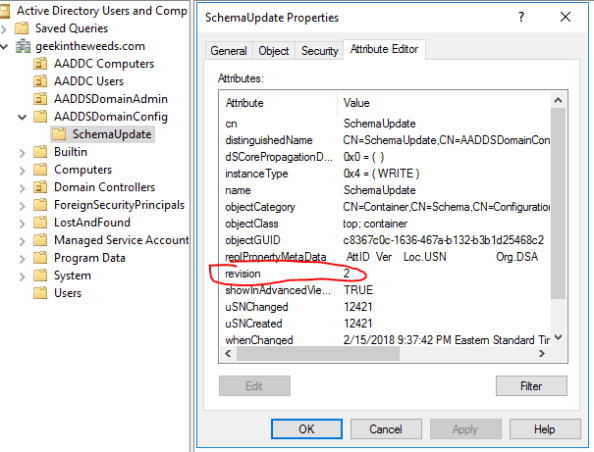
The AADDSDomainConfig container contains a single container object named SchemaUpdate.  I reviewed the attributes of both containers hoping to glean some idea of the purpose of the containers and the only thing I saw of notice was the revision attribute was set to 2.  Maybe Microsoft is tracking the schema of their standard managed domain image via this attribute?  In a future post in this series I’ll do a comparison of this managed domain’s schema with a fresh Windows Server 2012 R2 schema.

entry1pic7.png

Opening Active Directory Sites and Services shows that Microsoft has chosen to leave the domain with a single site.  This design choice makes sense given that a limitation of AAD DS is that it can only serve a single region.  If that limitation is ever lifted, Microsoft will need to revisit this choice and perhaps include a site for each region.   Expanding the Default-First-Site-Name site and the Servers node shows the two domain controllers Microsoft is using to provide the Windows Active Directory service to the VNet.

entry1pic8

So the layout is simple, what about the group policy objects (GPO)?  Opening up the Group Policy Management Console displays five GPOs which are included in every managed domain.

entry1pic9.png

The AADDC Users GPO is empty of settings while the AADC Computers GPO has a single Preference defined that adds the AAD DC Administrators group to the built-in Administrators group on any member servers added to the OU.  The Default Domain Controllers Policy (DDCP) GPO is your standard out of the box DDCP with nothing special set.  The Default Domain Policy (DDP) GPO on the other hand has a number of settings applied.  The password policy is interesting… I get that you have the option to source all the user accounts within your AAD DS domain from Azure AD, but Microsoft is still giving you the ability to create user accounts in the managed domain as I covered above which makes me uncomfortable with the default password policy.  Microsoft hasn’t delegated the ability to create Fine Grained Password Policies (FGPPs) either, which means you’re stuck with this very lax password policy.  Given the lack of technical enforcement, I’d recommend avoiding creating user accounts directly in the managed domain for any purpose until Microsoft delegates the ability to create FGPPs.  The remaining settings in the policy are standard out of the box DDP.

entry1pic10.png

The GPO named Event Log GPO is linked to the Domain Controllers OU and executes a startup script named EventLogRetentionPolicy.PS1.  Being the nosy geek I am, I dug through SYSVOL to find the script.  The script is very simple in that it sets each event log to overwrite events over 31 days old.  It then verifies the results and prints the results to the console.  Event logs are an interesting beast in AAD DS.  An account in the AAD DC Administrators group doesn’t have the right to connect to the Event Logs on the DCs remotely and I haven’t come across any options to view those logs.  I don’t see any mention of them in the Microsoft documentation, so my assumption is you don’t get access to them at this time.  I have to imagine this is a show stopper for some organizations considering the critical importance of Domain Controller logs.  If anyone knows how to access these logs, please let me know.  I’d like to see Microsoft incorporate an option to send the logs to a syslog agent via a configuration option in the Azure AD Domain Services blade in the Azure Portal.

I’m going to stop here today.  In my next post I’ll do some poking around by running a port scan against the managed domain controllers to see what network flows are open, enable LDAPS to see what the SSL/TLS landscape looks like, and examine authentication protocols and algorithms supported (NTLMv1,v2, Kerberos DES, etc).  Thanks for reading!